



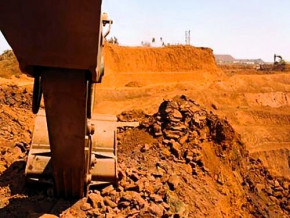
The Equatorial Guinean government launched the activities of the National Mining and Quarrying Company on July 15, 2026, as part of its economic diversification strategy. The announcement was made following the first meeting of the board of directors of this new structure, chaired by the Prime Minister. This session notably formalized the establishment of the public entity responsible for overseeing the exploitation of the country’s mineral resources.
This creation comes in a context marked by Equatorial Guinea’s strong dependence on hydrocarbons. Oil still accounts for over 80% of the country’s budget revenues, but this resource is declining due to a decrease in production. According to the Central African States Bank (BEAC), crude oil exports are expected to decrease from 3.2 million tons in 2025 to 2.6 million in 2026. Gas exports are also following a downward trend.
During this first session, the board of directors discussed several issues related to the organization of the new company, including the ratification of the executive body, the adoption of internal regulations, and the presentation of a strategic plan for the first three years of activity. The administrators also examined the operational implementation arrangements in Bata and La Paz.
Authorities present this step as a milestone in the structuring of the mining sector. “With the celebration of this first session, the National Mining and Quarrying Company officially begins its institutional activity, progressing in the consolidation of a governance structure aimed at strengthening the management of mineral resources and contributing to the economic diversification process promoted by the government,” they stated.
The launch of this company is part of a process that has been ongoing for several years. Since the opening of the mining sector to private capital in 2019, several companies have positioned themselves in Equatorial Guinea. Manhattan Mining Investment Co, Blue Magnolia, and Shefagold signed exploration contracts as early as 2020. Meanwhile, subsidiaries of the Russian group Rosgeo conducted seismic and mapping campaigns on behalf of the state. On the other hand, the Equatorial Guinean Mining Company (SEM), a joint venture between Equatorial Guinea and the Moroccan group Managem, is developing projects related to gold, iron, and bauxite.
Geological reconnaissance work carried out in Rio Muni, the mainland part of the country that is still largely unexplored, has revealed indications of the presence of gold, nickel, and titanium. These resources are among the metals sought in the context of energy transition. The Minister of Mines and Hydrocarbons, Gabriel Mbaga Obiang Lima, had already described a previous geological initiative as a “historic moment” for the country, which hopes to make this region a new hub of natural resources.
The new national company will now have to convert this geological data into effective permits and industrial projects. For the authorities, the objective is both to attract foreign capital, to better structure a sector that is still underdeveloped, and to promote the emergence of job-generating activities, in a context of gradually declining oil revenues.
It remains to be seen whether this public structure will succeed in accelerating a mining sector that has so far remained largely embryonic in the face of the historical weight of hydrocarbons.

