



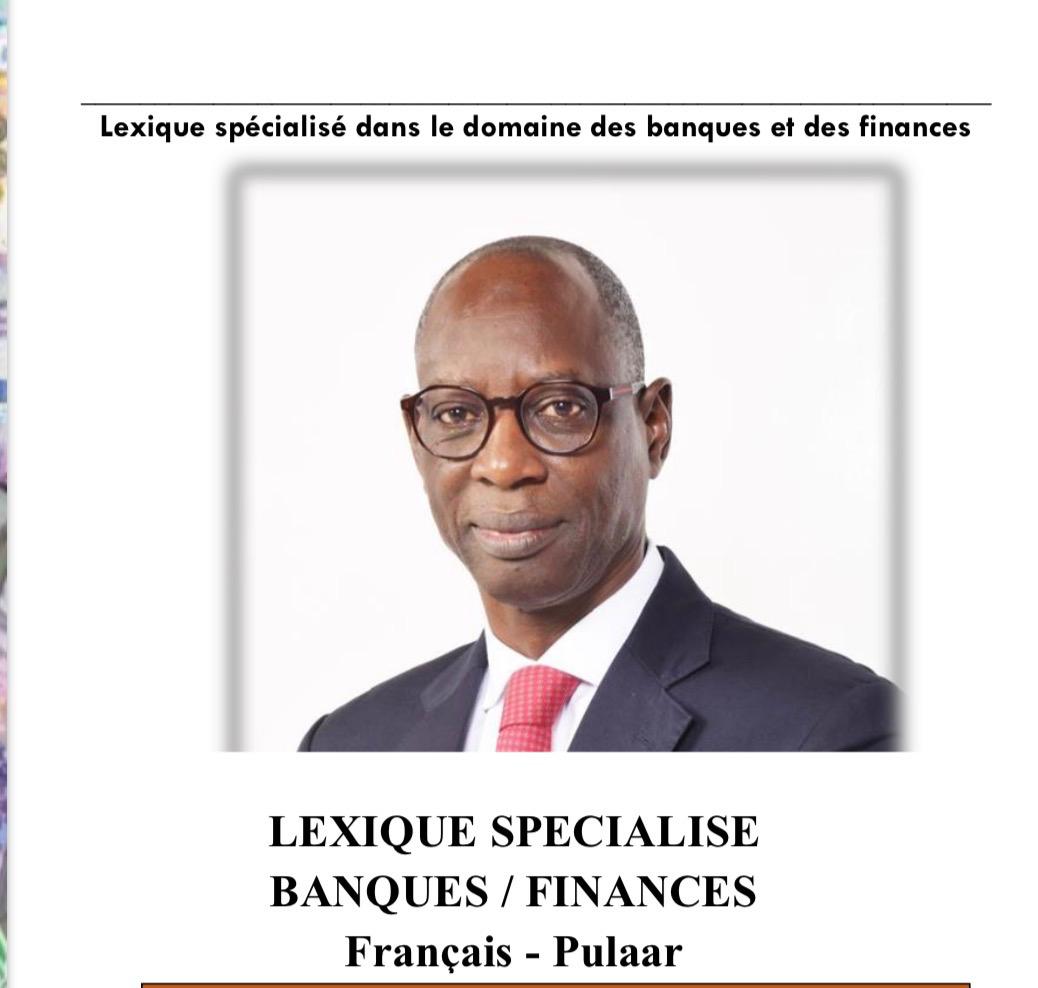
At a time when African languages are receiving increasing attention in public policies, educational systems, and inclusion strategies, Alassane Ba, former leader of Shelter Afrique, former senior official of the African Development Bank, and former Acting CEO of Africa50, contributes to this linguistic valorization effort with the publication of a unique work: Specialized French-Pulaar Banking/Finance Lexicon.
More than just a terminological collection, this work is a methodical attempt to translate some of the most sophisticated concepts of modern economics, accounting, banking, and financial markets into an African language. The author, a seasoned investment banker with thirty-seven years of experience, former CEO of Shelter Afrique, former advisor to the Vice President of Infrastructure and Private Sector at the African Development Bank, and interim CEO of Africa50, has accompanied the institution in raising $830 million from African shareholder states, the largest capital mobilization in the institution’s history dedicated to infrastructure financing.
The book is remarkable in that it addresses a language spoken by tens of millions of speakers across the entire African intertropical front, from East to West, from the lush valley of the Senegal River to the troubled areas of Darfur and South Sudan. Despite this considerable geographical dispersion – with some communities separated by nearly eight hours of flight – the economic Pulaar language maintains a surprising unity. A form of common linguistic market that has survived the borders inherited from colonization.
This unity is reflected in the terms chosen by the author. One of the most evocative examples is undoubtedly “Hore Jawdi,” proposed to refer to capital. Connoisseurs will immediately recognize the imprint of the famous Arabic “Ras El Maal,” literally “head of wealth,” of which it is a remarkable semantic adaptation. An illustration of the intellectual and commercial exchanges that have linked the Sahelian spaces to the Arab-Muslim world for centuries.
The reader also discovers a multitude of equivalences revealing the richness of the language. Gross Domestic Product becomes “dañal e nder leydi,” the investor “jeñtinoowo,” the entrepreneur “paggotooɗo,” while credit is translated as “ñamaande.” The author also tackles much more complex concepts such as securitization, bank refinancing, eurobonds, corporate governance, and Islamic finance, demonstrating that Pulaar has the necessary resources to accommodate the most contemporary concepts of global finance.
The work sometimes holds surprises. In many cases, it will probably be easier for a Pulaar speaker to understand the English term “Share” than the French word “action.” This observation reminds us that languages live through usage more than academic prescriptions. Commerce, migrations, digital networks, and international exchanges now shape economic vocabulary as surely as institutions.
In an introduction rich in linguistic and historical reflections, Alassane Ba argues that African experts should undertake the same effort in their respective fields to establish a terminological heritage capable of serving as the basis for teaching sciences, economics, and technologies in national languages. For him, as for many advocates of linguistic sovereignty, development is not just about mobilizing capital. It also involves societies’ ability to transmit knowledge in the languages they master best.
With this Specialized French-Pulaar Banking/Finance Lexicon, Alassane Ba is not just publishing a dictionary. He is embarking on an ambitious intellectual project: the appropriation of modern finance by African languages. A useful, rigorous, and visionary work that reminds us that before financing development, sometimes we must first give it the words to think of itself.

