



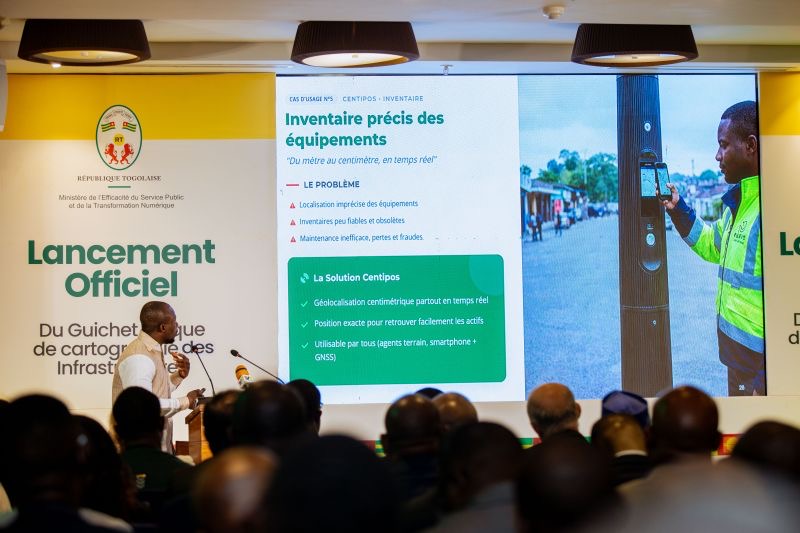
With the launch of its Single Infrastructure Mapping Counter, announced on Thursday, April 2, 2026, Togo is taking a new step in its digital transformation. This platform allows for the identification and visualization of all networks, particularly underground ones, from electricity to telecommunications, on a single map in order to prevent any destruction of existing infrastructure during the implementation of new projects.
Beyond the tool, the project illustrates a change in scale in public action: that of a country that structures its data, identifies its operational needs, and mobilizes digital technology as a lever for transformation.
Using data for the benefit of the Togolese
The ambition of the Single Counter is based on a simple principle: building without destroying. Concretely, it is a national digital platform that centralizes and maps all service infrastructure, including electricity, water, gas, and telecommunications networks, in order to make this information accessible and usable by the various stakeholders.
Until now, this data has been scattered, sometimes incomplete, complicating project planning and increasing the risks of damaging existing structures. The system aims to establish a unique national repository, made mandatory by decree: all the different stakeholders on the ground are obliged to declare their infrastructure and construction sites, thus ensuring a complete and continuously updated database, serving public decision-making and operators.
The project is based on three complementary components: a web platform listing all networks (electricity, water, gas, telecommunications, roads…); Centipos, a national network of 25 reference stations allowing for precise location of infrastructure down to the centimeter, with position corrections transmitted in real time; and a dedicated mobile application for field inspections, allowing technical teams to precisely locate structures, verify existing information, and update data in real time.
The data collected in this way, continuously updated, is accessible and usable by all operators. The system functions as a continuous chain, from work declaration to analysis of interactions between networks, to field intervention and information updates,” explains the project manager.
What sets the project apart is its scale. After a year of mapping, development, and testing, the system is operational at the national level. With 25 reference stations connected to a central calculator, it is presented as one of the most extensive mapping projects in West Africa.
For both public and private operators, the stakes are concrete: reducing work interruptions, limiting losses related to interrupted projects, and improving planning. Thanks in particular to Centipos, the uses go beyond the construction sector and also concern cadastre, land registry, as well as certain agricultural and environmental applications. This approach, focused on solving operational constraints, reflects a pragmatic positioning of digital technology, oriented towards practical uses.
A strategy in layers
This launch is part of a broader trajectory. Togo first invested in its infrastructure: the arrival of Google’s Equiano submarine cable in 2022 to significantly increase the country’s internet capacity, the project to deploy fiber optics on power lines, and the commissioning of its first data center in 2021.
Since 2024, initiatives have multiplied, particularly around data management and administrative modernization. The national Geoportal, launched in 2025, centralizes the state’s geospatial data. The National Digital Observatory aims to measure, through data from all socio-economic infrastructures, the impact of public policies. At the same time, the country is preparing a national strategy on artificial intelligence as well as a Digital Code aimed at updating the regulatory framework to boost economic growth.
In addition to these initiatives, there are projects focused on usage. The Togo e-ID system allows for unique biometric identification of residents. The Togo Digital Acceleration Program (PANT), a structuring program supported by the World Bank, is deploying high-speed fiber optic infrastructure, skills, and innovation ecosystem at the national level, underpinning many digital initiatives in the country, including connecting schools, health centers, and administrations. The digitization of municipalities and the online provision of civil status services contribute to the transformation of public services.
This all reflects a progressive approach, articulated around several levers: infrastructure, data, services, and training. If these initiatives produce the expected effects, Togo could consolidate its position among the most structured players in digital technology in West Africa.
The question remains of the concrete impact of these initiatives. The Single Infrastructure Mapping Counter constitutes a case study to follow in this regard. Its structured approach and stated ambitions are promising. The real effects on the ground remain to be measured.

