



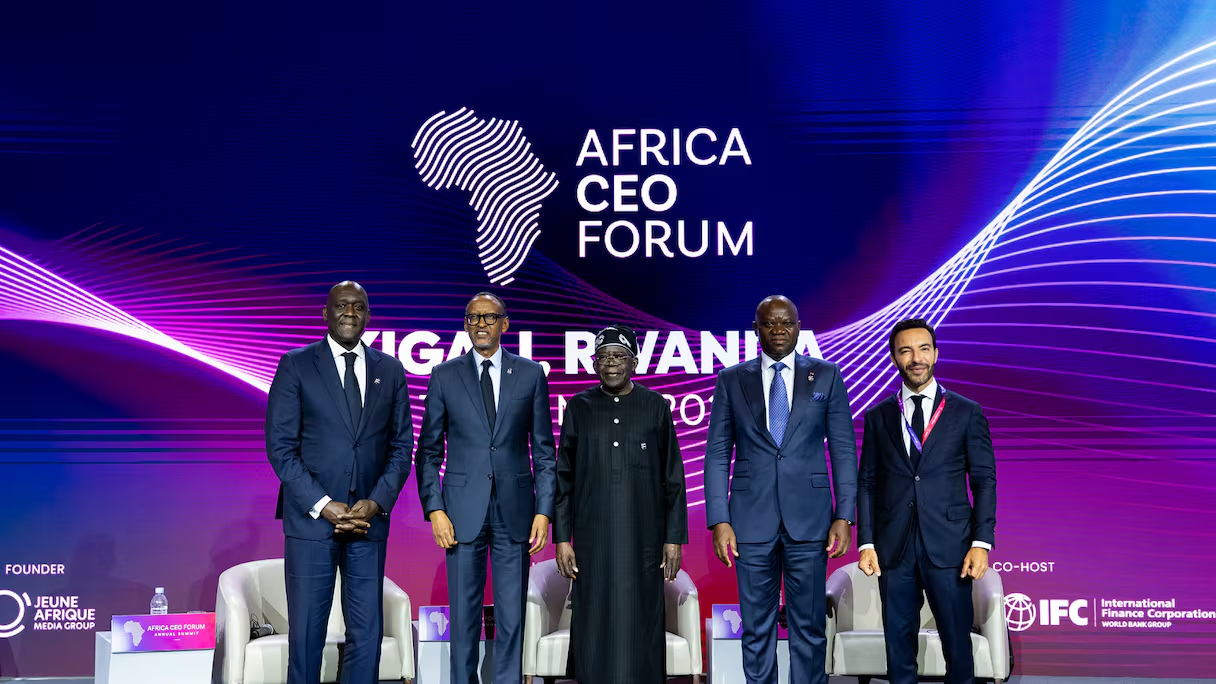
Kigali, May 18, 2025 – The 13th edition of the Africa CEO Forum, organized by Jeune Afrique Media Group and co-organized with IFC, a member of the World Bank Group, concluded this Friday in Kigali, Rwanda, after two days of high-level discussions bringing together more than 2,800 public and private sector leaders from over 77 countries. The stakes are clear: enabling the continent to move beyond a patchwork of still overly fragmented markets to become a truly integrated economic power, capable of producing world-class companies, mobilizing its own capital, and asserting greater influence in the new global value chains.
Held under the theme “Scale or Fail: Why Africa Must Embrace Shared Ownership”, this edition placed at the heart of the debates the imperative of critical mass and the concept of shared ownership as an essential condition for the continent’s economic competitiveness. In a world marked by the fragmentation of trade, the reshaping of capital flows, the rise of new economic blocs, and the questioning of multilateralism, participants reaVirmed a central conviction: Africa must overcome the dispersion of its markets, its capital, and its regulatory frameworks in order to build continental champions capable of weighing in on global value chains.
This 2026 edition once again confirmed the central role of the Africa CEO Forum, which now stands as a platform for accelerating and mobilizing high-impact investments. During the Forum, nearly USD 2 billion in agreements, partnerships, and memoranda of understanding were signed by several major players, including the Rwanda Development Board (RDB), Equity Bank, VISA, Spiro, Elsewidy, UNICEF, APIEX (Benin), BNETD, Access Bank, BOAD, Shelter Africa Development Bank, Baobab, NMB Bank, and Zaria Group.
IFC played a leading role in the announcements made in Kigali, committing more than USD 1 billion in investments through operations and partnerships with Equity Bank, Access Bank, Shelter Africa Development Bank, Baobab, NMB Bank, BOAD, and Zaria Group; these commitments cover a wide range of sectors, including infrastructure, energy, finance, agriculture, industry, and digital, and aim to accelerate productive investment, facilitate cross-border projects, strengthen market integration, and mobilize African capital to drive continental growth.
“This Forum confirms that Africa’s moment has come. Confidence in the continent’s ability to lead, innovate, and deliver results is growing rapidly. The talent is there. The capital exists. The ambition is undeniable,” said Makhtar Diop, Managing Director of IFC, co-host of the Africa CEO Forum. “What will define this decade is our ability to execute at scale: turning energy into industries, industries into jobs, and investments into tangible improvements in people’s lives. From infrastructure to agribusiness, through health, housing, sport, and the creative industries, the way forward is clear: develop bankable projects, mobilize capital, and deliver results. At IFC, we are ready to work with our partners to structure transactions, catalyze investment, and help turn Africa’s potential into sustainable growth at the scale of the continent.”
Over two days, heads of state, ministers, business leaders, investors, financial institutions, sovereign wealth funds, banks, industrial groups, and entrepreneurs debated the ways to transform a mosaic of national markets into a truly integrated economic power. The discussions focused in particular on three structuring levers: Shared Equity, to accelerate cross-border equity stakes and further mobilize African institutional capital; Shared Infrastructure, to connect markets and integrate regional value chains; and Shared Frameworks, indispensable to the free movement of capital, goods, services, and talent on a continental scale.
Amir Ben Yahmed, CEO of Jeune Afrique Media Group and President of the Africa CEO Forum, declared: “The real challenge for Africa is no longer simply to bring forth national champions, but to build continental players and an economic power capable of weighing in on a world dominated by the logics of size and influence. This Forum has shown that, by further pooling our capital, our infrastructure, and our interests, Africa can create the scale eVect needed to turn its potential into a lever of power.”
By concluding its work in Kigali, the Africa CEO Forum 2026 has charted a clear roadmap: to scale up, African capitalism will need to further pool its capital, its infrastructure, its ambitions, and its rules of the game. An essential condition for the emergence of regional and global champions, accelerating the productive transformation of the continent, and strengthening Africa’s place in the world economy.
A highlight of this edition, the Africa CEO Forum 2026 hosted the inaugural Africa NextGen Economist Prize, created by Jeune Afrique and The Africa Report, in partnership with the African Development Bank. Awarded in Kigali, the prize was given to Abdoulaye Ndiaye, a 37-year-old Senegalese economist, Assistant Professor at New York University’s Stern School of Business and aViliated with the Finance for Development Lab. Selected from more than 70 candidates from 14 African countries, he was distinguished for his research at the intersection of public finance, development economics, and political economy, particularly on domestic resource mobilization, taxation, and sovereign debt.

