



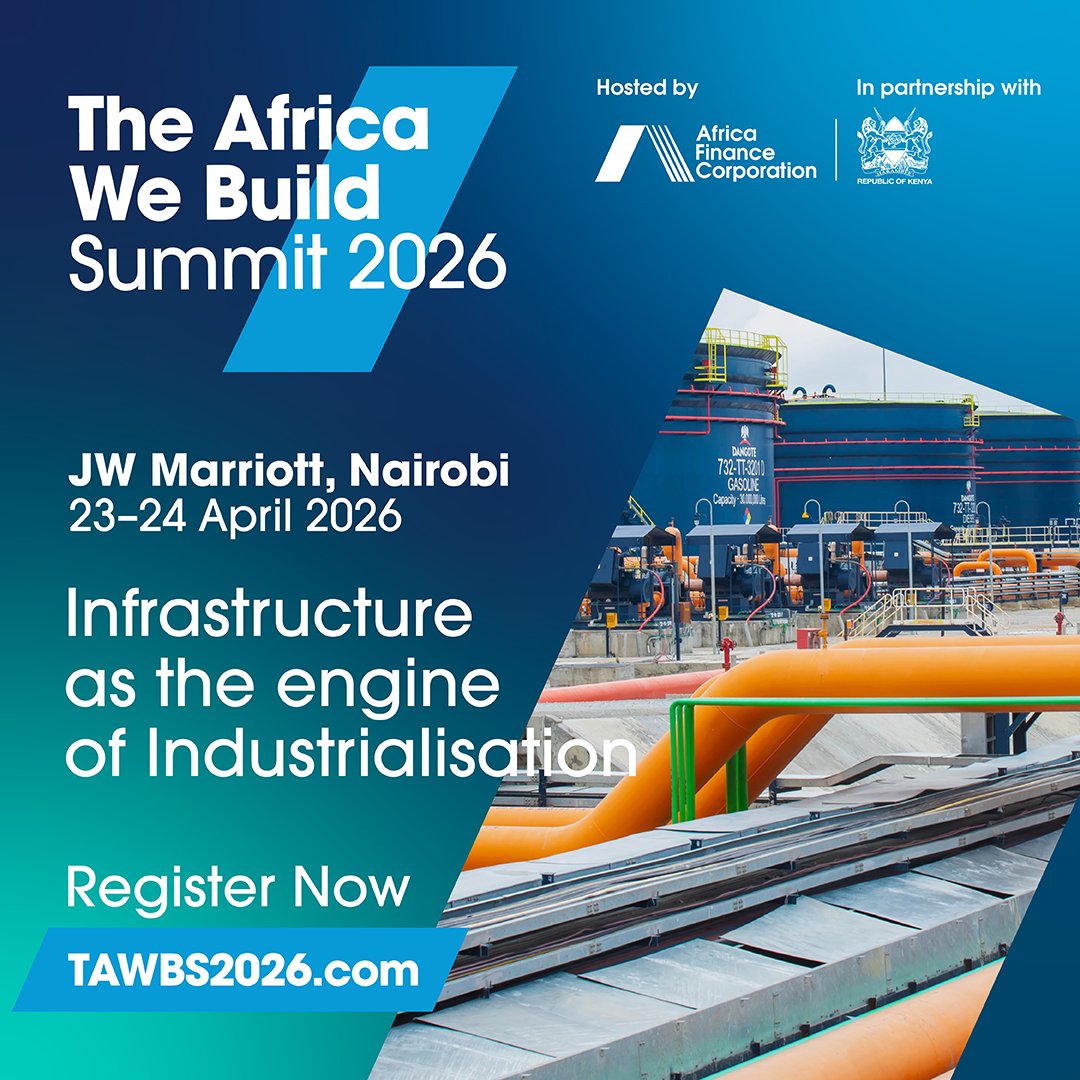
Lagos, Nigeria | Nairobi, Kenya – April 23, 2026 – Key infrastructure financiers, fund managers, investors, and industrial players from the continent are gathering in Nairobi today for the Africa We Build Summit, with a clear ambition: mobilize domestic capital and transform Africa’s industrial ambitions into concrete, job-creating results.
Organized by the Africa Finance Corporation (AFC), in partnership with the Government of Kenya, this inaugural summit, taking place on April 23 and 24, 2026, is themed “Infrastructure as a Driver of Industrialization.” It brings together decision-makers with a common goal: structuring bankable projects, enhancing regional integration, and accelerating the continent’s industrial development.
At the heart of the discussions, the summit heralds a paradigm shift: moving from isolated projects to integrated infrastructure systems. Sessions focus on investments in regional corridors, expanding railway and port networks, transboundary energy systems, as well as developing value chains around strategic minerals.
The President of the Republic of Kenya, William Samoei Ruto, is set to deliver the opening address, demonstrating high-level commitment to regional integration and large-scale industrialization.
One of the key focuses of the summit is to direct a larger share of African domestic capital towards infrastructure and industrial opportunities that are both bankable and globally competitive, in order to address the persistent gap between available resources and truly financeable projects.
The event also marks the launch of the State of Africa’s Infrastructure Report 2026, presented as one of the most comprehensive analyses to date of investment landscapes on the continent. This report examines financing deficits, capital flows, and priority project portfolios, with the aim of concretely guiding investment decisions and project execution within the “Africa We Build” agenda.
Commenting at the summit’s opening, Samaila Zubairu, President and CEO of the AFC, states: “Africa is not lacking in capital, it is trapped by it. The challenge today is to channel this capital towards large-scale infrastructure and industry, in order to transform resources into productivity, jobs, and sustainable prosperity.”
Designed as an execution-oriented platform, the summit emphasizes bankable projects, concrete investment pipelines, and operational partnerships. Structuring initiatives such as the Lobito Corridor and financing mechanisms like the Kenya National Infrastructure Fund illustrate the potential for better alignment between capital, public policies, and projects. These mechanisms aim to build integrated economic ecosystems connecting resources, energy, logistics, transformation, and markets.
Recognizing the East African Community as one of the continent’s most dynamic economic hubs, the summit highlights priority corridors such as the Northern Corridor, linking the Port of Mombasa to Uganda, Rwanda, the eastern Democratic Republic of Congo, and South Sudan. Complementary axes connecting port infrastructures to hinterlands are also discussed, as well as projects for modernizing cross-border roads and advancing a railway master plan for East Africa.
Lastly, a particular emphasis is placed on the link between energy and mineral resources, with a priority given to local transformation over raw exports, to ensure that infrastructure investments translate into sustainable economic transformation and effective industrialization of the continent.

