



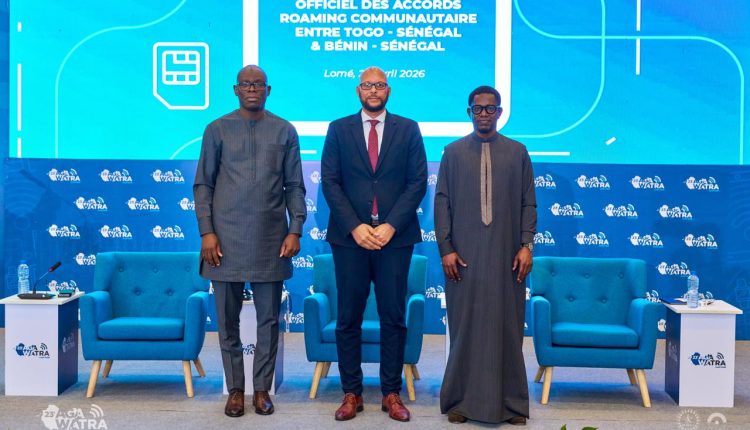
Senegal, Togo, and Benin officially launched a free roaming system on Friday in Lome, aimed at significantly reducing roaming fees between their territories. This advancement is seen as both technical, economic, and political, serving a more concrete digital integration in West Africa.
A new milestone has been reached in the construction of the West African digital market. Gathered in the Togolese capital on the sidelines of the 23rd General Assembly of the Association of Telecommunications Regulators (ARTAO), which includes the 12 ECOWAS countries, the three AES countries, and Mauritania, the telecommunications regulators of Senegal, Togo, and Benin officially announced on Friday, April 24, the implementation of free roaming between Senegal and Togo, as well as between Senegal and Benin.
Through these agreements, the three countries aim to significantly reduce communication costs for travelers in the sub-region by reducing mobile roaming surcharges and facilitating access to voice and data services.
A concrete measure for users
For Togo, this implementation marks a tangible advancement in regional digital mobility. The Director General of ARCEP Togo, Michel Yaovi Galley, sees it as “an important new step” in the community integration process.
Beyond the institutional framework, the measure is expected to have immediate effects for citizens: incoming calls will be free for the first thirty days of stay, while mobile internet access will be offered at much more affordable rates. A price reduction of up to 5000 times cheaper is mentioned.
For the Togolese official, the reduction in roaming costs is not just a commercial adjustment. It is part of a broader movement aimed at bringing populations closer together, facilitating exchanges, and strengthening economic dynamics in the community space.
Political ambition beyond the technical aspect
In Dakar, the initiative is also seen as a strong signal. The Director General of ARPT Senegal, Thiam Dahirou, described the implementation of this roaming as a “historic step” in building an integrated regional space.
For the Senegalese, these agreements go beyond just pricing or technical issues. They reflect a political vision: one of a more united West Africa, better interconnected and resolutely looking towards the future.
The official also advocated for a deepening of regional cooperation on other strategic fronts, including regulating emerging technologies and managing cross-border disputes.
The challenge of effective implementation
Last to speak at the official presentation ceremony, the Executive Secretary of ARCEP Benin, Coovi Hervé Guedegbe, emphasized the need to turn commitments into visible results. For the Beninese, the signed texts should not remain administrative instruments without effect, but become real tools for improving the digital daily lives of populations.
He reaffirmed the common will of Benin, Senegal, and Togo to ensure the operational success of the system, while expressing readiness to host a future evaluation of the agreements.
Towards a digital market without tariff barriers
Presented as harmonized agreements between regulators and operators, these mechanisms aim for a real and measurable decrease in roaming tariffs. The technical explanations provided during the ceremony highlighted a shared willingness: to go beyond strict regulatory compliance to have a concrete impact on calls to the home country and the use of mobile internet.
In Lome, the message from the three countries is clear: West African digital integration will also involve the gradual elimination of tariff barriers. For the states involved in this partnership, community roaming is no longer just an institutional promise, but a daily tool for circulation, exchange, and bringing people closer together.

