



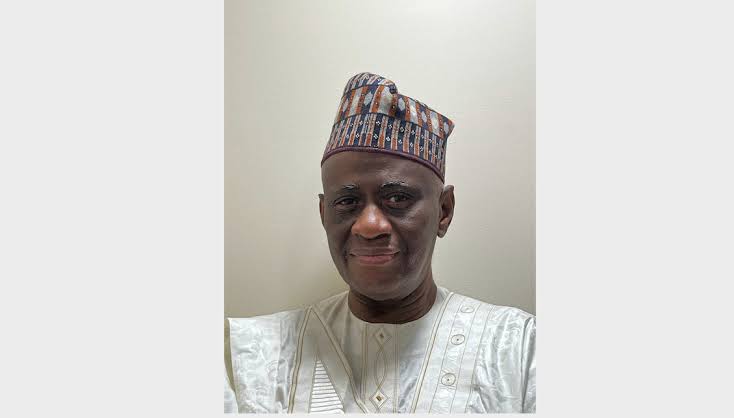
By Aboubakr Kaira Barry, CFA, CPA
Will Guinea’s mining boom work for the elites, as Angola’s oil did, or broaden prosperity, as Botswana’s diamonds did?
In November 2026, Guinea hosted the first Simandou Mining Summit to present its plan to develop the country through mining to investors. Mining alone will not do it. As Joe Studwell reports in How Africa Works, economist Keith Palmer estimates that during the mining boom of the 2000s, foreign-owned mining and oil accounted for 60 percent of growth in sub-Saharan Africa but less than 1 percent of jobs. What a country gains depends on the share of the wealth it captures, and how well it manages that share.
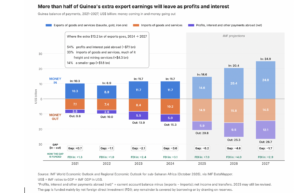
IMF projections show the scale: exports rising from about $12 billion in 2024 to $25 billion in 2027 (Chart 1). More than half of the extra earnings will leave as interest and dividends, and a third will pay for imports, much of it freight and mining services. The question is what stays. Guinea holds a free 15 percent stake in the mines, railway and port, and central bank governor Karamo Kaba expects state revenue from Simandou to rise from about $350 million in 2026 to $2.5 billion by 2040. That is the money good governance must protect.
Angola: oil for the few
Oil provided about 95 percent of Angola’s exports before the 2014 crash. More than $4 billion went unaccounted for in 1997–2002, according to Human Rights Watch, and the IMF later found a $32 billion gap for 2007–2010, most of it traced to Sonangol spending that never appeared in the budget. Angola also signed more than $49 billion in Chinese loans (Boston University). According to Studwell, Luanda’s new airport took almost 20 years to build and cost up to $6 billion; over the same years, some $100 billion was diverted to personal use.
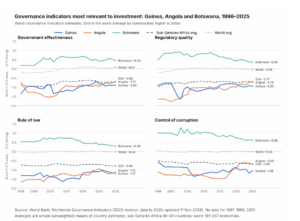
Sonangol answered to the President and was run by the “Futungo,” the network around President dos Santos; Oxford scholar Ricardo Soares de Oliveira called it “a parallel budget.” Manuel Vicente headed it before becoming Vice President; in 2016, the President appointed his daughter, Isabel dos Santos. When oil crashed, the kwanza lost over half its value, debt reached about 120–135 percent of GDP, and Angola turned to the IMF. Yet the path can change: since 2017, Sonangol has been restructured and Angola’s control of corruption score has improved sharply, while Guinea’s has worsened since 2020 (Chart 2).
Botswana: diamonds for the many
Botswana rose from one of the world’s poorest countries in 1966 to upper-middle income. The key was leadership based on inclusion and consensus. Seretse Khama, the first President, persuaded his own Bamangwato community to transfer its mineral rights to the nation, and Vice President Quett Masire ran the Ministry of Finance from 1966 until he became President in 1980, which put planning and financial control at the center of government. Botswana knew what it did not know: it hired outside advisers to negotiate with De Beers and wrote in a clause allowing renegotiation if extraordinary developments occurred. After the discovery of Jwaneng, the world’s richest diamond mine, it reopened the deal; its stake rose from 15 to 50 percent and its share of profits to 65–75 percent. Botswana is no paradise: unlike Mauritius, it failed to diversify. But its rules protected the revenue.
Guinea at a crossroads
The parallels with Angola are real. The President’s chief of staff chairs the Simandou Strategic Committee, which reports directly to the President, and also chairs the board of the state-owned Nimba Mining Company. In almost 30 years of World Bank data, Guinea has rarely risen above the sub-Saharan average on any governance measure, and it now scores below both that average and Angola on all six (Chart 2 shows the four that matter most for investment). In November 2025, Baowu said the $99 million it paid for its Simandou stake had gone into the project companies rather than the Treasury, because the Strategic Committee had not yet agreed to collect it. That same month, Guinea’s transitional parliament found the money had still not reached the Treasury. Two gold scandals at the central bank, in 2021 and 2024, exposed weak controls (Bloomberg; Financial Afrik).
Three risks Guinea must manage
Weak institutions. Government effectiveness has been stuck at about −0.9 for ten years, and control of corruption has fallen from −0.58 to −1.06 since 1996. Guinea’s PEFA (Public Expenditure and Financial Accountability) assessments, which grade how a government manages public money from A (good international practice) to D (below the basic level), tell the same story. Between the 2018 and 2024 assessments, budget credibility did not improve: actual spending still scores D, meaning it strayed from the approved budget by more than 15 percent in at least two of the three years assessed. The integrity of financial data rose only from D to D+, with bank, suspense and advance accounts still not reconciled. Procurement slipped from B to C+. If the accounts cannot be trusted, neither can the figures on Simandou revenue.
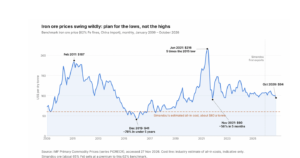
Price swings. The iron ore benchmark fell 78 percent between 2011 and 2015, rose fivefold by 2021, then dropped 58 percent in five months (Chart 3). With costs of about $60 a tonne, according to an industry estimate, a fall from $100 to $70 would cut profit-based revenue by more than half.
Borrowing and spending ahead of revenue. In September 2026, the Nimba Mining Company raised more than $300 million from Glencore against future bauxite output, and, according to The Economist, the government is considering its first Eurobond. Ghana borrowed heavily on the strength of its new oil, and when revenue fell short it defaulted in 2022. Mozambique took $2 billion in hidden loans on the promise of gas; when they came to light, donors froze aid and the country defaulted. Nigeria’s 1970s oil boom financed projects such as the Ajaokuta steel complex that stalled when prices crashed in the mid-1980s; prices did not recover for 20 years. Guinea should borrow only for projects that pass a conservative financial forecast, in full view of Parliament.
Yet Guinea has set the right direction: adding value at home through alumina refineries, its first gold refinery and a planned steel plant study. Finance Minister Mariama Ciré Sylla told Financial Afrik that Simandou revenues must go through the budget, with part saved for future generations. Such commitments will be resisted in influential circles. They need constant support from the top, and the IMF and the World Bank should champion them, using their leverage with the government.
What Guinea must do
First, know what Guinea is owed. Guinea relies on data from investors who are also the buyers, a conflict of interest. Its officials cannot check two of the seven control points: loading onto ocean-going ships and delivery to the final buyer. Miners can also shrink taxable profit through inter-company loans: as Studwell recounts, when the DRC added a 4 percent profit tax to Banro’s agreement, its subsidiary declared no profit through inflated inter-company transactions. Guinea must watch for the same practice. Like Botswana, Guinea should hire independent experts to verify and properly account for what is due, working alongside its officials until Guineans can do the job themselves.
Second, renegotiate when circumstances change. Every new mining agreement should include a renegotiation clause, triggered by extraordinary developments, as Botswana’s was. The Simandou agreements instead freeze the terms: the convention for Rio Tinto’s southern blocks fixes the tax and customs regime for the life of the mine.
Third, make structural reforms the core of the IMF program. With an IMF program of about $417 million approved on 23 November 2026, and a government in the spirit of reform, the stars are aligned. “We do not view the IMF as an entity that imposes reforms upon us,” Prime Minister Amadou Oury Bah told The Economist in November. “Rather, it is we ourselves who wish to implement reforms.” The IMF and the World Bank should take him at his word and make two sets of reforms, which the IMF Board has largely endorsed, conditions of their support, with clear benchmarks.
The first set would build the infrastructure of fiscal visibility, so that the government knows what it owns, what it owes and what it is worth; one cannot manage what one cannot see. It includes: (a) a golden rule in the constitution, limiting spending over each presidential term to revenue, with borrowing only for investment; (b) a fiscal rule that budgets mining revenue at the long-term average price, as Chile does for copper, so that spending does not boom when prices are high and bust when they fall; (c) a single Treasury account showing all cash belonging to the government, so that it can be controlled; (d) an integrated financial management information system that records all government revenue, expenses, assets, obligations and net worth to international accounting standards; (e) an electronic procurement system that puts every stage of public purchasing online for all to see; and (f) publishing every mining contract in full and implementing the recommendations of the Extractive Industries Transparency Initiative (EITI), the global standard for disclosing what mining companies pay and what governments receive. The EITI rated Guinea “good” in May 2026, but gaps remain, including mining revenue kept outside the budget and the real owners of mining companies.
The second set would establish a truly independent central bank, an urgent priority after the liquidity shortage and the gold scandals. It means breaking with a tradition in which the central bank served as the executive’s piggy bank, and giving it real independence from the government. It must be able to supervise banks and make sure they hold enough capital, since bank failures are expensive; develop an interbank market so banks can lend to each other, and lead the development of a money market as a step toward a bond market; and act as lender of last resort to sound banks in temporary difficulty.
Angola and Botswana both had the resources. What separated them was whether leaders bound themselves to rules and oversight. Guinea now faces that choice.
Aboubakr Kaira Barry, CFA, CPA, is Managing Director of Results Associates, a public financial management advisory firm in Bethesda, Maryland, and Chair of the Board of the Omou Financial Literacy Center. He served for ten years as Director of Finance at the Islamic Development Bank, after positions at the African Development Bank and PricewaterhouseCoopers in New York.

