



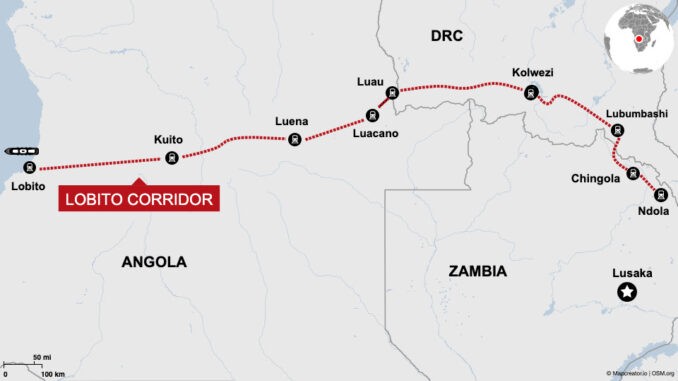
In this op-ed, Gregory P. Tosi, a lawyer based in Washington and former legal advisor to the United States Congress, argues for enhanced coordination between the DRC, Angola, and Zambia around the Lobito corridor. According to him, the success of this strategic project will depend not only on infrastructure, but also on a common economic diplomacy capable of presenting a coherent African vision of development, investment, and industrialization in Washington.
The Lobito corridor has entered a decisive phase. Rehabilitation and investments continue along the Angolan railway network, while planned and ongoing connections with the Democratic Republic of Congo (DRC) and Zambia could reshape trade in Central and Southern Africa. Supported by African institutions, international donors, and Western partners, the corridor is widely considered one of the continent’s most important initiatives in terms of transportation and regional integration.
In the United States, the Lobito corridor represents more than just a railway line. It is a test of regional infrastructure’s ability to strengthen supply chain resilience, develop trade relations, and support Africa’s industrialization. Washington also sees it as an opportunity to diversify critical mineral supply chains and increase exchanges with Central and Southern Africa.
Official presentations in Washington logically describe the Lobito corridor as an integrated regional project. However, significant progress remains to be made in terms of trade facilitation, regulatory harmonization, institutional coordination, and investment promotion.
Therefore, the next stage of the corridor is not just about engineering. It also involves diplomacy.
Transboundary infrastructure projects are often conducted as sets of national projects, with each government seeking to finance the portion within its own territory. The East African Standard Gauge Railway illustrates this risk. Although designed as a regional network, its construction and financing were mainly carried out through separate national sections. The system as a whole did not materialize within the initially planned timeframe, thus limiting the regional connectivity on which its full economic value depended.
The Lobito corridor should avoid this pitfall.
The DRC, Angola, and Zambia should engage with Washington not simply as three governments advocating separate priorities, but as a regional economic partnership pursuing a common growth vision.
This is not a call for political integration, but a proposal for strategic coordination.
The three governments have already demonstrated their ability to cooperate on railway planning, cross-border transport, trade facilitation, and customs coordination. They increasingly present the Lobito corridor as a trilateral initiative supported by common institutions and regional cooperation. The next logical step is to coordinate how this vision is presented in Washington and to other major centers of financing and political influence.
Although the three governments already participate in formal agreements related to the corridor and investment forums, there does not appear to be, at least publicly, a permanent trilateral mechanism responsible for coordinating their economic diplomacy and investment promotion in Washington. They should consider establishing a common engagement framework including enhanced coordination between their embassies, a common investment promotion strategy, joint presentation roadshows, and, where appropriate, collective exchanges with institutions such as the U.S. International Development Finance Corporation (DFC), the Export-Import Bank of the United States (EXIM), and other development financing partners.
Speaking with one voice would allow the three governments to present investors with a true economic proposition on a corridor scale, rather than three separate national opportunities. Together, they could highlight the combined market size of the corridor, its mineral resources, manufacturing potential, transportation network, workforce, and long-term economic value.
A coordinated approach could reduce costs related to redundant promotion efforts, attract greater political attention, and offer investors a clearer vision of the corridor as an integrated regional market.
The success of the Lobito corridor should not be measured solely by the volumes of copper or cobalt exported. It should also be measured by processed minerals, electrical equipment, batteries, agricultural products, and manufactured goods produced in Africa. The corridor should become an industrial platform, not just an export corridor.
African institutions have a crucial role to play in achieving this goal. The African Development Bank (AfDB) and the Africa Finance Corporation (AFC) already play a central role in corridor development. Afreximbank and regional commercial banks could expand African capital participation alongside international investments.
The African Continental Free Trade Area (AfCFTA) offers an equally important framework. The Lobito corridor should become a major example of how transboundary infrastructure can support regional value chains, reduce trade barriers, and connect African producers to African markets.
Regional coordination does not diminish national sovereignty. The DRC, Angola, and Zambia will continue to pursue distinct budgetary policies, industrial strategies, and national priorities. It simply recognizes that some goals can be more effectively achieved together than separately.
A concrete initiative would be to organize an annual Investment Dialogue on the Lobito corridor in Washington, bringing together the three governments, African financial institutions, U.S. agencies, Congress, development financing institutions, engineering companies, logistics firms, industrialists, and institutional investors.
The three governments could strengthen this momentum by creating a joint investment promotion secretariat to coordinate investor outreach, identify financing opportunities, and disseminate a consistent regional message to international partners.
The international community increasingly recognizes the strategic importance of the Lobito corridor. Africa must ensure that its own engagement strategy matches this ambition.
Railways transport goods. Economic corridors create industries. Regional partnerships strengthen bargaining power.
If the DRC, Angola, and Zambia speak to Washington with one African voice, they will strengthen much more than just a railway line. They will strengthen their ability to guide investment, industrialization, and long-term development according to priorities defined by Africans themselves.
Gregory P. Tosi is a lawyer in Washington, D.C., and former legal advisor to the United States Congress. He advocates for business investment and affordable housing development in developing countries. He regularly writes about international economic development, infrastructure, and public policy.

