



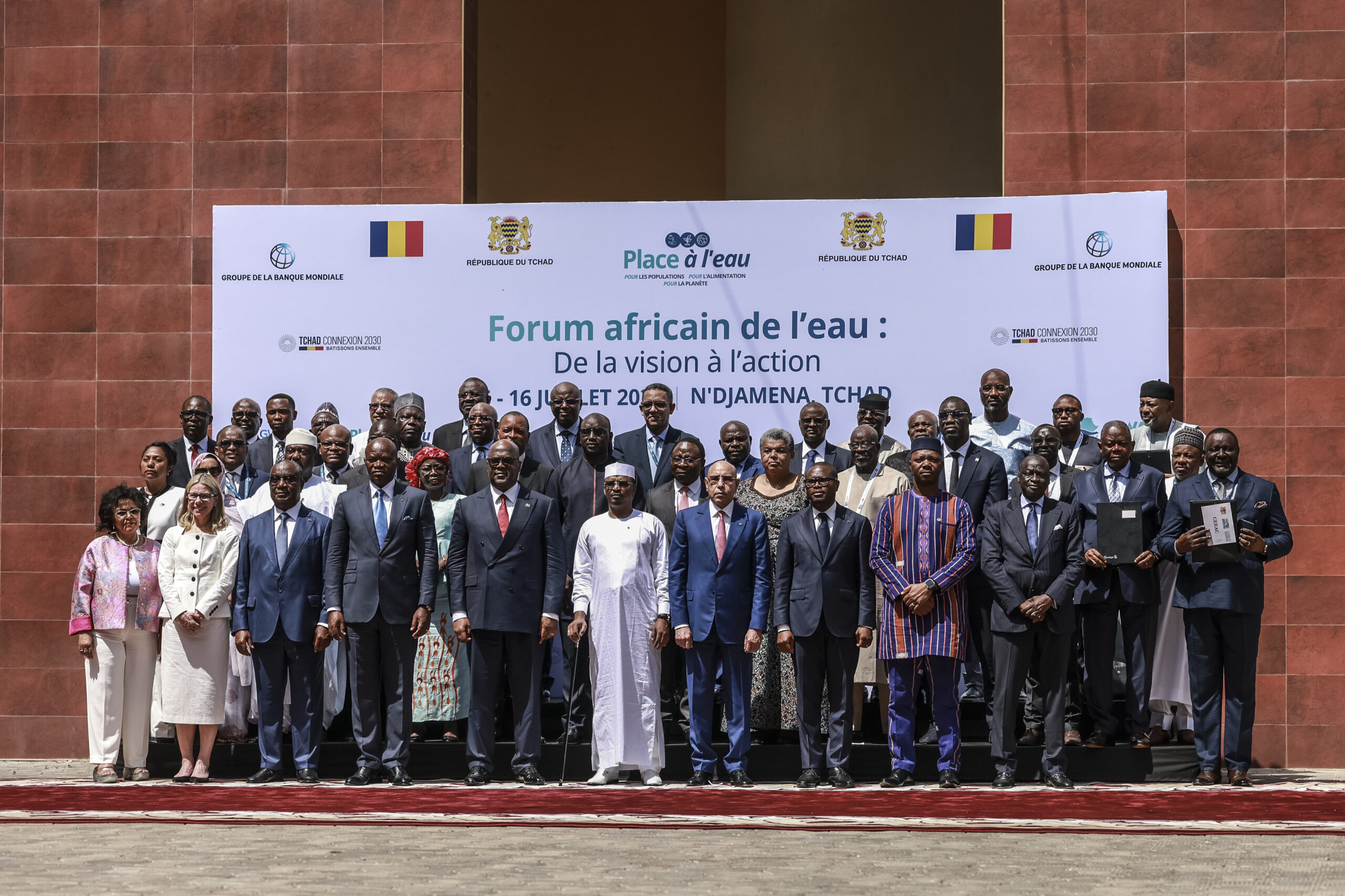
On July 15 and 16, 2026, N’Djamena hosted the first African Water Forum, co-organized by the Republic of Chad and the World Bank Group. Under the theme “From vision to action,” this meeting brought together several African heads of state, international financial institutions, transboundary river basin organizations, and representatives from the private sector, all sharing the same observation: Africa is rich in water, but hundreds of millions of Africans still do not have safe and sustainable access to it. Beyond this widely shared diagnosis, it was mainly the solutions put forward by the various participants that structured the opening ceremony.
Water Forward: pooling financing on a global scale
The main response put forward is Water Forward, an initiative launched by the World Bank in April 2026, on the sidelines of the World Bank Group and International Monetary Fund Spring Meetings. It aims to improve water security for over one billion people by 2030, by combining the resources of ten multilateral development banks rather than dispersing them.
Ousmane Diagana, World Bank Vice President for West and Central Africa, presented this coalition as a response to the dispersion of efforts: “Multilateral development banks are joining forces to increase their impact beyond what each institution could achieve individually.” Concretely, the proposed solution is based on three levers: making the water sectors more attractive for private investment by improving the financial viability of operators, advancing public policy reforms, and developing projects capable of attracting larger volumes of both public and private capital. “A central objective of Water Forward is to make the water sectors more attractive for investment,” he summarized, emphasizing that priority should always be given to the most vulnerable populations.
National compacts: turning strategies into financeable projects
At the heart of the system are “water compacts,” national pacts through which each country defines its reform priorities, aligns its partners, and sets specific financing and implementation trajectories. Nineteen compacts have already been launched worldwide, including eleven in Africa; three new compacts, including Chad’s, were presented in N’Djamena.
Chad thus unveiled its own Water Compact, which assesses the financing needs over five years at $3.8 billion — of which 20%, approximately 115 billion CFA francs per year, must come from national resources — to increase access to clean water to 80% by 2030. The Chadian Minister of Finance, Tahir Hamid Nguilin, emphasized a solution often overlooked: maintaining existing infrastructure rather than just building new structures. “It is not enough to build (…) we must also maintain, protect, and sustainably manage the resources and infrastructure created,” he said, adding that “an abandoned or poorly maintained structure is a broken promise; a functional well, a restored pond, or a productive irrigated area is, on the contrary, a promise kept to the populations.” For him, water must become “a requirement for public performance,” with every franc invested translating into a measurable service.
Reforming institutions and separating sectors
Several heads of state presented institutional reforms initiated in their countries as a prerequisite for effective financing. Gabonese President Brice Clotaire Oligui Nguema detailed the strategy adopted by Gabon since 2023: a modern water code, the separation of the national operator into two distinct entities — one dedicated to water, the other to electricity — in order to “better manage, finance, and control each sector,” as well as a national portfolio of priority projects valued at over 1,700 billion CFA francs. Faced with the supply crisis that Libreville has been experiencing since 2014, Gabon mobilized brigades to reduce water losses in the network and supervise informal distribution. “Having water resources is not enough without strong governance, reliable infrastructure, and adequate financing,” he summarized.
He also argued for relying more on African expertise rather than foreign companies imposed with external funding: “Western companies involved in these major projects must rely on our national expertise,” he said.
Five directions to move from vision to action
Democratic Republic of Congo President Félix Tshisekedi proposed the most detailed roadmap of the ceremony, centered around five directions. The first calls for an integration of public policies: stop conceiving water, agriculture, energy, and urban planning separately, and think of each project on a basin and territorial scale. The second focuses on the quality of institutions, with a change in success indicators: “We must measure our progress not by the number of meetings organized, but by the number of newly served people.” The third concerns the technical preparation of projects, a condition he believes is too often neglected: “Our countries lack neither needs nor ambitions; what they lack are technically mature, legally secure, financially structured, and quickly financeable projects.”
The fourth direction addresses the cost of capital, a recurring obstacle for African projects: “African projects cannot continue to bear disproportionate risk premiums,” he argued, calling on financial institutions to expand their guarantee instruments. The fifth aims at the industrialization of the sector itself — local production of pipes, pumps, meters, and irrigation systems, strengthening engineering skills, digitalization to detect leaks and anticipate risks — with the goal of “building not only African water infrastructure, but also a true African water industry.”
Transboundary cooperation as a tool for stability
Several speakers emphasized the regional dimension of the solutions, as water ignores administrative boundaries. Mauritania highlighted its cooperation around the Senegal River and its alignment with the G5 Sahel initiative. Its president, Mohamed Ould Cheikh El Ghazouani, summarized this approach with a formula repeated by several speakers: “Preserving water is preserving life. Investing in water is investing in peace.”
Chadian President Mahamat Idriss Déby Itno, for his part, praised the role of basin organizations — Lake Chad Basin Commission, Niger Basin Authority, Organization for the Development of the Senegal River, Volta Basin Authority — and proposed the establishment of “dynamic platforms for sharing real-time hydrological data to anticipate droughts and floods.” He structured his own roadmap around three commitments: financing, calling for transforming national compacts into “solidly bankable projects”; governance, with the strengthening of regional institutions and water management companies; and inclusion, placing women and youth at the heart of public policies, with women bearing “the burden of water chores” daily and youth carrying the hopes of a modernized and job-creating agriculture.
A common requirement: accelerate without losing rigor
At the end of the opening ceremony, the same message echoed in the mouths of most speakers: strategies and declarations already exist, it is now the execution that must progress. As Félix Tshisekedi summarized, it is about moving “from strategies to investments, from commitments to projects, from projects to services, and from services to measurable results.” The United Nations Water Conference, scheduled for December 2026, will be the next meeting where these commitments must, according to Ousmane Diagana’s words, translate “from ambition to results, and from partnership to impact.”

