



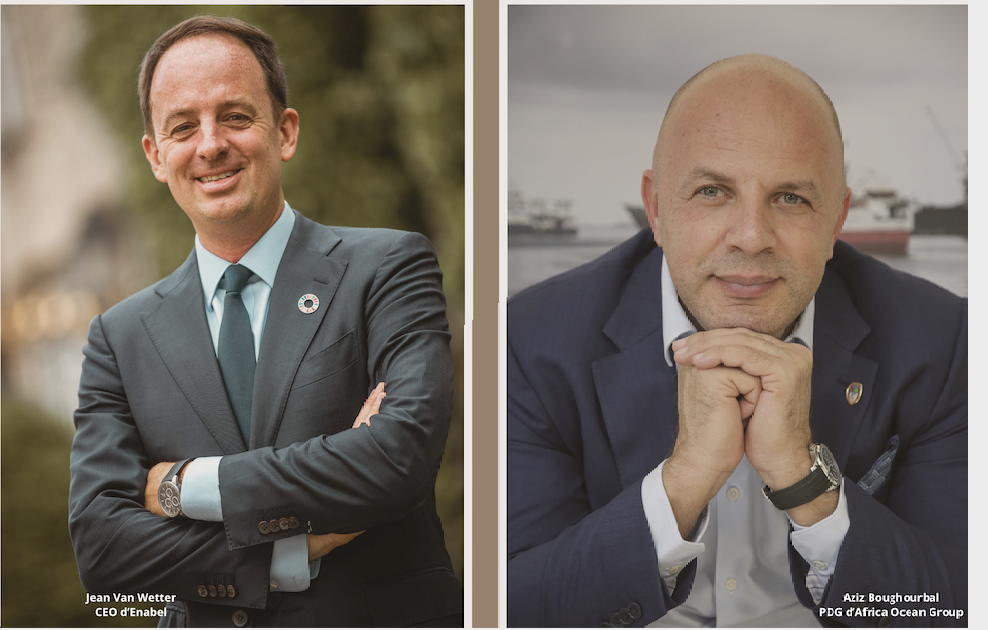
By Jean Van Wetter, CEO of Enabel, and Aziz Boughourbal, CEO of Africa Ocean Group
Faced with the magnitude of financing needs and the increasing constraint on public finances, one thing is clear: Africa’s economic emergence can no longer rely primarily on aid.
By 2050, the continent will represent nearly a quarter of the world’s population. It will concentrate a growing share of the global workforce as well as massive needs in infrastructure, energy, and consumer goods. According to the African Development Bank, over $130 billion will be needed annually for infrastructure alone. No public actor will be able to solve such an equation on their own.
But another, more discreet reality is already at work. Across the continent, companies are emerging, investing, innovating, and creating jobs. Like Africa Ocean Group, they are integrating into regional and international value chains, moving upmarket, and structuring entire sectors, often in constrained environments. This dynamic is profoundly transforming the African economic landscape.
The question is no longer whether Africa has potential. It is how to accelerate, structure, and amplify a transformation that is already underway.
This requires a clear change in model: moving from a logic of expenditure to a logic of investment.
For decades, public aid has been central, and it remains essential in certain fragile contexts. But it can no longer be the backbone of economic strategies. The challenge today is to use every public euro as a lever to mobilize large-scale private financing. In other words, transforming public spending into an investment catalyst.
Concretely, this involves reducing perceived risks, improving project bankability, stabilizing regulatory frameworks, and enhancing predictability. It also means better structuring projects upfront to make them readable and attractive to investors. Often, the problem is not the lack of capital, but the insufficient strength of projects to attract it.
The African private sector is at the heart of this equation. It is no longer a peripheral actor but the main driver of economic transformation. SMEs, industrial companies, regional groups: they are the ones investing in productive tools, structuring sectors, and creating the majority of jobs. Their dynamism is real, but it is still hindered by persistent obstacles: limited access to financing, high cost of capital, inadequate financial instruments, and often excessive risk perception.
That is precisely where partnerships come into play.
By combining public and private financing, sharing risks, and structuring truly investable projects, it becomes possible to attract capital on a significant scale. These blended financing approaches are not a miracle solution, but they allow for a breakthrough: turning opportunities into concrete investments. And in doing so, we are not just funding isolated projects; we are building markets, strengthening ecosystems, and accelerating industrialization.
This approach is already materializing through initiatives like Global Gateway, to which Enabel actively contributes. With its local anchoring and expertise, Enabel helps to structure strong projects and create conditions conducive to mobilizing private financing, in addition to public aid.
For European companies, the stakes are equally strategic. In a context of value chain reconfiguration, geopolitical tensions, and accelerating energy transition, Africa emerges as a key partner. Access to growing markets, securing supplies, co-developing sustainable industrial sectors: the interests are mutual.
But this convergence cannot be decreed. It must be organized, structured, and above all balanced. Without this, it risks reproducing old asymmetries and limiting the impact of the partnership.
The role of development actors must evolve accordingly. Their added value no longer lies solely in financing but in their ability to bring forth concrete opportunities, structure complex projects, and reduce information asymmetries. It is, in essence, about turning potential into investment flows.
The moment is pivotal. Viewing development as a cost would be a strategic mistake. It is an investment in economic stability, in the resilience of value chains, and in shared prosperity between the two continents.
On one condition: recognizing that the private sector will be the driver. Not as a substitute for public action, but as a complement. This is the price at which the Africa-Europe partnership can move beyond the promise stage to become a true lever for sustainable and inclusive growth.

