



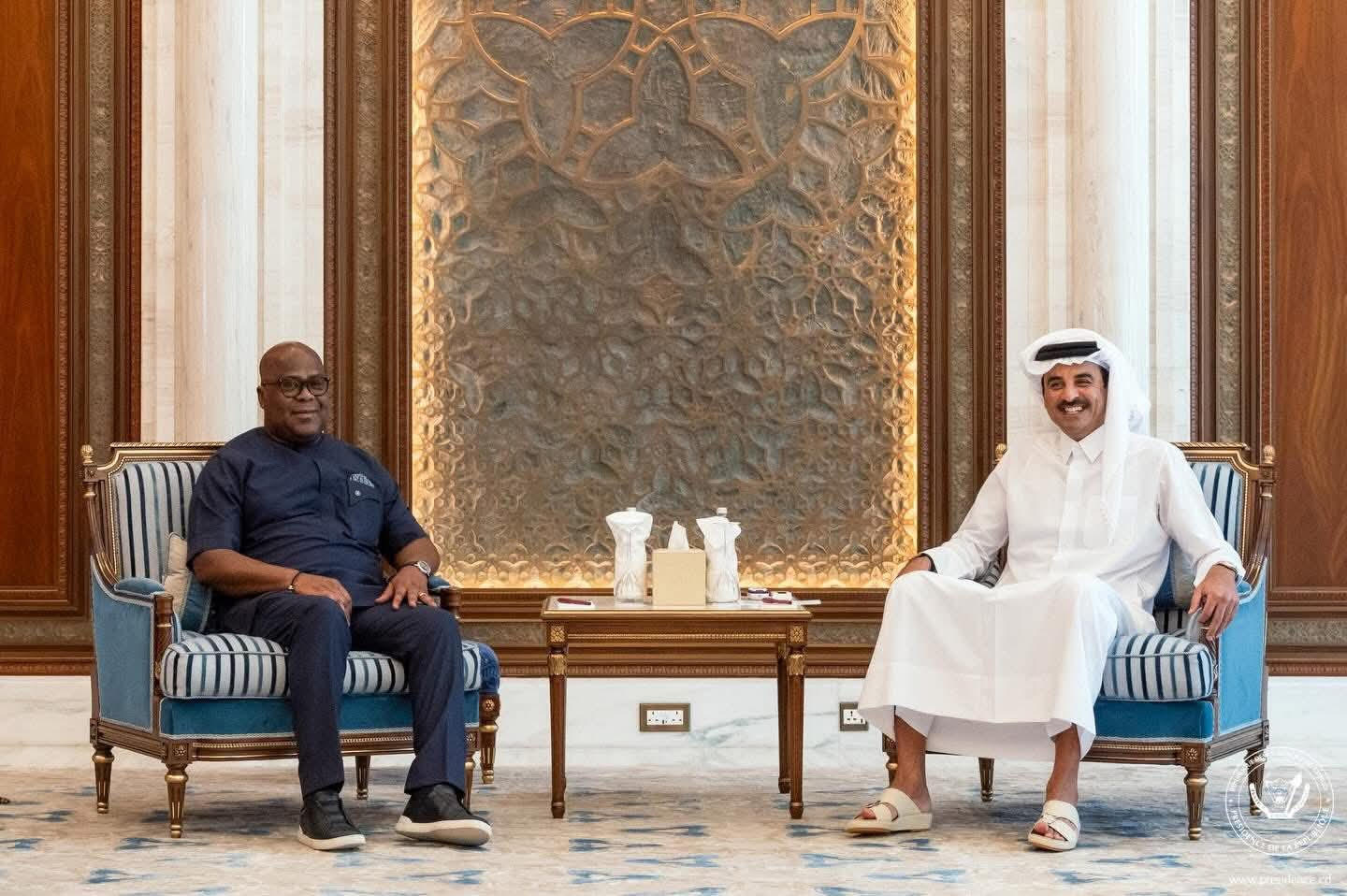
The meeting on April 1, 2026 between Félix Tshisekedi and Tamim ben Hamad Al Thani takes place in a particularly tense geopolitical context, marked by escalating tensions between Iran and a coalition led by the United States and Israel. Far from a simple protocol meeting, this discussion reflects a convergence of strategic interests between Kinshasa and Doha, at the crossroads of security, diplomatic, and economic issues.
Presented also as a gesture of solidarity, the visit of the Congolese head of state aims to express the support of the Democratic Republic of Congo to Qatar, perceived as a collateral victim of regional tensions in the Middle East. But beyond this political dimension, the meeting reveals a gradual strengthening of bilateral relations initiated since 2024.
At the heart of the discussions, the persistent crisis in eastern DRC emerges as the most sensitive issue. Doha has gradually established itself as a discreet but influential actor in the M23 dossier and regional tensions involving Rwanda. Through the “Doha process,” Qatar seeks to establish a de-escalation dynamic and promote a negotiated political solution. According to several diplomatic sources, the emirate plays the role of an agile mediator, combining displayed neutrality and influence capacity. The meeting on April 1 aims to maintain diplomatic pressure and revive discussions whose progress remains fragile.
This diplomatic sequence also reflects a strategic repositioning of Kinshasa. Faced with the limitations of traditional partnerships, the DRC is multiplying openings to new allies capable of providing both political support and financial capabilities. In this reconfiguration, Qatar appears as a preferred partner, eager to expand its footprint in Central Africa and the Great Lakes region.
The economic issue is the other pillar of this relationship. Discussions focused on Qatari investments in the DRC, particularly in the transport, logistics, and port infrastructure sectors. The Doha-Kinshasa air link, already operational, fits into this logic of economic integration and strategic projection. For Kinshasa, the objective is clear: to attract structuring financing to modernize its infrastructure. For Doha, it is about securing positions in a country with high potential, rich in natural resources, and still largely under-equipped.
On the diplomatic front, the meeting also aims to consolidate a partnership in the making. Several bilateral agreements have been signed in recent years, and the April 1 meeting allowed for an evaluation of their implementation while outlining new perspectives for cooperation. For Félix Tshisekedi, the stake is also domestic: to display active diplomacy, achieve tangible results on the security front in the East, and attract visible investments, likely to strengthen his internal legitimacy.
In the end, this meeting goes beyond the symbolic framework. It materializes an emerging strategic axis between Kinshasa and Doha, blending crisis diplomacy, economic ambitions, and the quest for regional influence. In a fragmented international environment, the DRC and Qatar seek to transform their converging interests into a sustainable lever of power and stability.

