



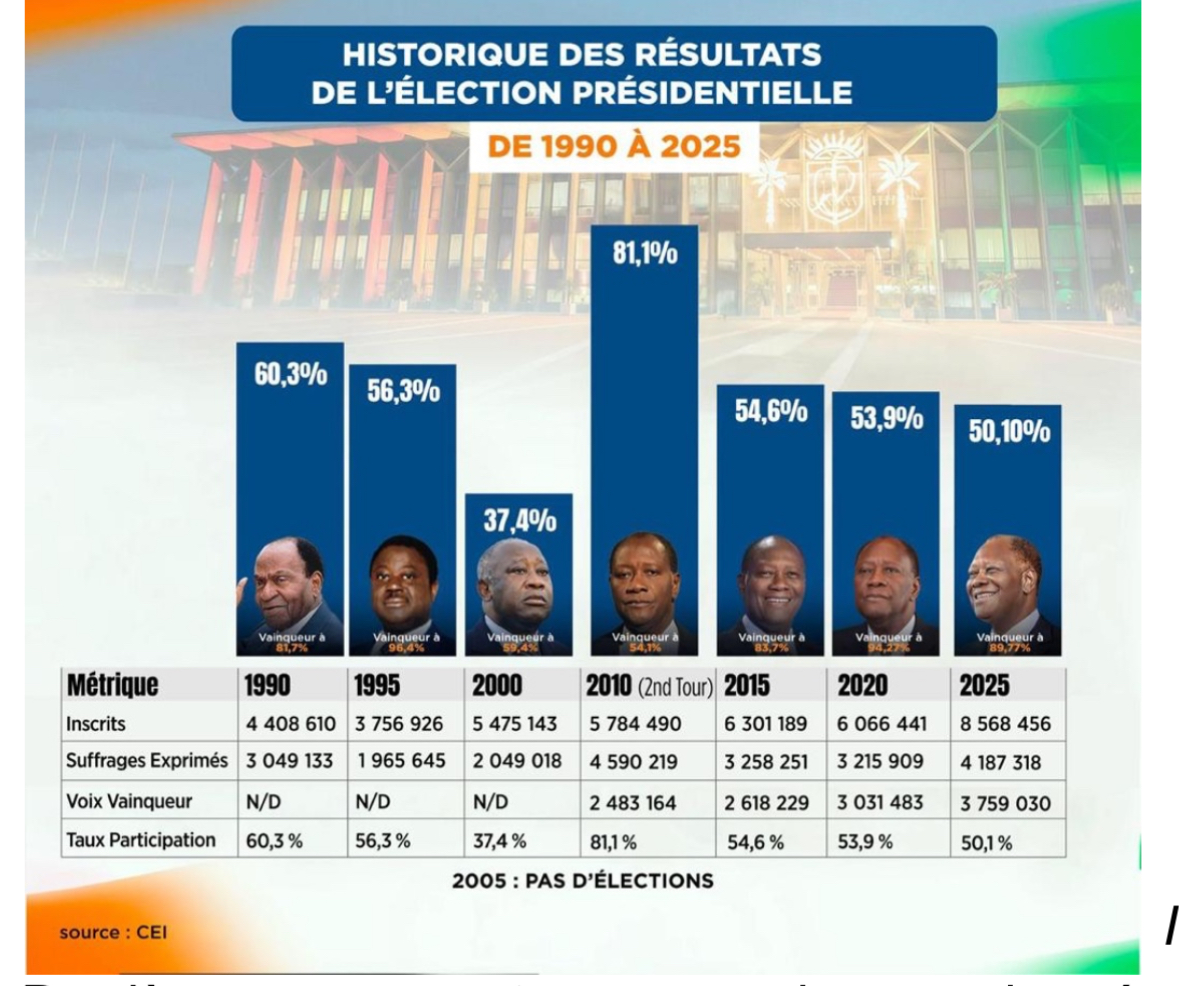
In the hours following the announcement of the results of the Ivorian presidential election of 2025, one number dominated television screens and newspaper columns: 50.10%. This, we were told, was the turnout rate. Immediately, some commentators saw it as proof of electoral demobilization, comparing this percentage to the 53.90% of 2020. However, this superficial reading does not tell the reality of the election.
Behind this percentage hides a fundamental data: the actual number of voters. In 2020, 3,269,813 voters went to the polls. In 2025, there are 4,292,474, more than a million additional Ivorians. Never in the history of Côte d’Ivoire have so many citizens expressed themselves in a presidential election. “In countries experiencing demographic expansion, the mathematical mechanics inevitably dilute percentages. What matters is the volume of citizens exercising their right. And, on this point, Côte d’Ivoire is progressing,” said an African demographer interviewed on the issue.
This progression is explained by several factors: a continuous rejuvenation of the electoral body, the improvement of biometric enrollment systems, and a strengthened mobilization of the diaspora, very present in this year’s election.
Another mistake: reading the score of the outgoing president
Another element widely commented on: the score of candidate Alassane Ouattara would be “down,” dropping from 94.27% in 2020 to 89.77% in 2025. Once again, percentages, taken out of context, lead to a false perception. Because in terms of votes, the outgoing president progresses significantly: 3,031,483 votes in 2020, 3,759,030 in 2025, that is 727,547 additional voters.
A recurring bias in the reading of African elections
This confusion between volumes and ratios is far from unique to Côte d’Ivoire. In Nigeria in 2019 or Ghana in 2016, similar phenomena had already fueled hasty comments. For many experts in electoral governance, this problem is almost structural. They observe that, in newsrooms and on debate platforms, the immediacy of the percentage is favored. However, in Southern countries, where demographics are exploding, only the evolution of volumes allows the measurement of democratic vitality.
In other words: more voters turned out, more voters voted for the incumbent.
Demographics change political equations
Between 2020 and 2025, the number of registered voters has significantly increased. In such a context, the participation rate can decrease even when the number of voters increases significantly. It is a simple mechanism, but often misunderstood.
A statistical rigor cure
This election above all reminds us of the need for a more rigorous look at African elections. By ignoring volumes, we create an artificial narrative of disaffection. By observing them, we see instead a participatory dynamic and strengthened support.
For an electoral governance expert based in Nairobi, the issue goes beyond just Côte d’Ivoire: “We need to move away from a lazy reading of electoral results. Percentages are useful, but they are never enough. In Africa, where demographics are changing fast, only volumetric analysis allows us to understand political trends.”
Contrary to the impression given by a simple ratio, the Ivorian presidential election of 2025 does not show a decrease in citizen interest. It shows a country where more Ivorians are voting.

