




How Africa finances, every year, the mistake of those who rate it
By Junior Mbuyi Kanganga, Founder & CEO of JPG Consulting Partners Group, President of Africa Risk – Strategic Institute for African Sovereignty & Transformation.
Op-ed based on the author’s work and upcoming essay, From Chaos to Prosperity: Towards an African Revolution?(L’Harmattan Editions, September 2026, foreword by Dr. Cheikh Tidiane Gadio).
The world we thought was stable is completing its dissolution before our eyes. Washington is breaking with its own multilateral dogmas, Beijing is advancing its pieces on critical infrastructure and minerals, Moscow is playing the diplomatic balancing act, and Europe, weary, struggles to find a voice that resonates. I extensively document this shift in my second essay, From Chaos to Prosperity: Towards an African Revolution? (L’Harmattan Editions, foreword by Dr. Cheikh Tidiane Gadio), to be published in September 2026. But this book is not just another observation of the world’s disorder. It is a thesis: Africa can and must seize this chaos as a springboard.
The end of one world, the beginning of another
From Bandung to the BRICS+, through the Taiwan Strait and the reshaping of the Middle East, the common thread of the book is simple: the unipolar order of the post-Cold War era is collapsing, along with the intellectual comfort of viewing Africa solely as a battleground for powers. The continent is no longer a passive stake. It holds critical minerals for energy transitions, the youngest demographics on the planet, and a geostrategic position that becomes more central every day in a multipolar world. The question is no longer whether Africa will matter in the world of tomorrow. It is whether Africa will choose its own terms, or continue to endure those set by others.
The triptych of real sovereignty
The manifesto I develop in the book is based on three inseparable pillars: human capital, resource control, and political unity. Without all three, sovereignty remains a slogan. I also outline three scenarios for the horizon of 2050 – exacerbated dependence, controlled integration, or balancing power – and I do not hide my bias: only the demanding third way allows Africa to influence the rules of the game rather than passively accept them.
Because that is the crux of the problem, and it is the battle I have been fighting for over twenty years in my consulting work with central banks, regulators, and African and international financial institutions: the continent is structurally undervalued. African sovereign risk is often assessed through lenses designed elsewhere, for different realities, and this mispricing results in an artificially inflated cost of capital – leading to less investment, fewer infrastructures, and less budgetary flexibility for states every year.
What the numbers say
Available data confirms this diagnosis, and readers of Financial Afrik are familiar with it. An analysis commissioned by the African Development Bank from Moody’s Analytics over fourteen years of history places the average loss rate of African projects at around 1.7%, compared to approximately 13% in Latin America and 10% in Eastern Europe. On the sovereign portfolio alone, the World Bank notes an annual default rate of around 0.7%, with a high recovery rate. Yet, despite these fundamentals, the continent continues to pay an estimated “Africa premium” of around 2.9 percentage points above a rate that would reflect its actual risk – an gap that the World Bank quantifies as tens of billions of dollars lost each year in investment capacity. At the macroeconomic level, this extra cost directly fuels the debt crisis: in many African countries, debt servicing now absorbs more budgetary resources than health, education, or social protection combined, even as the financing gap for the continent’s development is estimated at over $1.3 trillion per year.
Ghana and Zambia: the fast-track trial
Two recent trajectories illustrate this discrepancy almost in its purest form. Ghana, in default since December 2022, finalized the restructuring of $13.1 billion in eurobonds in October 2024, with a 37% discount for creditors and rescheduling until 2037. Since then, the country has meticulously honored each deadline – over $2.1 billion paid since January 2025, including an early repayment of $700 million in July 2026 – and its public debt has dropped from about 93% of GDP in 2022 to 81% in 2024. As a result, Fitch upgraded it from “B-” to “B” in May 2026, and S&P to “B-” as early as November 2025. Zambia, in default since November 2020, completed the bulk of the restructuring of $13.3 billion in external debt – bilateral agreement in February 2024, exchange of eurobonds in mid-2024 – and S&P removed it from selective default to rate it “CCC+” in December 2025; the country even launched in June 2026 an early debt buyback mechanism backed by a concessional loan from the African Development Bank.
Yet, in June 2025, Fitch downgraded Afreximbank’s rating in part by classifying its exposures – albeit marginal – to Ghana (2.4%) and Zambia (0.2%) as defaults, even though neither country had missed a deadline or expressed any intention to repudiate its debt. The African Peer Review Mechanism denounced a biased methodology. In a single sequence, this demonstrates the thesis of the book: even when a state strictly follows the precepts of budget discipline and honors restructured debt, external rating frameworks continue to penalize it based on an outdated and uncontextualized assessment – and this penalty mechanically affects the credit cost of an entire continent through Basel risk weightings.
From a strictly technical standpoint – that of my profession – this distortion stems from how international prudential frameworks, notably Basel III and Basel IV standards and their internal ratings-based (IRB) approaches, calibrate the probability of default (PD) and loss given default (LGD, particularly in a downturn scenario) of African sovereign and banking exposures. These parameters, largely inherited from Western historical series or from rating agency methodologies that are not granular on the continent, mechanically inflate the risk-weighted capital requirements (RWA) applied to African counterparties – thereby increasing the cost of credit for banks, businesses, and ultimately, the states themselves.
Measuring, rather than being measured
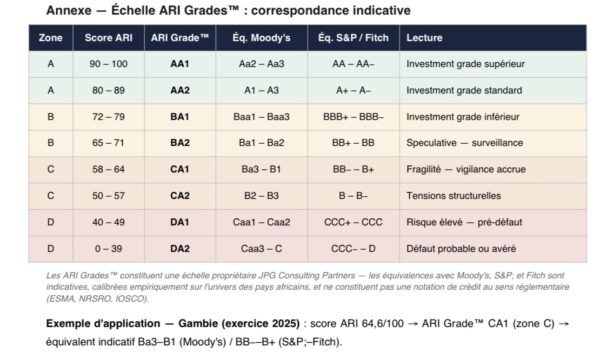
This conviction gave rise to Africa Risk, the think tank I chair, and its two flagship tools: the ARI (Africa Risk Index), a sovereign mapping covering 54 African countries through four pillars – macro-financial stability, financial system, external vulnerability, governance – comprising 33 variables, and the RCE (Risk Calculator Engine), the first RWA calculator calibrated on both international standards and African realities.
These instruments are not just technical products: they embody the doctrine I have advocated since the beginning of my work and which runs through the entire book – Africa should no longer be evaluated, it should evaluate.
The pilot we conducted on Gambia illustrates another equally revealing aspect of this same problem. Gambia is not covered by the three major agencies – it finances itself almost exclusively with concessional resources (IMF, World Bank, AfDB) and has never had the opportunity to test its actual ability to borrow on international markets on fair terms.
Our pilot assigns it, for the year 2025, an ARI score of 64.6/100, equivalent to an ARI Grade™ “CA1” (zone C, “fragility – increased vigilance”), indicative of a Ba3-B1 at Moody’s or a BB-/B+ at S&P and Fitch – a fragile profile, yes, but far from the “ghost country” status to which its lack of rating relegates it de facto in the markets.
This is precisely the blind spot that the ARI is designed to fill: providing a quantified, independent, and updated reading of economies that Western agencies deem too marginal to cover – and therefore, in practice, too marginal to be funded on terms other than those dictated by others.
This doctrine did not originate in an office. It was born, as I recount in the book, in a working-class neighborhood in Île-de-France, where an unwritten rule imposed itself on every child: if you do not assert yourself, you are crushed. I find this street grammar intact today when I argue that a continent that does not set its own rules sees the price of its own risk decided by others – and ends up accepting it for lack of choice.
A call to action, not an observation
From Chaos to Prosperity is not meant to reassure. It poses a disturbing question to those who govern, finance, or think about Africa today: are we ready to build our own measuring instruments, our own doctrines of sovereignty, our own financial architecture – or will we, once again, let others write the rules for us?
The current multipolar chaos offers a rare historical window. It will not remain open indefinitely.
This is the message I wish to convey to the readers of Financial Afrik, whose intellectual rigor on these issues is beyond doubt: the world of tomorrow will not be made without Africa. However, Africa must decide, starting now, to define the terms.
About
Junior Mbuyi Kanganga is the Founder & CEO of JPG Consulting Partners Group, a financial consulting firm specializing in credit risk and banking regulation (Basel III/IV, IRB, IFRS 9), President of Africa Risk – Strategic Institute for African Sovereignty & Transformation, and author of An Emerging African Superpower (2023) and From Chaos to Prosperity: Towards an African Revolution? (September 2026).

