



By Aboubakr Kaira Barry, CFA, Managing Director of Results Associates, and President of the Omou Center for Financial Education, Bethesda, Maryland, United States
Economists explain the dominance of the dollar by the depth of the American capital markets, network effects, and the credibility of institutions. A fourth pillar, equally important, is rarely mentioned: the eurodollar market. This is the vast reservoir of U.S. dollars held and lent outside the United States, beyond the reach of the Fed. It is arguably the most underestimated factor in the supremacy of the dollar, with real lessons for Africa.
Bretton Woods and the Triffin Dilemma
In 1944, Europe was devastated and the United States held most of the world’s gold. The Bretton Woods conference then pegged the dollar to gold at $35 per ounce, and all other currencies to the dollar. It also created the IMF and the World Bank, and imposed capital controls against destabilizing flows. Europe initially faced a shortage of dollars. The Marshall Plan (around $13 billion, 1948–52, representing 2 to 5% of the U.S. GDP) helped fill the gap. By the end of the decade, this shortage turned into a surplus. In 1960, Belgian-American economist Robert Triffin warned Congress: the increase in foreign-held dollar assets would surpass U.S. gold reserves — undermining confidence in convertibility.
Born out of Cold War Fear
An eurodollar is simply a deposit in U.S. dollars held outside U.S. jurisdiction. The name dates back to the Cold War. In the 1950s, the Soviet Union and governments in the Eastern bloc feared that their dollar deposits in American banks would be frozen. This fear intensified after Washington froze Yugoslav gold in 1948 following Tito’s split with Stalin. In February 1957, the Soviets transferred their dollars to their own banks in London and Paris — one bearing the telex address “Eurobank,” which gave the market its name. They kept the dollars but escaped U.S. jurisdiction. Capital flight driven by sanctions became the founding logic of the market.
Kennedy and Johnson Buy Time
Instead of defending gold convertibility through austerity, Washington implemented temporary measures. Kennedy introduced the Roosa bonds in 1962, sold to foreign central banks to discourage conversion to gold. Johnson then added the interest equalization tax (1963–64, taxing U.S. residents’ purchases of foreign securities to curb capital outflows), the voluntary foreign credit restraint program (1965, capping foreign loans by U.S. banks), and tied aid requiring recipients to buy American goods. In 1969, the IMF also created the Special Drawing Right, an additional reserve asset. None of these measures resolved the underlying surplus. They merely bought time until Nixon unilaterally suspended gold convertibility in 1971 — the “Nixon shock” that ended Bretton Woods. Ironically, these controls only pushed borrowers — and American banks themselves — towards the only channel beyond Washington’s reach: the eurodollar market.
Two Regulatory Accidents That Propelled the Market
Two accidents mattered more than generally recognized. First, the 1957 sterling crisis: to defend the pound, the Bank of England prohibited British banks from financing tripartite trade in pounds. They simply turned to dollar deposits, anchoring the market in London. Then, the U.S. Regulation Q capped interest on American bank deposits at around 4% in the 1950s and 1960s, even as market rates rose. Unregulated London banks paid more, attracting offshore dollars whenever U.S. rates hit their ceiling. At the height of tension in 1966 and 1968–69, major U.S. banks re-borrowed these same dollars from their London branches. Commitments to foreign branches soared from $4 billion in 1966 to $13–15 billion by late 1969. Neither London nor Washington wanted to curb a market that suited both — London earned commissions, Washington avoided gold repayments. The market then grew unhindered, towards a boom in eurodollar lending and eurobond issuance. Regulation Q was gradually phased out from 1980, fully abolished in 1986. But the market had long outgrown this loophole.
How Dollars Multiply — Without Reserve Fund
When a commercial bank grants a loan, it immediately creates a brand-new deposit for the borrower. The loan itself is a creation of money, not a draw on reserves. Outside the U.S., a parallel process unfolds beyond the Fed’s control. The $100,000 in U.S. sales revenue from a European company, deposited in Paris, is lent and redeposited, again and again, through European banks. The sum never leaves the American banking system, but each offshore bank extends new credit against that same deposit, under lighter national rules.
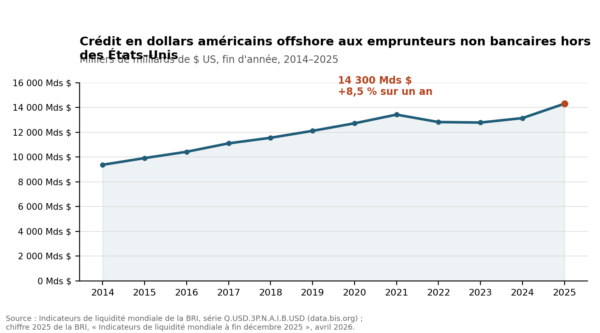
By the end of 2025, dollar credit to non-bank borrowers outside the U.S. reached $14.3 trillion, up 8.5% from the previous year — its strongest growth since 2014 (BIS Global Liquidity Indicators, 2026). The Fed intervened when it mattered most. Dollar swap lines to foreign central banks — secured by local currency loans, then re-lent to ease funding strains — peaked at $586 billion during the 2008 crisis and $449 billion during the COVID shock in 2020. In March 2020, it also created a standing repo facility for Foreign and International Monetary Authorities (FIMA), allowing central banks to exchange their Treasury securities for dollars, on a daily basis.
As historian Carlo Cipolla put it, offshore dollars are “more or less faithful” copies of the U.S. dollar. They are created and lent — from London to Hong Kong, through Singapore and the Cayman Islands — without U.S. authorization.
The Underestimated Advantage — and a Counterfactual
This is the idea most analyses miss: networks, institutions, and capital market depth explain why people want dollars. The eurodollar market explains why dollars are always plentiful enough to be held, lent, and traded at low cost, almost everywhere. A reliable but scarce currency cannot dominate as the dollar does. A reliable and abundant currency can.
If holders of these $14.3 trillion in offshore credit attempted a massive shift to the euro or renminbi, where would the assets come from?
As Christine Lagarde, ECB President, highlighted, the highest-rated eurozone sovereign debt remains below 50% of GDP, compared to over 100% in the U.S. This is not deep enough to absorb such a shift without driving prices up. The Chinese bond market is larger on paper, but still under construction. Competing with the dollar would require floating the renminbi, opening the capital account, and building institutions — an independent central bank, a reliable judiciary — none of which are on the agenda. In short, there is no exit door wide enough. The dollar’s dominance is not due to trust or institutions, but to the fact that there is nowhere else to put so much money.
What It Means for Africa
Practical conclusion: the dollar will continue to dominate international finance for decades, with no credible successor in sight. The euro’s share of global reserves has stagnated near 20% for a quarter century, hindered by a too limited stock of well-rated sovereign debt, despite reliable institutions and an open capital account. The Chinese renminbi represents only about 3% of global payments, held back by managed exchange rates, capital controls, and still-developing financial markets. Even Beijing reinforces the dollar’s dominance more than it challenges it: the renminbi follows a currency basket anchored to the dollar, keeping China within the dollar system, not outside. African economies must plan based on this reality, not on a hoped-for multipolar order. Nearly 40% of global goods trade is invoiced in dollars, far beyond the roughly 10% share of the U.S. in global trade. Most African economies are price takers in a dollar system, whether they trade directly with the U.S. or not.
The focus of African policy should be on directly managing dollar risk, not just a tick on a checklist. This requires governance and budget discipline to protect debt sustainability, regardless of dollar movements. It calls for export diversification and reserve accumulation to manage exchange rates and contain inflation. It entails controls on short-term capital inflows to cushion sudden reversals of “hot money.” And it requires investment in independent central banks and deeper local capital markets, so that states raise more financing domestically. None of this immunizes a country against the dollar cycle. But managing this risk well determines whether one rides the cycle — or gets shaken by it.

