



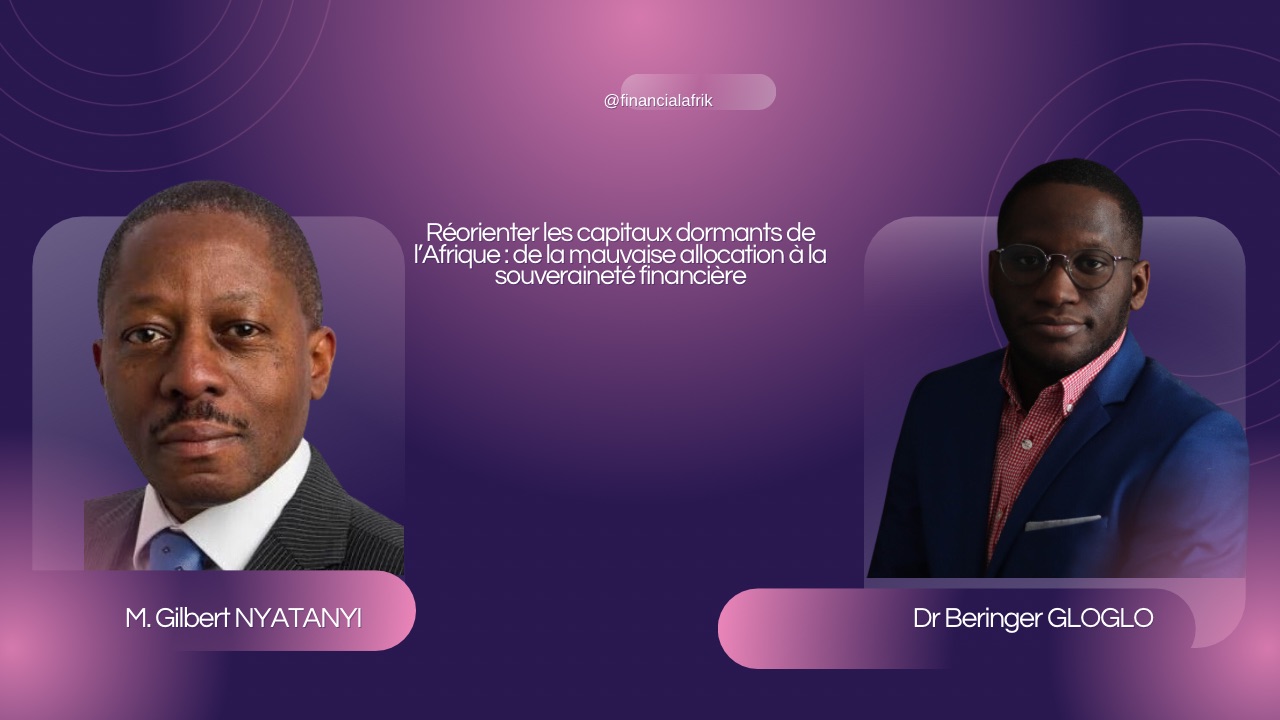
Dr Beringer GLOGLO – Economist, former advisor to the General Directorate
Mr. Gilbert NYATANYI – Counsel at Janson, former CEO of the Rwanda Sovereign Fund
The financing deficit for development in Africa remains one of the most structuring challenges facing the continent. The social stakes are immense, while the global financial environment is becoming increasingly fragmented and constrained. According to the African Development Bank (AfDB, 2024), Africa will need to mobilize $495.6 billion per year, approximately 17% of its projected GDP for 2024, until 2030 to accelerate its structural transformation and converge towards the most performing emerging economies. By 2063, this annual need would drop to $86.7 billion, approximately 3% of GDP, a still considerable amount.
The sectoral breakdown of these needs is particularly revealing. Road infrastructure alone absorbs nearly two-thirds of total needs, illustrating several decades of chronic underinvestment in transport systems. Education (17.4%), energy (11%), and research and development (6.8%) follow. Together, these figures highlight the still fragile foundations of a continent whose essential infrastructures remain insufficiently funded.
For decades, the dominant discourse argued that Africa did not have the necessary financial resources to finance its own development, making the mobilization of external capital the cornerstone of public policies. We now believe that this paradigm must evolve: the priority is no longer to mobilize more capital, but to redirect the already existing resources in Africa towards long-term productive investments. Africa does not suffer from a shortage of capital; it suffers from a systemic inability to effectively deploy the capital it already possesses.
Africa’s stock of domestic capital is estimated, conservatively, at over $4 trillion (Africa Finance Corporation – AFC, 2026). Institutional investors – pension funds, insurance companies, sovereign funds, and public development banks – alone represent $1.1 trillion. Commercial banking assets amount to $2.5 trillion, while foreign exchange reserves exceed $470 billion, with $38 billion in gold. Diaspora remittances reached $95 billion in 2024, confirming their role as a stable and countercyclical source of financing, superior to official development assistance.
However, these resources remain largely underutilized as drivers of long-term investment. The problem lies not in the size of the capital pools, but in their allocation. The portfolios of pension funds and insurance companies, valued at $777 billion, remain predominantly invested in government securities, short-term deposits, and listed stocks. This cautious allocation is explained by high domestic interest rates, significant sovereign risk premiums, inadequate regulatory incentives, and the scarcity of investment instruments suited to long-term horizons. Sovereign funds and development banks, managing around $400 billion, face similar constraints due to fragmented mandates and a lack of alignment with national development strategies.
The importance of the informal sector further exacerbates this situation. In many African economies, it accounts for up to 90% of employment and 65% of GDP, placing immense income flows beyond the reach of formal savings mechanisms. Even partial formalization could unlock over $200 billion in additional savings. This opportunity is reinforced by Africa’s exceptional demographic dynamics, with the world’s fastest-growing working-age population.
Perhaps most concerning is that a significant portion of African capital is invested abroad, mainly in low-yield OECD sovereign bonds, rather than in the continent’s infrastructure, energy systems, or industrial capacities (International Finance Corporation – IFC, 2026). This is not just a technical anomaly, but a strategic failure.

