



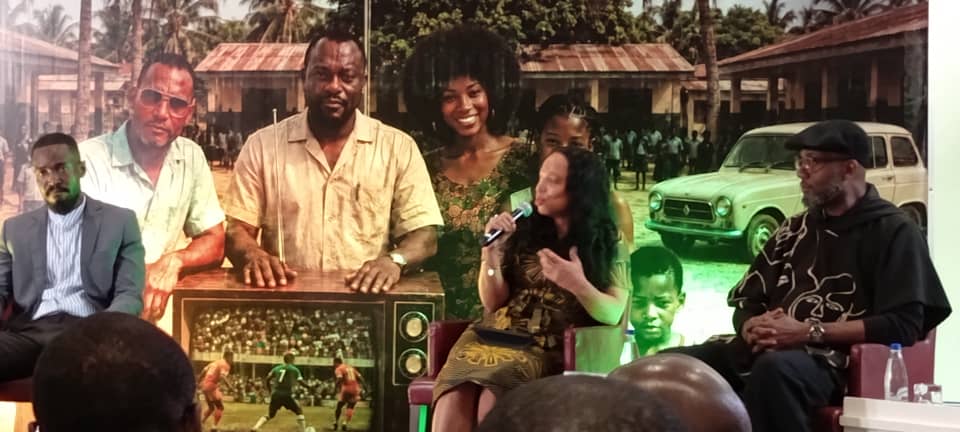
While the African creative industry traditionally suffers from a chronic lack of structured financing and institutional investors struggle to engage massively in this sector, a strong signal is sent by regional markets. Fleur Tchibota, known for leading the financial communication of leading institutions such as Afreximbank and Africa 50, is making a strategic shift by fully investing in the cinema ecosystem through the project “The Director’s TV”, presented on Tuesday, August 4 in Abidjan. This 90-minute historical and social drama, anchored in 1980s Ivory Coast and built around a television set disrupting the social dynamics of a popular neighborhood, illustrates the shift of capital towards cultural assets with high symbolic and economic returns.
At the heart of this initiative, the financial vision of the entrepreneur redefines the profitability of intangible assets by positioning culture not as a secondary activity, but as a full-fledged macroeconomic lever. Founder and CEO of Mantis Group and the Africa Worldwide brand, Fleur Tchibota acts as a co-producer alongside the Ivorian company Incrust’, co-founded by O. Assi, which ensures the direction and delegated production. Her contribution lies in the financial structuring of the film and its positioning on regional and international markets, guaranteeing a montage meeting the standards required by major donors and investment funds.
“As a secondary industry, coming from a finance background, I find that cultural industries are just as strategic. Because in fact, they allow us to build memories, transmit a collective memory, immerse ourselves in our identity, and have a soft power that we can then sell to the world…”, said Mrs. Tchibota. The economic model behind this production is based on the valorization of continental “soft power”, transforming cultural identity into an exportable product with high added value. According to the co-producer, cultural industries allow for the crystallization of collective memory and the establishment of lasting identity markers that future generations can promote on global markets.
On a narrative and commercial level, the film articulates universal themes – the educational reforms of teacher Joseph Adou in Grand-Bassam, marital tensions around Hortense’s emancipation, the emergence of technological modernity in households – with a broad distribution ambition. The involvement of Ivorian music legend Meiway, who plays the lead role, is intended to guarantee transnational commercial visibility. This casting enhances the project’s attractiveness to distributors, streaming platforms, and theater operators.
Fleur Tchibota’s commitment to “The Director’s TV” illustrates an approach where financial engineering serves the African film industry to structure viable business models.
This connection between finance and artistic creation demonstrates the potential of the Ivorian cultural economy as a growth lever and vector of international influence.

