



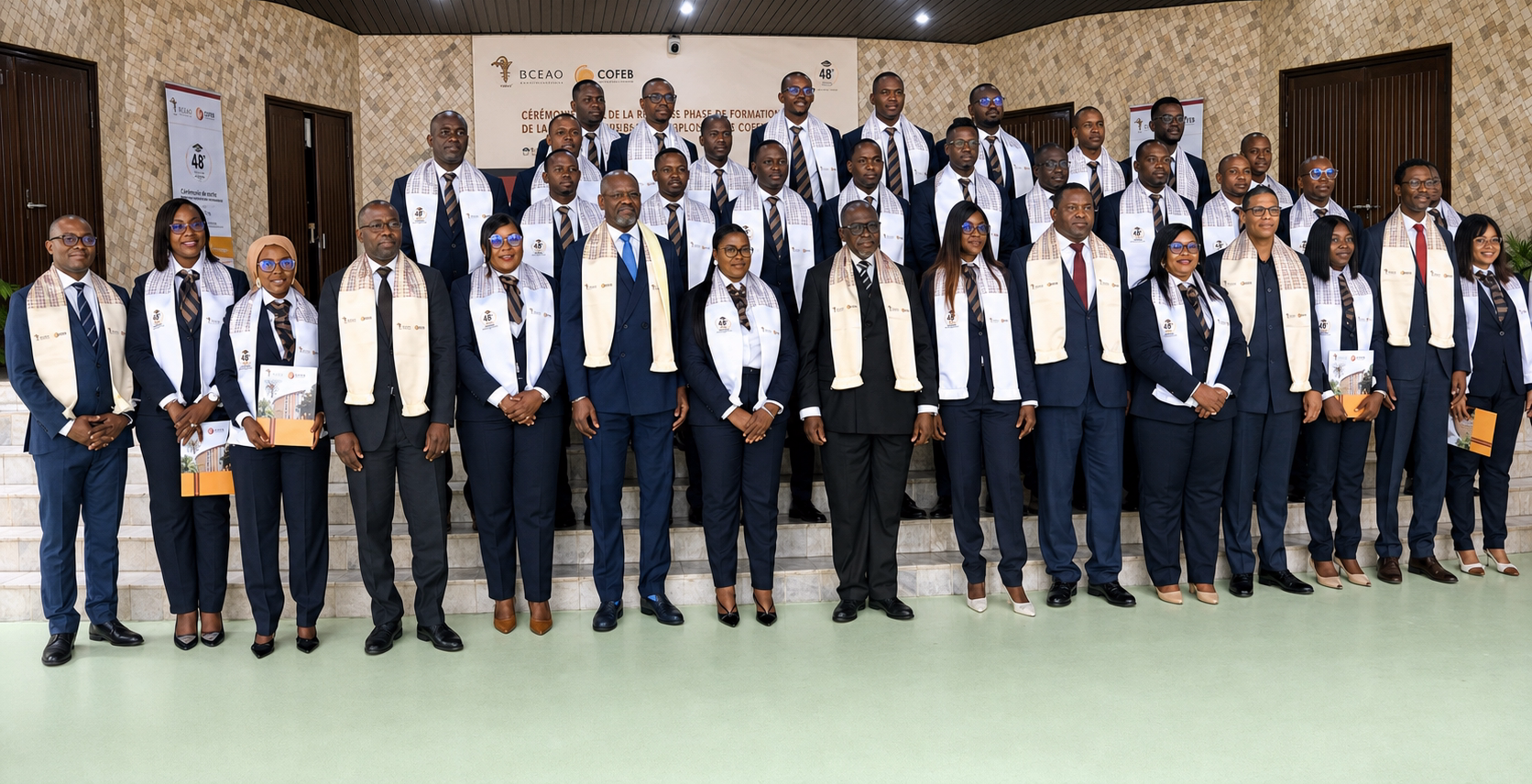
The West African Training and Banking Studies Center (COFEB), a training and research center of the Central Bank of West African States (BCEAO), organized a ceremony in Dakar on Saturday, July 25 marking the end of the first phase of training for the 48th promotion of its diploma cycle.
This step comes before obtaining the COFEB diploma. It marks the completion of the theoretical phase of a training focused on banking, financial, and economic disciplines related to the environment of the West African Economic and Monetary Union (UEMOA).
The 48th promotion consists of 30 auditors from the eight member states of the Union: Benin, Burkina Faso, Ivory Coast, Guinea-Bissau, Mali, Niger, Senegal, and Togo. On this occasion, they received their certificates of completion of the first phase of training. Among them, 20 come from public administrations, four from credit institutions, three from microfinance institutions, and three from other private financial structures.
Over nine months, the auditors followed courses covering five areas of expertise: monetary and financial macroeconomics, public finance and debt management, market finance, banking techniques and practices, as well as quantitative methods. Their journey also included current affairs conferences and specialized seminars focusing on management, leadership, and the evolution of banking professions.
The training, lasting a total of twelve months, will continue with three months of practical internship. At the end of this internship, the auditors will have to write and defend a thesis before obtaining the diploma.
The teaching staff involved consists of researchers from COFEB, experts from BCEAO business units, executives from the Bank of France, as well as teachers from CESAG, Cheikh Anta Diop University of Dakar, Gaston Berger University of Saint-Louis, and IBRA Business School in Lyon.
The program also includes professors from partner institutions, including Laval University in Canada, Paris-Dauphine University, and the Center for Studies and Research on International Development (CERDI) in Clermont-Ferrand.
COFEB also indicates regularly updating the content of its teachings. According to the Center, the program will integrate themes related to emerging technologies, including fintech, blockchain, crypto-assets, artificial intelligence, and machine learning.
Presiding over the ceremony, BCEAO Vice-Governor Rogatien Poda emphasized the contribution of the diversity of profiles, experiences, and institutions represented within the promotion.
“The diversity of profiles, experiences, and institutions represented promotes exchanges, nourishes strategic thinking, and contributes to better quality analysis and decision-making. Beyond the technical skills acquired, this training contributes to the dissemination of high-level expertise within economic and financial administrations, financial institutions, and other organizations of the Union,” he said.
On behalf of the auditors, Abey Jean Simonet Abey, spokesperson for the 48th promotion, expressed gratitude to BCEAO and COFEB for their commitment to capacity building.
“On this day, which marks the completion of the theoretical phase of our training, we take this opportunity to express our deep gratitude to all those who have contributed to our journey. Your commitment to capacity building demonstrates a clear vision of the challenges facing our Union. By investing in the training of high-level executives, you are investing in the future of our monetary Union,” he affirmed.
Fernand Aboutou, advisor to the director general of COFEB, recalled the Center’s journey since its creation.
“Since its creation, COFEB has trained, through 47 promotions, 1,828 graduates. These come not only from the eight member states of UEMOA, but also from the Republic of Guinea, Mauritania, the Democratic Republic of Congo, Burundi, Rwanda, Djibouti, and several other African countries,” he said.
Established in 1977 and based in Dakar, COFEB’s mission is to train and improve the skills of executives from economic and financial administrations as well as those from banking and financial institutions of UEMOA. Initially, the Center offered the Diploma in Banking Techniques (DETB), at the Bac+2 level, and the Diploma in Banking and Financial Studies (DESBF), awarded until 2017.
As part of the Bachelor-Master-Doctorate (LMD) reform, the DESBF was replaced in 2018 by a master’s degree in finance and banking management, accredited by the African and Malagasy Council for Higher Education (CAMES).

