



By Eric Topona
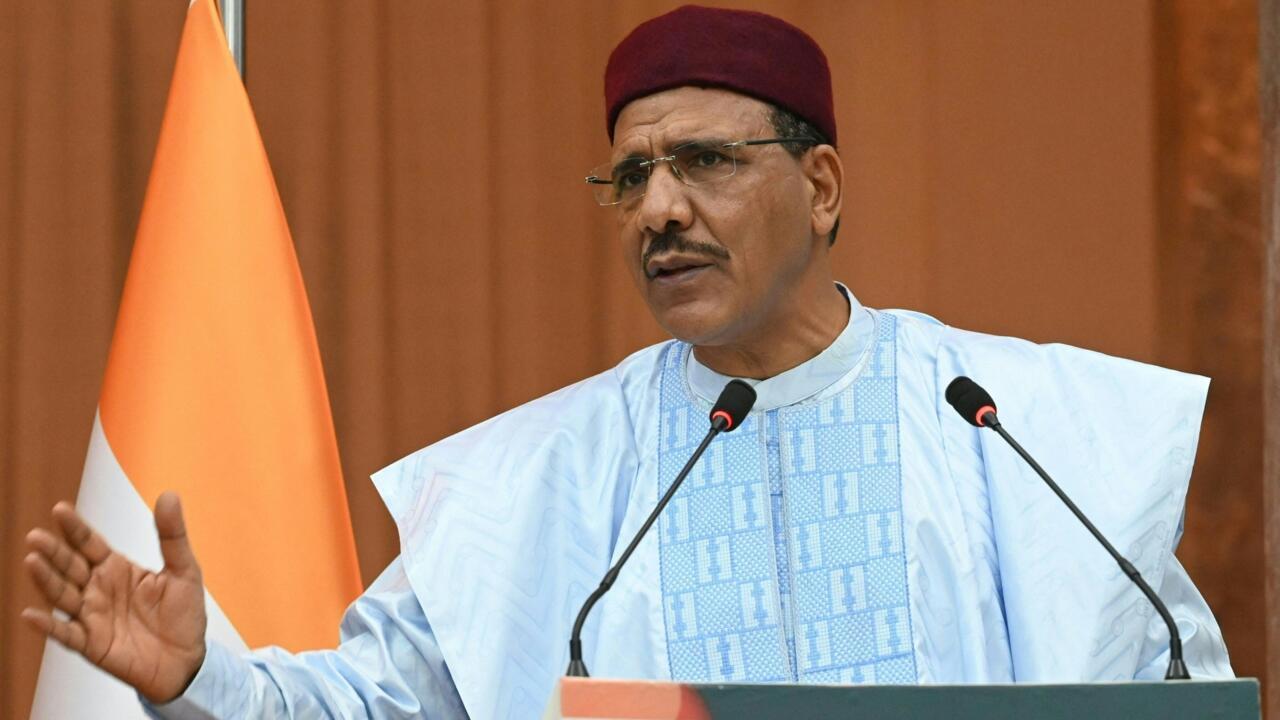
Mohamed Bazoum was the 10th president of Niger, in office from April 2, 2021 to July 26, 2023, when he was overthrown by a military coup led by General Abdourahamane Tiani. Three years after his fall, he is still detained with his wife, Hadiza Ben Mabrouk Bazoum, within the premises of the presidency in Niamey. Several international organizations, including ECOWAS, UN bodies, the European Parliament, and Human Rights Watch, are calling for his release. Eric Topona.
On March 21, 2021, Niger closed a political chapter that was hailed throughout Africa and beyond its borders. Following a democratic election, a vote that all observers agreed was regular and transparent, Mohamed Bazoum was declared head of state by the Nigerien Constitutional Court. Beyond the healthy electoral competition that brought him to power, Mohamed Bazoum’s election was a source of pride and hope for the lasting establishment of peaceful democracy in Africa.
Mohamed Bazoum succeeded a President of the Republic, Mahamadou Issoufou, who freely and consciously decided not to amend the Nigerien Constitution to seek a third term. It is extremely important to note that Mohamed Bazoum belongs to the Arab community of Niger, specifically to the minority tribe of Ouled Souleymane (or Ouled Slimane). In a Africa where communal arithmetic remains a major factor in the composition of alliances and political careers, his triumphant election was a welcome exception. Niger then appeared as a cradle of a true democratic renewal in Africa.
Disappointed Hope
However, on July 26, 2023, this new world in the making collapsed. Mohamed Bazoum was overthrown by elements of his presidential guard, under the leadership of General Abdourahamane Tiani. But this was not just an attack on state institutions, as in addition to this coup, the democratically elected President of the Republic and his family were held captive in an annex of the presidential palace, where he remains deprived of his fundamental rights, alongside his wife, Hadiza Ben Mabrouk Bazoum. Unlike a common prisoner, Mohamed Bazoum is almost entirely cut off from social ties, apart from the rare visits allowed by the ruling junta.
For three years, Mohamed Bazoum has never been given the opportunity to defend himself against the charges brought against him by the current regime, especially since, beyond official speeches, there has been no judicial process in accordance with the rule of law to allow him to defend himself. This delay will likely have no end, as the emptiness of any potential indictment against Mohamed Bazoum is hardly in doubt.
Disregard for the Rule of Law
On July 23, 2025, Human Rights Watch, through senior researcher Ilaria Allegrozzi, stated: “The military junta in Niger shows its contempt for the rule of law every day it keeps former President Mohamed Bazoum and his wife detained. His detention and the charges against him, motivated by political considerations, discredit any claim by the junta to a more democratic Niger.”
When will this ordeal end?
This is the question being asked by those in public opinion who are concerned about the cruel injustice done to Mohamed Bazoum and his wife. In truth, a strong international mobilization immediately took place after his overthrow and sequestration. It has even persisted over time, through support groups that have brought together high-profile individuals from various backgrounds, as well as condemnation from leading international institutions, including the European Parliament, which recently adopted a resolution to this effect almost unanimously.
It is clear that not only does the Bazoum couple remain in detention, but no sign of their release is visible in the near or distant future.
Boosting the momentum in favor of the Bazoum couple
It is therefore essential to move from principled condemnations to coercive measures. The European Union has tools that are proving effective against Russia due to its aggression against Ukraine. The moral and geopolitical responsibility of the European Union is even greater, as its civilization space remains the only one capable of supporting the promotion of peace, freedom, and democracy on the continent for many African democrats. It is also in its interest to know that peaceful and consensual political societies are emerging at its borders, particularly in Africa.
In a regime like the one in place in Niger, where the press is muzzled, civil society is virtually non-existent, and any dissenting opinion is almost criminalized, those who conscientiously oppose the continued detention of the Bazoum couple, and the disregard for their most basic rights, can only do so in conscience and not in action.
On a different note, it is impossible not to note, and regret, the apathy, even the assumed silence, of the African Union. After timid protests in the days following the coup, it seems to have favored normalization with the ruling junta. Its principles, values, and charters will have to wait.

