



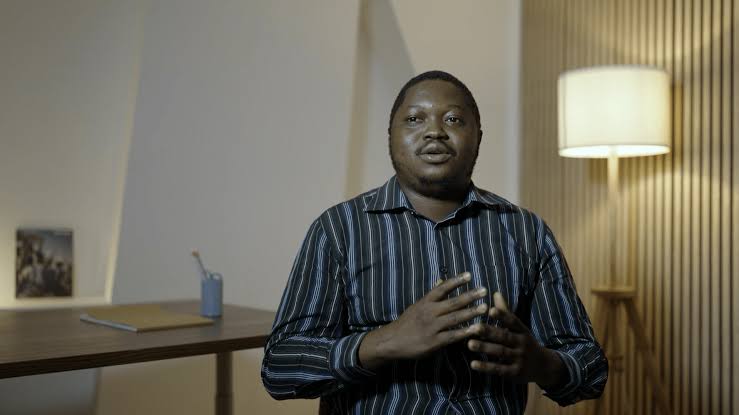
The asylum request of Ephrem Yalike-Ngonzo, a Central African journalist who exposed the propaganda system of the Wagner group in the Central African Republic (CAR), has been rejected by the French authorities. The Platform for the Protection of Whistleblowers in Africa (PPLAAF) announced on Thursday, July 9, that they have filed an appeal against this decision, which they consider contrary to France’s commitments.
According to PPLAAF, Ephrem Yalike-Ngonzo was allowed to come to France in 2024 after an intervention by President Emmanuel Macron, as he faced threats in the Central African Republic. The rejection of his asylum request would now place him in a situation of great vulnerability, according to the organization.
As a journalist in the CAR, Ephrem Yalike-Ngonzo participated in the international investigation conducted by Forbidden Stories and its partners on Russian influence operations in Africa. His testimony helped document the functioning of a communication network attributed to the Wagner group in the Central African Republic. These investigations, covered by over 200 media outlets, led the European Union to sanction Mikhail Prudnikov in May 2025, who was identified as responsible for Russian communication operations in the country.
Between 2019 and 2022, Ephrem Yalike-Ngonzo claims to have participated, under the direction of a man known as “Micha,” identified in the investigation as Mikhail Prudnikov, in the dissemination of content favorable to the Central African authorities and their Russian allies. He says he left this operation after refusing to relay a falsified version of an incident involving Russian mercenaries and two young Fulani shepherds.
Following this episode, he claims to have been threatened with a weapon.
Fearing for his safety and that of his family, he decided to leave the CAR. While his departure to France seemed assured in February 2024, he was arrested by the Central African authorities, questioned for treason, and deprived of his travel documents. His family managed to reach France nonetheless, while he remained stuck in the country.
After several months in hiding, including crossing the Oubangui River to the Democratic Republic of the Congo, he finally obtained a laissez-passer allowing him to reach France.
Since his arrival, he has collaborated with French authorities and given several interviews to the international press. His testimony has been used to document the disinformation mechanisms deployed by Russian networks in Africa.
For PPLAAF, the rejection of his asylum request is difficult to understand considering his role in exposing these influence operations. The organization believes that a forced return to the Central African Republic would expose him to serious risks to his safety.
“The French administration has made a perfectly incomprehensible decision that leaves Mr. Yalike-Ngonzo without any protection against the risk of serious reprisals against his physical integrity and that of his family,” said Jimmy Kande, executive director of PPLAAF.
Henri Thulliez, the organization’s director of strategy, also believes that “France’s commitment against disinformation in Africa loses credibility if it does not protect those who contribute to revealing its mechanisms.”
PPLAAF calls on the French authorities to review the case and provide protection to Ephrem Yalike-Ngonzo and his family. Otherwise, the organization believes the journalist may be forced to return to the Central African Republic, where he claims his life is still threatened.

