



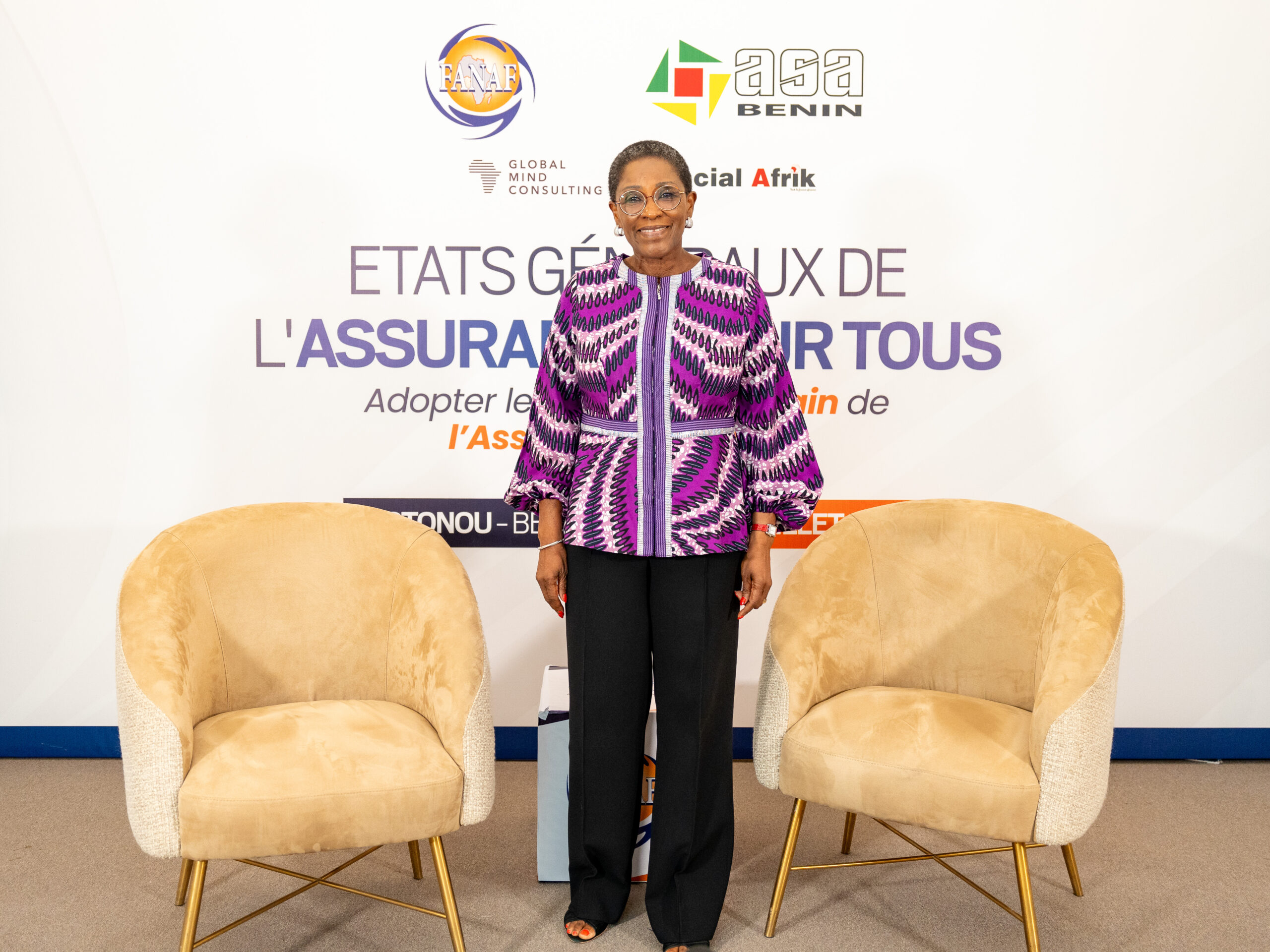
Forty years in the insurance industry, including twenty spent in international groups in Côte d’Ivoire, followed by twelve years at the helm of a company she founded herself before merging it with a leading player in the Beninese market. The journey of Evelyne Fassinou, chair of the board of directors of SUNU Assurances Vie Benin, is intertwined with several key stages in the structuring of the sector on the continent. As a guest on the Financial Afrik platform in Cotonou (Benin) as part of the General States of Insurance for All, she openly discusses the topic that now occupies her – making women’s insurance the lever for doubling the insurance penetration rate in Africa by 2040, driven by the Pan-African Pact for Inclusive Insurance adopted on July 8, 2026 by the Federation of African National Insurance Companies (FANAF).
Forty years in the industry, between Abidjan, Paris, and Cotonou
The story begins with a round number, acknowledged with a mix of caution and pride: “I have been in the insurance business for a certain number of years – I will not say how many.” Four decades that unfold in three acts. After studying law and insurance in France, the young graduate chose Côte d’Ivoire: “I started working in Côte d’Ivoire where I worked in international groups for about twenty years,” she says.
At the end of these two decades, the step becomes more entrepreneurial and personal. The leader decides to embark on “another great adventure,” that of creating her own life insurance company in Benin. “I led this company for 12 years, and it was a project that was truly transformative for me, which effectively allowed me to see that insurance can reach people who were not familiar with insurance.” But to allow the company to go “even further,” she initiated the merger with SUNU Assurances Vie, a player already present in the Beninese market, of which she currently chairs the board of directors.
In parallel, six years on the executive board of FANAF opened up another field of vision: “For 6 years, the role of a member of the FANAF executive board […] allowed me to look at African insurance issues from a higher perspective.”
The turning point: what the field showed her about the role of women
It is in the continuation of this continental experience that the topic, since then, has not let her go. “I have endeavored […] to focus mainly on the issue of African insurance and women, which has become a passion for me.”
Field missions, she says, did the rest. When talking about life insurance, she observes, families benefiting from it also testify to what is missing. “Women are left out. In any case, insurers do not really approach women with suitable products.”
Hence the fight she has chosen to lead, which she formulates as follows: “I wanted […] to show that women have their reality and that it is necessary to listen to them, understand their reality in order to truly reach out to them and provide them with the right insurance solution.”
For Evelyne Fassinou, the topic is not philanthropic. It is, she says, a condition for sectoral growth: “If we, as insurers, do not reach out more to the female clientele, which represents 50% of the African population, we will have difficulty developing insurance in Africa. So it is not social work that we want to do, it is something strategic.”
The Pan-African Pact, and the pressure of keeping one’s word
Thus, she specifies, the work in Cotonou will not be in vain: “We know that this work will lead to a Pan-African Pact for Inclusive Insurance. The primary objective of this pact, as the president of FANAF stated at the opening, is to record a commitment.”
Because the sector has already seen good intentions in the past without follow-up: “We have had general states in the past where we had a lot of good wishes, we decided to do many things, and we realize that five years later, nothing has been done.”
This time, there is a quantified commitment, and it is clear: “Doubling the insurance penetration rate in Africa by 2040. When we know that the average in our countries is a maximum of 1%, it means that at least […] all African countries should have a penetration rate of at least 2% by 2040.” And she emphasizes the condition: “Indeed, in order to achieve this, no one should be left behind.”

