



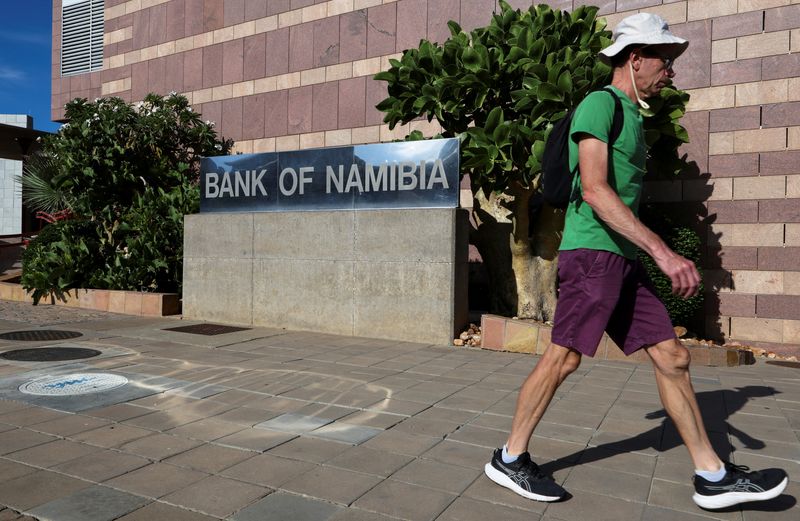
The Central Bank of Namibia has revised downwards its economic growth outlook, now expecting an expansion of 2.6% in 2026 and 2.9% in 2027, according to a statement released on Monday, April 14.
These new estimates represent negative revisions of 1.2 percentage points for 2026 and 1.4 points for 2027 compared to the December 2025 projections, mainly due to weaker than expected performance in primary industries.
The Central Bank highlights that the slowdown is largely attributable to a marked contraction in metallic minerals production and the persistent weakness in the diamond sector, in a context of sluggish global demand.
Namibia’s economy, heavily reliant on natural resources, continues to feel the effects of a prolonged slowdown in the diamond market, although the rise in gold and uranium prices partially mitigates the impact. Uranium production is expected to remain a key support to activity, driven by existing operations.
However, growth is expected to be supported by the secondary and tertiary sectors, including construction, energy, trade, financial services, as well as public administration and defense.
The apex bank’s forecasts for 2026 remain below those of the Ministry of Finance, which anticipates a growth of 3.1%, reflecting more optimistic assumptions established before a rise in international geopolitical tensions.
Furthermore, the institution warns of several downside risks, including increased volatility in commodity prices and the potential impact of a foot-and-mouth disease outbreak in neighboring countries like Botswana and South Africa, which could weigh on animal production and exports.

