



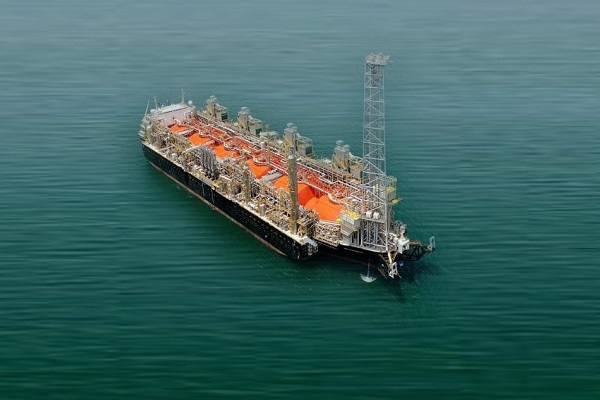
In Cameroon, LNG export revenues have decreased from 381 billion XAF (around 680 million USD) in 2024 to 350.2 billion XAF (around 625.5 million USD) in 2025. This represents an 8.1% annual decrease. This information is revealed by the National Institute of Statistics (INS) in its latest report on foreign trade.
According to these data, there has been a downward trend in LNG export revenues since 2022. Thus, according to the INS, in four years, revenues went from 622 billion XAF (around 1.1 billion USD) in 2022 to 421 billion XAF (nearly 751 million USD) in 2023, then to 381 billion XAF (around 680 million USD) in 2024. In 2025, revenues fell to 350.2 billion XAF (around 625.5 million USD).
In its aforementioned report, the statistics manager in Cameroon reveals that during the period under review (2025), “LNG represented 11.4% of Cameroon’s total export revenues”. “Revenues from the sale of Cameroonian LNG abroad mainly come from Hilli Episeyo, a floating liquefaction unit installed off the coast of Kribi, in the South region,” says the INS. For whom “this infrastructure is the main tool for valorizing the country’s gas resources on the international market”.
It is worth noting that Cameroon became a LNG producer in March 2018, thanks to a partnership with a consortium of companies consisting of the French group Perenco, the National Hydrocarbons Corporation (SNH), and Golar LNG, specialized in floating liquefaction platforms. The deployment of this consortium at Hilli Episeyo allowed for the production of 1.2 million tons of LNG, before increasing the production capacity to 1.4 million tons.

