



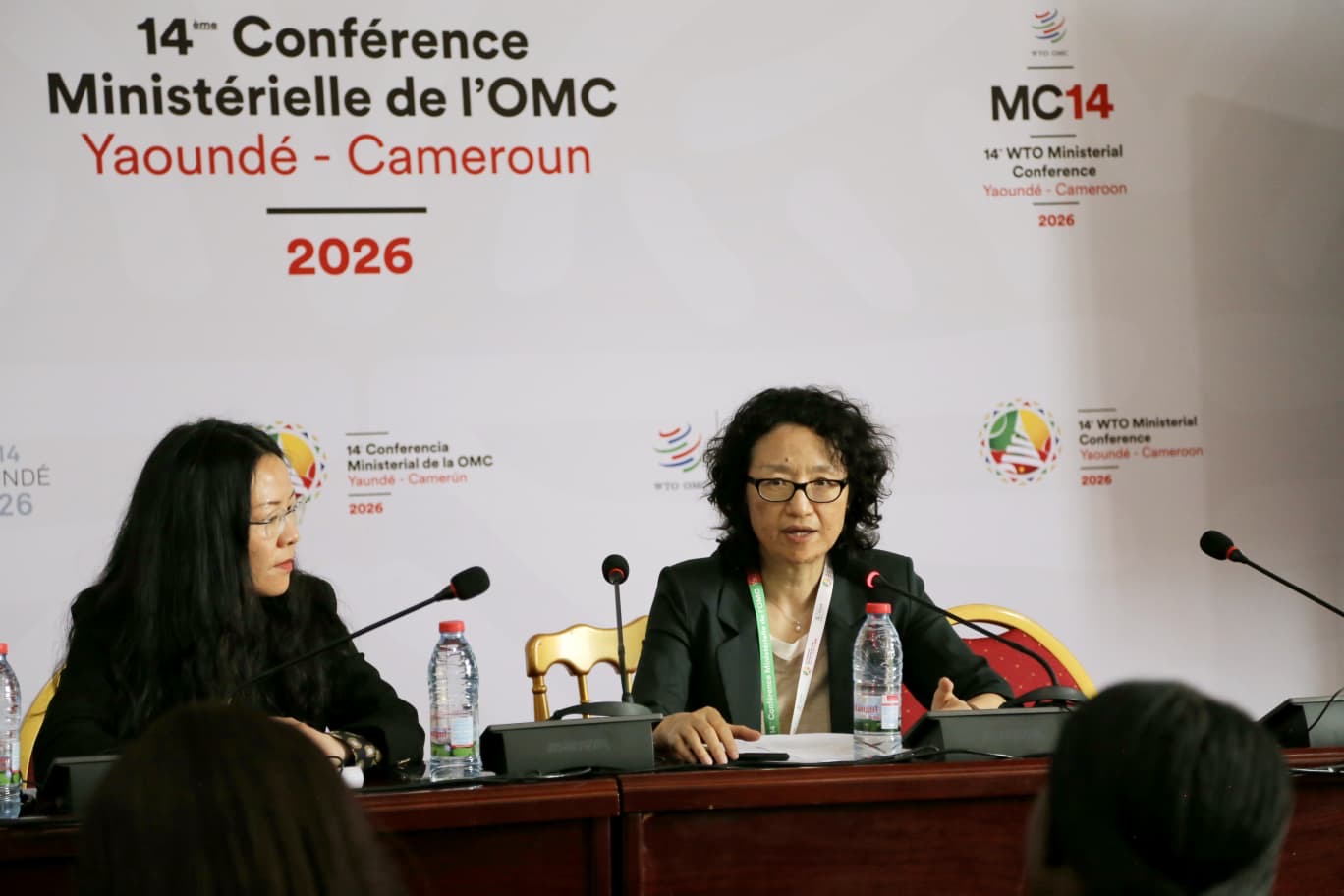
In the margins of the 14th Ministerial Conference of the World Trade Organization (MC14), currently taking place in Yaoundé (March 26-29, 2026), China, through Ambassador Li Yongjie, reaffirmed its commitment to a multilateral trade organization that is “operational, performative, and focused on development”. During a press briefing on March 27 in front of journalists from the least developed countries (LDCs) and developing economies, Beijing outlined a clear strategic line: defending the rules, accelerating reforms, and strengthening South-South cooperation.
Ten years after the last ministerial conference held on the African continent, this MC14 comes at a time of high trade tensions and challenges to the multilateral system. “The global trade order is facing serious challenges,” reminded the Chinese diplomat, emphasizing the need for member states to reaffirm the value of the WTO while engaging in deep reforms to make it “more relevant and resilient”.
For China, the expectations are clear. The conference should lead to the adoption of a ministerial declaration on reform and a structured work plan. It should also produce concrete results in key areas such as e-commerce, investment (IFDA), agriculture, fisheries, and development issues. This is a way to reposition the WTO at the heart of global economic governance.
On the substance, Beijing recalls the achievements of the multilateral system. Since 1995, global trade in goods and services has multiplied by more than five, allowing for increased integration of developing economies into global value chains. In 2024, these economies accounted for 47% of global goods exports and 33% of services. However, this model is now under strain. The rise of unilateral measures, especially tariffs, as well as the blocking of the dispute settlement mechanism, fuel the risk of a return to a power-based logic, described as “the law of the jungle”.
In this context, China advocates for a reform centered around three priorities: improving decision-making mechanisms, focusing on development issues, and promoting fair competition. The stated goal is to build an “inclusive and beneficial globalization for all”, particularly by enabling developing economies to take advantage of opportunities offered by the digital economy and green transition.
Beyond institutional reform, Beijing highlights South-South cooperation as a strategic lever. Africa plays a central role in this approach. China reaffirms its support for the African Continental Free Trade Area and encourages its companies to invest in key sectors: infrastructure, agricultural transformation, automotive industry, new energies, or the digital economy.
This strategy also relies on the opening of the Chinese market. In 2025, goods imports reached 18,480 billion yuan (approximately 2,640 billion dollars), confirming China as the world’s second-largest importer for the 17th consecutive year. In this logic, Xi Jinping announced the establishment, starting from May 1, of a zero tariff regime for 53 African countries with diplomatic relations with Beijing.
Beyond the commercial dimension, this measure is presented as an investment tool. The goal is twofold: stimulate African exports while attracting more capital to the continent, in order to accelerate its integration into global value chains. According to an International Monetary Fund report, Chinese investments have already helped increase local processing rates in Africa from 15% to 45%.
In line with this, Chinese Minister of Commerce Wang Wentao organized a high-level meeting on the industrialization of the African continent on the sidelines of the conference, bringing together nearly 50 countries and the WTO Director-General, Ngozi Okonjo-Iweala. This sends a strong signal in favor of development based on market access rather than just assistance.
In the background, China aligns its commitment with a long-term vision. The recent five-year plan adopted by the National People’s Congress foresees enhanced support for the multilateral trade system, with the WTO at its core, as well as active participation in ongoing reforms. Beijing thus shows its willingness to position itself as a defender of a regulated trade order, in the face of rising protectionist temptations.

