



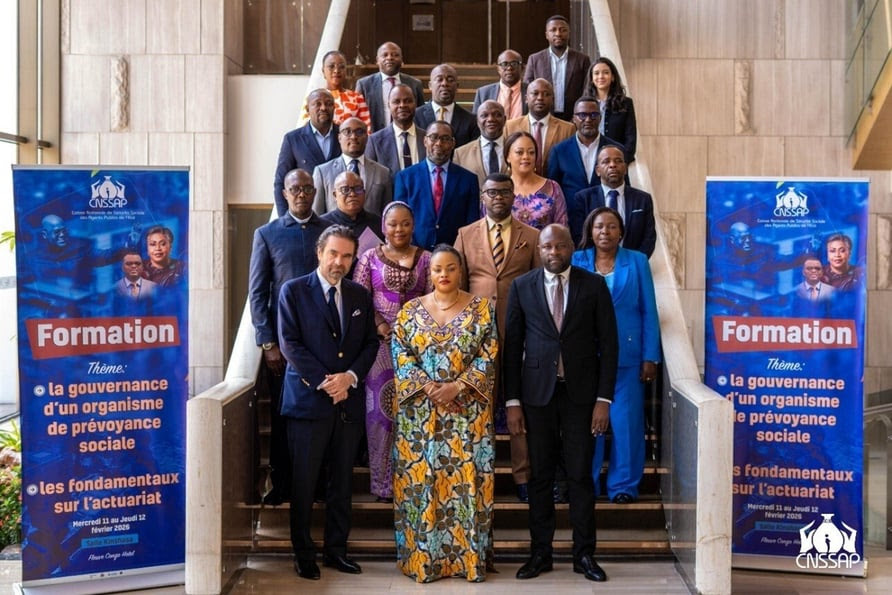
The FINACTU Group is pleased with a particularly dynamic month of February 2026 in the context of its support activities for the National Social Security Fund for Public Servants (CNSSAP) of the Democratic Republic of Congo. Led by its president, Denis Chemillier-Gendreau, a delegation of about ten consultants traveled to Kinshasa to present to the Congolese authorities the major progress made in the strategic partnership initiated since last September, aimed at strengthening the technical and operational capacities of the CNSSAP.
On this occasion, the president of FINACTU was received by Deputy Prime Minister Jean-Pierre Lihau, in the presence of his chief of staff, Bienvenu Madjulu, who is also a representative on the Board of Directors of the Fund. This meeting allowed for an update on the progress of the projects, to provide precise answers to the authorities’ questions, and to better understand their expectations. Sensible to the challenges of modernization and innovation, the Deputy Prime Minister emphasized the importance for the CNSSAP to strengthen its digital investments and to acquire IT solutions meeting international standards.
The mission also led to in-depth exchanges with the new members of the Board of Directors of the CNSSAP, now chaired by Mrs. Marie Karumba Nabintu and composed of fourteen representatives from various ministries.
Furthermore, Denis Chemillier-Gendreau, accompanied by experts from the FINACTU Group, presented in detail the progress of the projects to the Director General, Mr. Junior Mata M’Elanga, to the Deputy Director General, Maître Gabin Kalala Kabengele, as well as to the management teams of the Fund, during several working sessions.
On this occasion, the president of the FINACTU Group reiterated the strategic challenges of this transformation: “Since its creation in 2017, the CNSSAP has accomplished remarkable work in managing the basic pension scheme for Congolese civil servants. It must now prepare to integrate new schemes entrusted by the State. This ambition largely relies on the development of a high-performance IT system, essential for the efficient management of social protection schemes intended for nearly two million public servants.”

