



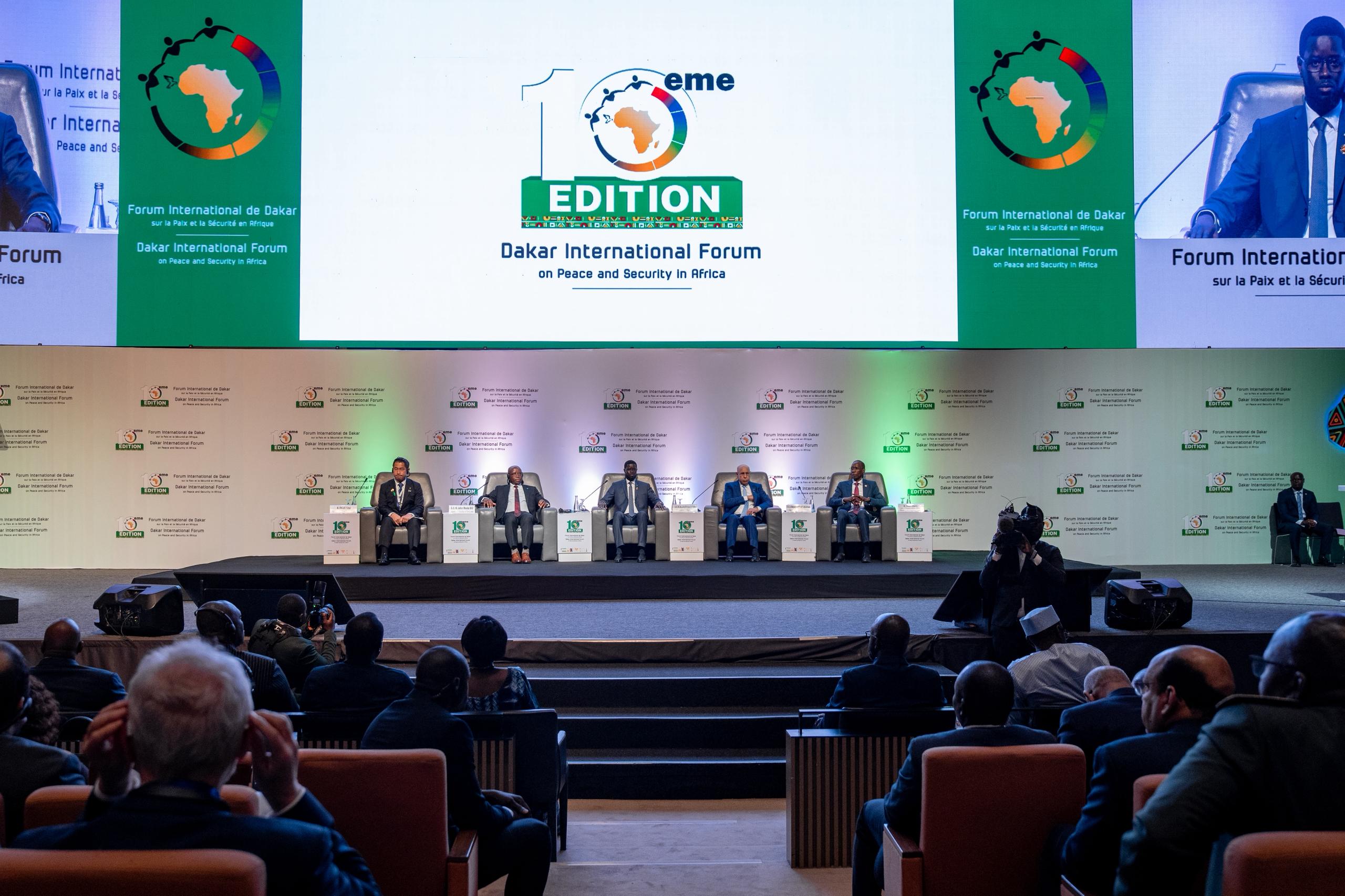
At the opening of the 10th edition of the Dakar International Forum on Peace and Security in Africa, on Monday, April 20, 2026, Senegalese President Bassirou Diomaye Faye called for a collective response to the security challenges facing the continent, particularly to transform security crises into a lever for strategic integration and sustainable economic development.
Organized in a context of geopolitical reconfiguration marked by the decline of traditional alliances in the Sahel, the weakening of the Economic Community of West African States and the spread of terrorism to the coastal states of the Gulf of Guinea, this edition takes place at the Abdou Diouf International Conference Center in Diamniadio (CICAD), under the theme: “Africa facing the challenges of stability, integration, and sovereignty: what sustainable solutions?”
In his speech, the Senegalese head of state estimated that no country could face current security threats alone, advocating for solutions built on a collective scale. According to information shared at the opening of the Forum, discussions focus on terrorism, cybercrime, disinformation, maritime piracy, and the effects of climate change on the continent’s stability.
“Even with full acquired sovereignty, no country or continent can triumph alone against these security threats. Any effective solution will only be built collectively,” he affirmed in front of heads of state, military leaders, and international partners.
Beyond the traditional security challenges, President Faye provided a global diagnosis: transboundary terrorism, cybercrime, strategic disinformation, maritime piracy, and climate disruptions now constitute a system of interdependent threats. In this context, security is no longer just a military issue, but an economic and governance issue.
“Prosperity does not come from the abundance of resources, but from our ability to govern them,” emphasized the president, advocating for an industrial transformation of African resources according to a clear logic: “extract here, transform here, and sell at a fair price.”
The Senegalese president also stressed the need to operationalize the African standby forces and develop a continental defense industry, supported by stable financing controlled by African states. This direction opens up new opportunities for investors in defense, critical infrastructure, and cybersecurity technologies.
Faced with the expansion of armed groups and global economic fractures, the call from Dakar aims to reposition Africa as a strategic player in the reshaping of international balances.
“May this edition be one of maturity and action,” concluded President Faye, inviting African and international partners to translate political commitments into concrete actions.
In a global environment marked by instability, the Dakar Forum appears as a strategic platform where the contours of a new African security architecture are being drawn, inseparable from economic stability, investment attractiveness, and sustainable development of the continent.

