



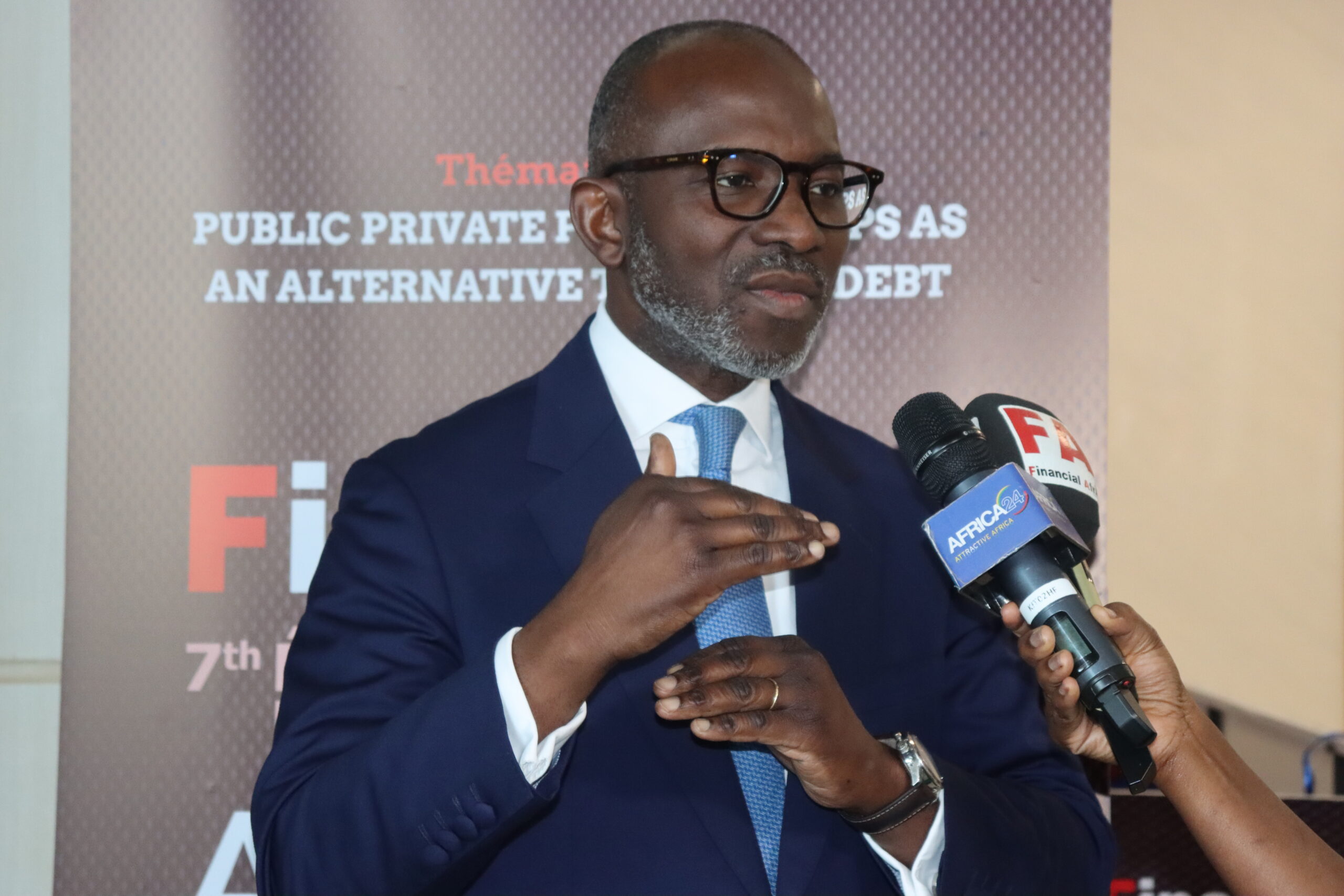
Didier Acouetey, founder of the AfricSearch Group, is participating in the 7th edition of the Financial Afrik Awards in Banjul on January 22 and 23, 2026. On the sidelines of the event, he, who has just been appointed special advisor to the President of the African Development Bank (AfDB) in charge of the New African Financial Architecture (NAFA), deciphers, with Financial Afrik, the issues of public-private partnerships (PPP) and the foundations of NAFA. Exclusive interview!
This edition of the Financial Afrik Awards focuses on the theme of public-private partnerships as an alternative to public debt. What is your view on the subject?
This theme is fundamental. The financing gap for infrastructure in Africa is estimated at over $400 billion per year. States alone do not have the necessary budgetary capacities to finance all essential infrastructure, whether it be roads, hospitals, ports, access to water, or electricity. In this context, the use of public-private partnerships is essential. The private sector has the capacity to mobilize resources, build these infrastructures, and finance them, either through state payments or through direct remuneration mechanisms, such as tolls for toll roads. Accelerating PPP projects is therefore a necessity in the face of significant needs.
Are these needs accentuated by the demographic dynamics of the continent?
Absolutely. Africa is experiencing a major demographic evolution. The population of the continent could reach nearly two billion inhabitants by 2050, which will significantly increase pressure on cities and public services. This implies the construction of housing, roads, urban infrastructure, and collective facilities. This acceleration of investments is made necessary by this demographic pressure. However, it is difficult, if not impossible, to meet these needs without fully involving the private sector through structured and well-designed PPPs.
You were recently appointed special advisor to the President of the African Development Bank (AfDB) in charge of the New African Financial Architecture (NAFA). Can you tell us more about this initiative?
The financing needs of Africa are considerable, whether for infrastructure, financing small and medium enterprises, or energy transition. Mobilizing African domestic resources is a central issue, championed for many years by actors on the continent. The new President of the African Development Bank, Sidi Ould Tah, has made it a strategic priority. However, mobilizing these resources, although essential, is not sufficient on its own. NAFA aims to rethink the functioning of the African financial ecosystem by bringing together, in a more coordinated manner, all actors: development banks, commercial banks, capital markets, insurers, pension funds, and guarantee funds.
How does this new financial architecture concretely work?
NAFA is based on a three-level organization: continental, regional, and national. This structuring allows for a more efficient integration of the various actors in the financial ecosystem, by implementing mechanisms of complementarity, subsidiarity, and mutualization. The goal is to mobilize much larger volumes of resources, not only from domestic resources, but also through the mobilization of additional external financing. One key aspect of this architecture is its multiplier effect: when one actor is funded, it can in turn mobilize other resources, allowing for a gradual scaling up.
Can it be said that the AfDB is now moving towards a new financial architecture?
Yes, clearly. The African Development Bank is the continent’s bank. Its role is to support African economies, states, and the private sector by aggregating financial actors and financing them. The AfDB also has a significant capacity to mobilize concessional resources at very low rates. However, the central question of Africa’s financing remains the cost of debt, that is, the rate at which the continent finances itself. Africa bears a risk premium often perceived rather than real, which hinders its growth. As a pan-African reference institution, the AfDB can mobilize resources at lower rates, thus enabling African states and the private sector to access more competitive financing, in a context of strong international competition.
How is this approach crucial for PPP projects?
In large projects, especially in PPPs, African companies are often in competition with European, Chinese, or Turkish companies that finance themselves at rates of 2 to 3%, while African companies must borrow at 8, 9, or even 10%. This situation creates a major competitive distortion. The goal of NAFA is also to correct these imbalances by facilitating African companies’ access to financing at more competitive rates. This is an essential condition to strengthen their competitiveness and allow them to fully play their role in the economic development of the continent.

