



By Aboubakr Kaira Barry, Managing Director of Results Associates, a consulting firm based in Bethesda, Maryland, United States.
Guineans are experiencing a cash shortage that seems to defy all logic. Currency exchange dealers in Conakry tell their customers that they have run out of francs. Banks are limiting withdrawals. Merchants and transporters claim that cash has become hard to come by, even for the smallest transactions.
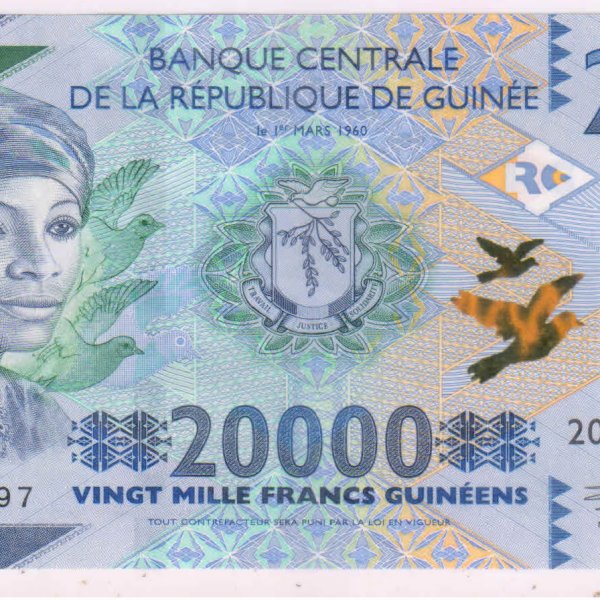
The government argues that the population is hoarding cash. In 2025, the Central Bank of the Republic of Guinea (BCRG) acknowledged that about 94% of issued banknotes are circulating outside the banking system. Despite the importation and distribution of new banknotes, the BCRG and commercial banks describe a severe cash shortage at tellers and ATMs – a problem of circulation and liquidity, not of printing capacity.
But if almost all banknotes are outside the banks and the majority of Guineans live in a largely informal economy, why is this informal sector still lacking in cash?
A problem of velocity in a low-trust system
The answer lies not in the money supply, but in trust and circulation. According to the quantity theory of money – MV = PQ – the money supply (M) multiplied by the velocity of circulation (V) equals the overall level of transactions. Guinean authorities have focused on M by injecting new banknotes, but it is V that is crucial.
Banknotes stashed under mattresses or in private safes do not circulate. For a seller at the Madina market or a motorcycle taxi driver in Kankan, a hoarded or nonexistent banknote is the same: neither allows for a transaction. Immobile money is, in fact, absent money.
Why does velocity collapse? Because, in a weakened environment marked by corruption and banking liquidity restrictions, staying outside the formal system becomes a form of rational self-assurance. According to the World Bank’s worldwide governance indicators, Guinea ranks among the weakest countries in terms of government effectiveness and anti-corruption efforts. When the rules of the game can change overnight and banks start rationing withdrawals, economic agents hold onto their money.
A significant portion of this 94% is likely immobilized in the hands of large merchants, politically connected businesses, and actors in the gray sector, while small businesses and households are suffocated. It is not so much a story of “collective misconduct” as a phenomenon of liquidity concentration in an untrustworthy system.
Beyond conventional solutions
Conventional remedies are not enough. Relying on “moral persuasion” – encouraging citizens to deposit their money in the bank – treats hoarding as irrational behavior, when it is a response to institutional failure. Technical solutions like importing new banknotes or expanding electronic money are necessary but insufficient.
Operators like Orange Money or MTN Mobile Money have indeed developed extensive agent networks, but these depend on the liquidity of commercial banks. The same institutional trust deficit that leads to hoarding also limits the depth of digital adoption. Electronic wallets risk reproducing, in digital form, the same trust deficit.
Two decade-long pacts to restore credibility
If the problem is trust, the solution is for the state to impose credible discipline on itself. Before the creation of the European Monetary Union, several European countries with fragile fiscal discipline linked their currency to the German mark to import the credibility of the bloc’s most stable currency. Guinea could follow a similar logic: two decade-long pacts, concluded with the World Bank and the IMF, temporarily importing this credibility while strengthening domestic institutions.
Pillar 1 – Sovereign investment partnership: the government would retain the definition of development priorities and project selection, but for agreed projects, procurement, financial management, and disbursement procedures would be carried out through the World Bank’s fiduciary systems, with independent verification of results. Far from a loss of sovereignty, this would be an anti-corruption choice aimed at proving to citizens and investors that public money is being well spent. In the long run, this would reduce investment costs and attract actors seeking to create value rather than capture rents.
Pillar 2 – IMF-governed monetary and fiscal co-governance: the Governor of the Central Bank would remain a Guinean national, appointed based on agreed criteria, operating within a framework developed jointly with the IMF. A technical governance council, composed of experts supported by the IMF and Guinean officials, would over ten years build capacities for an autonomous central bank: inflation targeting, rigorous banking supervision, and prudent reserve management in a competitive exchange rate regime.
On the fiscal side, the state would commit to balancing the budget over the economic cycle, allowing temporary countercyclical deficits while preserving public finance sustainability and monetary stability.
Rehabilitation of banking and domestic markets
The pact with the IMF would integrate two additional elements:
a) Recapitalization and cleansing of the banking system: over ten years, recapitalize and consolidate viable banks, while fragile institutions would be restructured or closed, and gradually clear state arrears to restore bank balance sheets.
b) Development of the public securities market: strengthen the legal and operational framework of the interbank market to allow banks to lend to each other safely, and create a secondary market for negotiable Treasury bills. This would reduce dependence on direct financing from the central bank, in favor of transparent borrowing from domestic savers and investors.
To make these pacts credible, Guinea could draw inspiration from countries like Botswana, which has embedded its medium-term development plans in law. It would adopt legislation framing these two decade-long partnerships, with clear objectives, monitoring obligations, and sunset clauses.
Trust, ratings, and future growth
Such pacts would send a strong signal to rating agencies and investors. A credible and transparent framework for monetary, fiscal, and investment policy would pave the way for a gradual improvement in Guinea’s sovereign rating, up to an investment grade, enabling broader access to innovative financing – including securitization of stable mining revenues to finance infrastructure and human capital.
The guiding idea is simple: Guinea must choose today to tie its hands in order to unleash its economy tomorrow. Without trust, the financial sector will remain fragile, politicized, and unable to finance development. Households will continue to hoard, businesses will invest little, and banks will operate as extensions of the state rather than engines of growth.
With restored trust, the same banknotes can support much more activity. Deposits deepen, credit flows, and the informal economy regains access to cash and financial services. Money starts moving again. The 94% of currently immobile banknotes could become the foundation of a financial system capable of financing Guinea’s development.

