



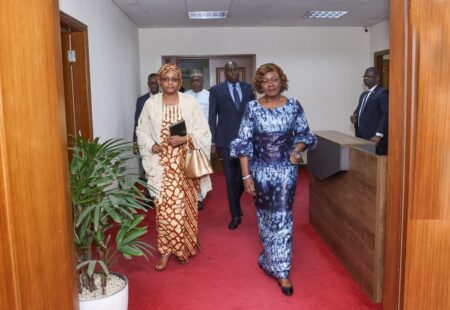
The office of the Minister of State, Minister of Foreign Affairs, Kaba Nialé, formally summoned the ambassador of the Republic of Niger in Côte d’Ivoire on January 30, 2026. Through this official step, Abidjan expresses its “strong indignation” and rejects the accusations of involvement in the assault on Niamey airport, marking a clear break with Niger’s allegations.
The diplomatic climate between Côte d’Ivoire and Niger has sharply deteriorated following a major terrorist attack. During the night of January 28 to 29, 2026, the 101st air base of Niamey’s Diori Hamani International Airport (Niger) was the target of a large-scale assault. Before the act was officially claimed by the Islamic State (IS) through its propaganda organ Amaq, Nigerien authorities quickly shifted the responsibility towards a political and regional dimension.
During a field visit on Thursday, January 29, General Abdourahamane Tiani, head of the Nigerien junta, made unusually strong statements towards several heads of state. While praising the bravery of his troops, he specifically named Emmanuel Macron (of France), Patrice Talon (of neighboring Benin), and Alassane Ouattara (of Côte d’Ivoire) as the “sponsors” of the mercenaries. In a warlike rhetoric, the general issued an explicit warning: “we have listened to them bark enough and they are also preparing to listen to us roar”.
Faced with these deemed outrageous statements, the Ivorian government immediately reacted. This new tension between Abidjan and Niamey illustrates the persistent fragility of relations within the sub-region. Despite the documented jihadist claim, the political instrumentalization of this security incident by Niger further complicates the dialogue between the junta and the ECOWAS institutions. As each side stands firm on its positions, the future of bilateral cooperation seems more uncertain than ever, casting a shadow of increased diplomatic isolation for the Sahel.

