



By Christine Holzbauer, special envoy to Conakry
With the presidential election on December 28, 2025, Guinea finds itself at a new crossroads in its history. Four years after the military coup that overthrew President Alpha Condé, General Mamadi Doumbouya swaps his military uniform for a candidate’s suit, with the ambition of turning the transition period into a seven-year term.
As an independent candidate, Mamadi Doumbouya, 41 years old, is running under the banner “Building Together.” This former Foreign Legion officer, married to a French woman, is the strong but discreet man of the transitional regime he has led since the coup against Alpha Condé on September 21, 2021. According to his campaign director and spokesperson, Prime Minister Bah Oury, the general aims for continuity, even evoking Sékou Touré, Guinea’s first president who stood up to General De Gaulle by introducing the Guinean franc and an ambitious plan for youth employment and the mining sector.
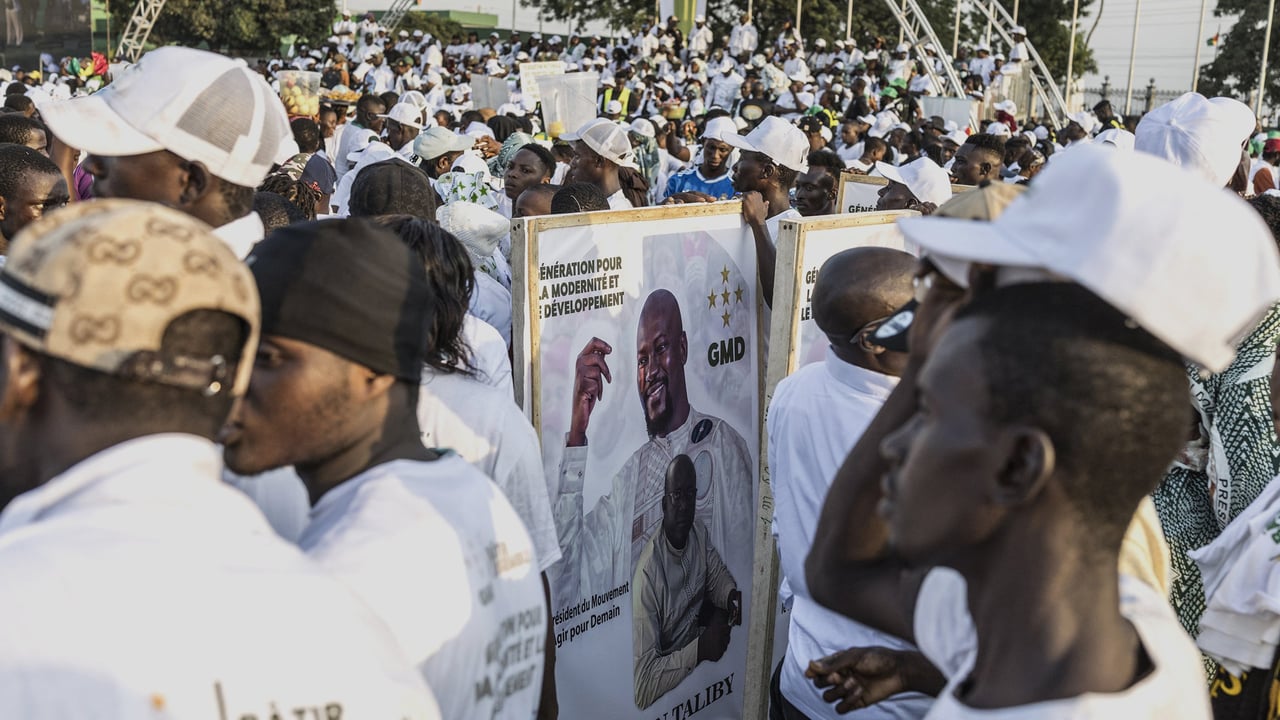
In addition to the election posters displaying the portraits of the nine candidates, references to the “Simandou 2040” program, with its gigantic iron ore deposit inaugurated with great fanfare a few weeks ago, are everywhere in the capital. Thanks to a change in the constitution, the coup leader general managed to impose his candidacy for the Guinean presidential election on December 28. For a month, this native of Kankan mobilized supporters who converged on the capital on December 25 for the final rallies. With a single motto: to convince voters on Sunday that he is the only possible future for Guinea, even if it means enrolling – willingly or by force – the press and the opposition in his ambitious national development plan for the country.
The “refoundation contract”
Reading his program, one cannot help but be convinced of his determination to transform Guinea’s natural resources into a lever for inclusive development. With three main axes to achieve this: the Simandou project, first and foremost, which aims to be the “economic lung” to propel Guinea by 2040. A flagship of his electoral campaign, the exploitation of the world’s largest iron ore deposit began at the end of 2025. If elected, the transitional president – which was not in doubt on the eve of the election – has promised to use mining revenues to finance his national development plan aiming to create tens of thousands of jobs.
This program notably emphasizes the obligation for mining companies to process raw materials on site (such as bauxite into alumina) in order to capture more added value. In addition to this requirement for increased sovereignty through local processing, he adds modernization and digitalization to bring more transparency to business. Building on his reforms during the transition, he also plans to generalize e-procurement (online public procurement) and the digitization of administration to fight corruption and clean up public finances.
Direct beneficiaries of the mining windfall through a development fund, agriculture and tourism are the two key sectors to accelerate the transition towards a “green economy,” provided there is massive investment in rural infrastructure to reduce food dependency. In the candidate’s program, they are designed as the pillars of diversification to avoid the “Dutch disease” (exclusive dependence on mining). As the country’s largest employer (70% of the active population), agriculture will be mechanized with the distribution of tractors and certified seeds, as well as hydro-agricultural developments in the country’s 33 prefectures. Tourism remains the most “new” sector of the program, with a focus on island tourism and heritage protection.
Between “economic mirage” and “political exclusion”
While the junta’s infrastructure achievements appeal to some of the youth, the opposition and several independent analysts point out major flaws, starting with an electoral competition deemed unfair. The main opposition leaders, such as Cellou Dalein Diallo and Sidya Touré, are in exile, while other candidates, such as Lansana Kouyaté, have been disqualified for technical reasons. The opposition denounces a tailor-made election where Mamadi Doumbouya is both judge (through transitional institutions) and party.
Although the Simandou mine is presented as a miracle solution, independent sources note that the completion of infrastructure works has paradoxically led to thousands of layoffs of local workers. Economist and candidate Abdoulaye Yéro Baldé criticizes opaque management of mining revenues and denounces a “militarization of the economy” that, according to him, scares off some foreign investors outside the extractive sector.
Evaluations by the PEFA (Public Expenditure and Financial Accountability) taken up by the French Development Agency and Expertise France highlight that, despite a 7.5% GDP growth in 2025, mainly driven by mining, to reach over 11% in 2027-2030, budget discipline remains fragile. The shift from a 5 to 7-year term (via the new constitution) also raises fears of authoritarian drifts that could lead to long-term political instability, detrimental to the country’s financial rating.
A vote without surprises
Although General Doumbouya is the clear favorite against eight lesser-known opponents with less means to campaign, Sunday’s vote is expected to be tense. According to many analysts, the major issue remains the voter turnout, as the opposition has called for a boycott in some strongholds. Restrictions on civil liberties and the press during the campaign also raise fears of post-election disputes if the results are not deemed transparent by observers, including those from ECOWAS and the UN.
A victory for Doumbouya in the first round is the most likely scenario. This would mark the beginning of a new era where Guinea will have to prove that it can translate its mining successes into real poverty reduction. The viability of President Doumbouya’s program will also depend on his ability to reassure international partners about a return to genuine constitutional order, beyond mere electoral formality. The “Building Together” program is a long-term bet. But as many analysts and opponents point out, economic success cannot bypass social peace. For one of them, the transition’s bet is clear: “One cannot ‘make love’ to Guinea while gagging its children. Development without freedom is a golden prison that always ends up collapsing!”

