



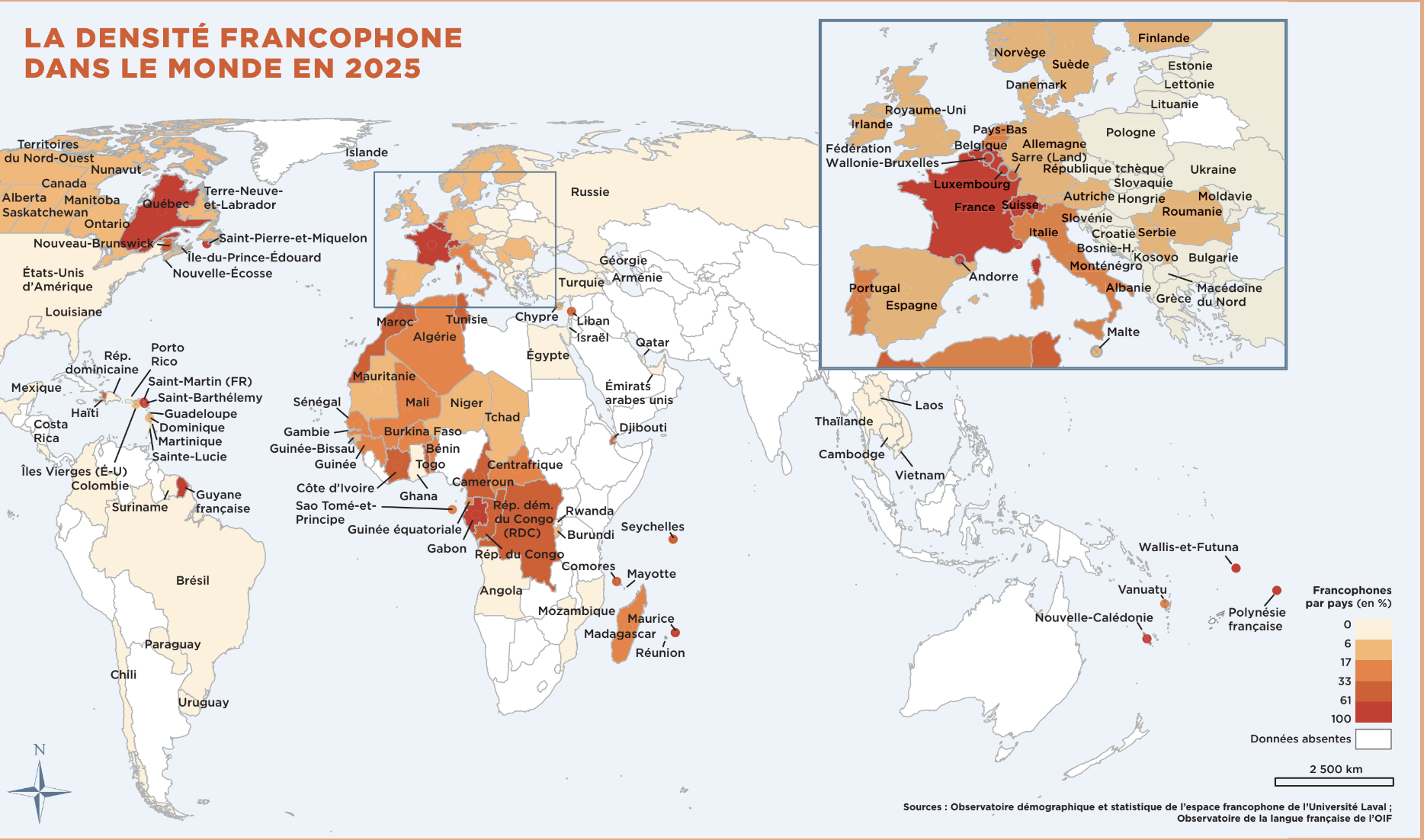
There are now 396 million French speakers in the world, and 65% of them live in Africa. These figures come from the 6th edition of the report by the Observatory of the French Language of the International Organization of La Francophonie (OIF) published on the eve of March 20, International Francophonie Day. The document, the result of rigorous scientific work, estimates that French is now the 4th most spoken language in the world, up from 5th place in 2022. The progression is remarkable compared to 2010 when French speakers did not exceed 220 million. From 274 million in 2014, 300 million in 2019, 321 million in 2022, and 396 million in 2026, French speakers have increased, challenging the narrative of a decline in French.
This dynamic is mainly fueled by African demographic growth, the expansion of educational systems, and urbanization, according to the report. By 2050, the world could have 590 million potential speakers, with nine out of ten French learners being African. At that time, the world will have 220 million young French speakers. In the meantime, French is presented by the OIF as the 2nd most taught language in the world, ahead of Spanish, with over 170 million learners of and in French. It is also the official language of 36 countries.
In 2024, more than 170 million students in 36 countries around the world have received education in French or learned French in institutional settings, in contexts of French as a first language (FLM) or French as a second language (FLS). The number of learners of French as a foreign language (FLE) in the world is estimated at around 51 million learners.
Now the focus is on correcting the paradoxes. French is growing in demographics but remains underrepresented in digital infrastructures, with only 4% of content published on the Internet, compared to 24% for English, even though it is now the 4th language on the Internet. Institutionally, the OIF reminds that French is one of the two working languages of the UN Secretariat and a major language of multilateral diplomacy. It also represents a concrete economic lever through access to employment, academic mobility, and participation in business networks. Furthermore, French is the 3rd language of global business, associated with 20% of world trade, with a growing role in African legal and business ecosystems, particularly around OHADA and regional integration dynamics.
The 2026 report specifies that the gap between the 321 million in 2022 and the 396 million in 2026 does not reflect a sudden explosion in the number of speakers. It is largely explained by an evolution in the counting method, with the inclusion of children aged 6 to 9 enrolled in French-speaking countries where French is an official, co-official, or main language of instruction. The old approach focused on people aged 10 and over who could communicate in French, totaling 348 million; the new method results in 396 million. The report also adds that this estimate remains cautious, as some groups of speakers are not yet fully taken into account.

