



In the vast, arid expanse of Mauritania, where water is scarce and ecosystems are fragile, Kinross’ Tasiast mine has sought to embed environmental responsibility into every aspect of its operations. The mine has gone beyond merely complying with environmental regulations and has instead integrated sustainability into its culture from water management and energy sourcing to waste handling and land restoration.
This approach reflects a broader transformation in Africa’s mining sector, where environmental, social, and governance (ESG) standards are no longer optional. Governments are tightening compliance frameworks, investors are demanding credible disclosure, and communities are increasingly vocal about environmental impacts. Against this backdrop, operations such as Tasiast are investing significantly to ensure sustainability is at the forefront of their business.
Integrating environmental standards into daily operations
Tasiast’s environmental system combines Mauritanian legislation with international frameworks such as ISO 14001 and the International Cyanide Management Code (ICMC), for which the mine has been certified since 2017 and was recertified in 2023. Compliance is backed by continuous monitoring and transparent reporting to the Ministries of Environment and Mines. Seven air-quality stations measure dust and emissions, while water usage and stormwater management are audited to ensure strict adherence to standards.
Almost all of Tasiast’s water use approximately 99% comes from brackish or saline sources, thereby preserving scarce freshwater resources for the surrounding communities. Tasiast’s operations rely entirely on non-potable saline water drawn from company-drilled wells. This water is treated for domestic use and reused within a closed-loop system that recycles processed water rather than discharging it into the environment.
This approach is crucial in a context where sustainable water management is of national importance. Mauritania’s arid zones are facing increasing pressure from climate variability and population growth, and industrial users are expected to operate with minimal impact on freshwater resources. Tasiast’s system demonstrates how large-scale industrial activity can function in a closed cycle, aligning operational efficiency with environmental prudence.
Expanding clean energy and climate action
Energy is another area where Tasiast has sought to lessen its environmental footprint. In March 2024, the mine’s US$55 million solar power plant became fully operational. Comprising roughly 80,000 solar panels, the facility produces 34 megawatts of power enough to meet almost a fifth of the mine’s electricity needs. During its first year, it generated over 50,000 megawatt-hours of clean electricity equivalent to just over 3% of Mauritania’s annual electricity production in 2023 saving more than 20 million liters of fuel since 2024.
The plant contributes to Mauritania’s broader ambitions to harness solar potential for national energy diversification. In a country with some of the world’s highest solar irradiation rates, such private-sector investments demonstrate how renewable energy can reduce reliance on imported fuels while cutting emissions. Further investments, such as Mauritania’s first independent power contract, the US$300 million partnership with Dubai-based developer Iwa Green Energy to build a 220MW solar-wind power plant, will be key to achieving this transformation. President Ghazouani laid the project’s foundation stone on 25 December 2025, underscoring the state’s commitment to energy sovereignty.
Across Africa, mining operations are increasingly adopting similar models to cut emissions and lower costs. Egypt’s Sukari mine operates a 36 MW solar array with battery storage; Mali’s Fekola mine integrates a 30–36 MWp hybrid system; and South Africa’s South Deep mine runs a 50 MW grid-tied solar facility. Tasiast’s experience fits within this emerging pattern of mines investing in clean energy to sustainably power operations.
Beyond large-scale power generation, smaller operational shifts reinforce this transition. The introduction of eleven electric buses for employee transport saves over 14,000 liters of fuel annually, while optimized haul routes and larger-capacity trucks reduced diesel consumption by 4.3 million liters over 2023 and 2024—cutting the equivalent of over 11,000 tonnes of CO₂. Together, these measures illustrate how energy efficiency and innovation can translate environmental goals into tangible operational gains.
Restoring habitats
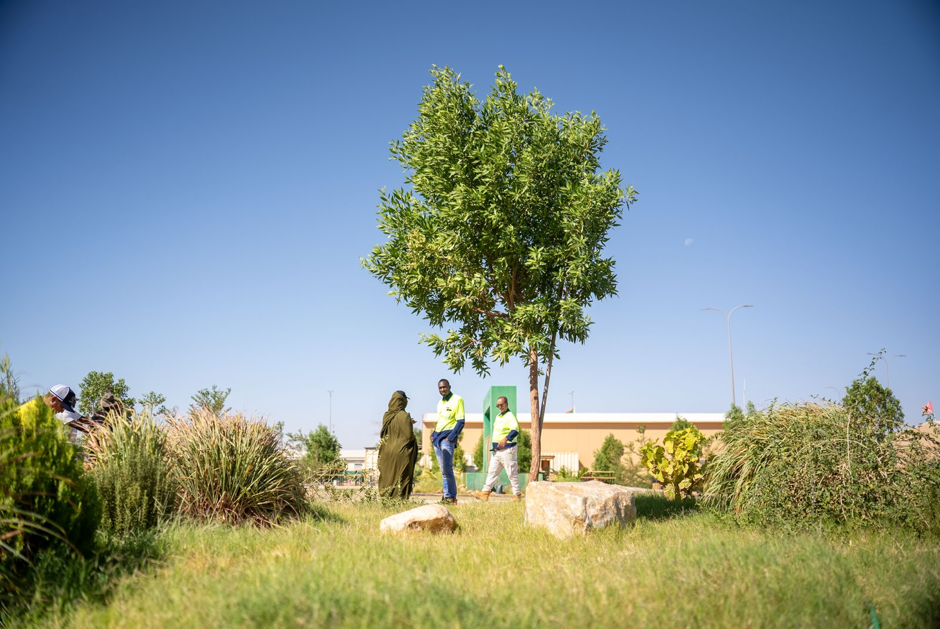
Through the Tasiast Green Project, launched in 2022, the company has been working to restore vegetation and promote biodiversity in areas affected by mining. By mid-2025, over 1,600 native trees had been planted across 5 hectares, with plans to revegetate an additional 12 hectares. These reforestation efforts are not only cosmetic. In a desert environment, native vegetation helps stabilize soil, combat erosion, and create microhabitats that support local fauna.
Environmental responsibility at Tasiast also extends beyond the mine’s perimeter. Since 2019, Tasiast has maintained a partnership with the Parc National du Banc d’Arguin (PNBA), a unique UNESCO World Heritage Site and 12,000-square-kilometer nature reserve renowned for its migratory bird habitat. The partnership focuses on protecting the park’s universal value through environmental monitoring, biodiversity conservation and support for traditional communities. To this end, Tasiast has re-commissioned three desalination units in the PNBA, benefiting over 1,200 residents. In a separate project, the company is also building a new desalination unit in the park.
Safe waste and chemical management
The responsible handling of waste and chemicals remains another key pillar of Tasiast’s environmental strategy. The mine adheres to the ICMC’s strict protocols governing cyanide transport, storage, and use. All processing occurs in a closed circuit designed to prevent environmental discharge. Packaging and residual materials are destroyed in controlled incineration facilities that meet national and international safety standards.
Beyond this, Tasiast has implemented a recycling program for ferrous and non-ferrous materials, allowing a substantial share of industrial waste to be recovered and reused. This circular approach mirrors emerging global best practices and aligns with Mauritania’s evolving environmental policy, which increasingly prioritizes recycling and material recovery as part of sustainable industrial development.
Towards a Mauritanian model of responsible mining
In an era of mounting scrutiny of extractive industries, Tasiast’s approach illustrates how environmental considerations can be fully integrated into mining operations. The company’s efforts to reduce emissions, manage water sustainably, and promote biodiversity restoration demonstrate that responsible mining in Mauritania extends beyond regulatory compliance.
As African governments and investors accelerate the shift toward greener industrialization, Tasiast’s model offers a tangible blueprint—showing how sustainability can strengthen, rather than constrain, the future of mining both in Mauritania and across the continent.

