



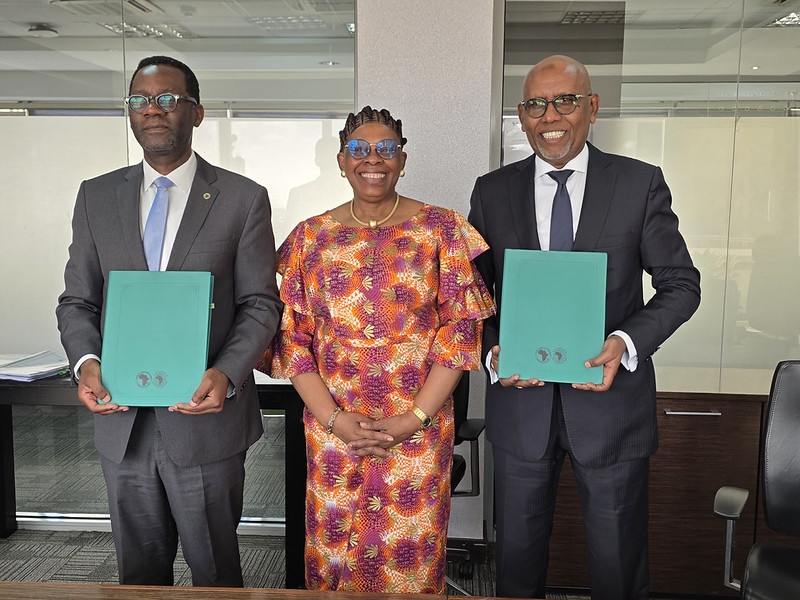
The African Development Bank and Djibouti have signed agreements for $80 million to support infrastructure and resilience.
The African Development Bank Group and the government of Djibouti signed four agreements on February 5 for $80 million in financing to support the implementation of key projects in road infrastructure, urban development, and climate-resilient agriculture.
Djibouti’s Minister of Economy and Finance, Ilyas Moussa Dawaleh, who is also the Bank’s governor, and Alex Mubiru, the institution’s Director General for the East Africa region, signed on behalf of their respective entities. The Bank’s Vice President for Regional Development, Integration, and Service Delivery, Mrs. Nnenna Nwabufo, also attended the signing.
Under the first agreement, a $22 million grant from the African Development Fund (ADF) – the Bank Group’s concessional window – will finance the rehabilitation of seven kilometers of urban roads in the city of Djibouti. This is phase I of the Integrated Urban Infrastructure and Climate Change Adaptation Project.
The second financing is a $30 million grant from the ADF for the rehabilitation of a key road axis for regional trade, as part of the Djibouti-Ethiopia-South Sudan Regional Transport Corridor project. Strengthening this corridor is expected to boost cross-border trade, reduce logistical costs, and improve the movement of people and goods in the Horn of Africa.
Two additional agreements – a $14 million grant and a $14 million loan from the Green Climate Fund – were signed as part of the Building Resilience around Food and Livelihoods (BREFOL) program in the Horn of Africa. This program aims to improve food security, enhance climate resilience, and support sustainable livelihoods through climate-smart agriculture, more robust pastoral and agro-pastoral systems, and economic opportunities for women and youth.
“These agreements reflect our vision of a modern and resilient Djibouti,” Minister Dawaleh said. “By investing in our roads and agriculture, we are not just building infrastructure. We are securing the future of our most vulnerable communities.”
Director General Mubiru emphasized: “The agreements we are signing today reaffirm our commitment to supporting the government’s development priorities, including Djibouti Vision 2035 and the ongoing National Development Plan 2025-2030.”
These commitments reflect a significant expansion of the Bank’s portfolio in Djibouti, which has increased from around $100 million at the beginning of the Djibouti Country Strategy 2023-2027 to $221 million after two years of implementation.

