



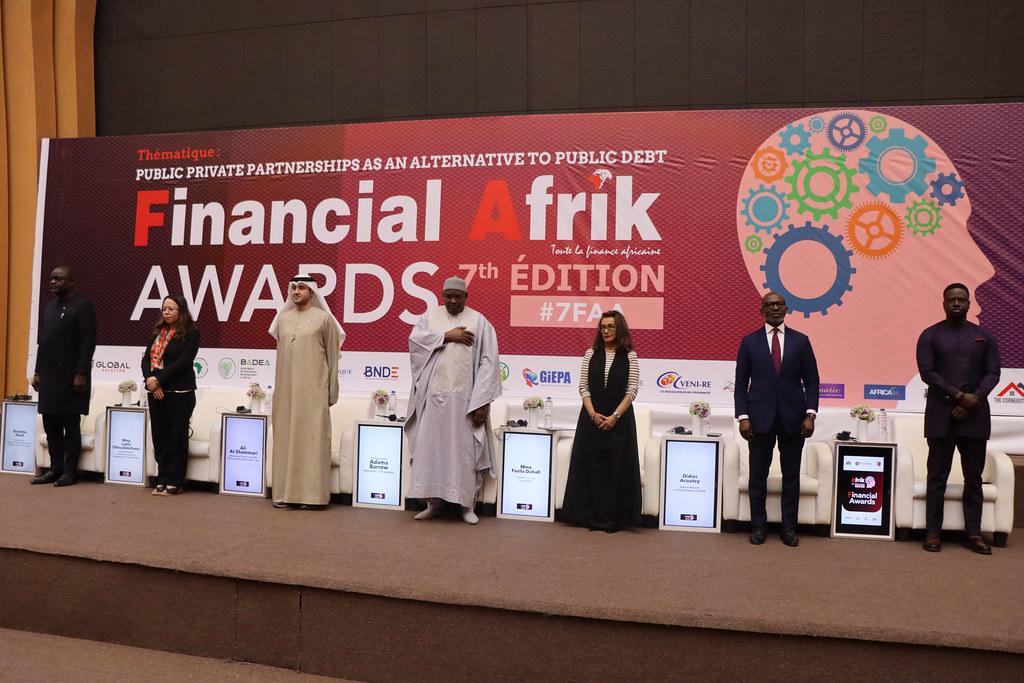
Inaugurated by H.E. President Adama Barrow, this 7th edition of the Financial Afrik Awards, held in Banjul on January 22 and 23, brought together 400 participants from Africa, Europe, and North America. Like the previous edition in Abidjan, the focus was on the partnership between Africa and the Arab world, with the presentation of no less than 29 investment opportunities covering Gambia, Senegal, Sierra Leone, Gabon, Guinea, and Burkina Faso. The heart of the discussions revolved around Public-Private Partnerships (PPP) in a context marked by over-indebtedness, shrinking budget margins, rising interest rates, and the limitation of sovereign guarantees by international financial institutions.
By Christine Holzbauer, special envoy to Banjul
By hosting this 7th edition, Gambia offered valuable lessons through its own economic ambitions and reforms. Officially opened by President Adama Barrow, this annual gathering of economic, financial, and institutional decision-makers from the continent once again established itself as a major platform for strategic reflection and high-level networking around Africa’s major economic transformations.
In his inaugural speech, President Barrow – a former businessman who oversaw the increase in Gambia’s electricity coverage from 30% to 80% – described private financing as a “survival necessity” in a volatile global economy. “The theme of this year’s forum is both timely and highly relevant. Across the continent, governments are facing increased pressure to meet development aspirations while preserving macroeconomic stability. In this context, public-private partnerships, blended finance, and innovative investment structures are no longer optional: they are essential pillars of sustainable development.”
President Barrow also issued a direct challenge to the financial sector: “We invite your banks! Without the mobilization of banks and their ability to finance the future, vital infrastructure projects – crucial for growth and regional integration – will remain mere intentions.” Recalling his first meeting with the President of the African Development Bank (AfDB), Sidi Ould Tah, he summarized his vision in three words: “Infrastructure, infrastructure, and more infrastructure!” The forum also reaffirmed that Gambia is a “safe and peaceful” country, “open for business,” and “action-oriented” in the energy, digital, agriculture, tourism, real estate, and employment sectors.
The “strategic urgency” of infrastructure
The discussions began with the Trans-Gambian Corridor Special Economic Zone (TGC-SEZ), examining how transport corridors and Special Economic Zones (SEZs) can serve as powerful levers for trade facilitation and logistics through PPPs. The panel included Hamey B. Jawara (GIEPA), Njundu Fatty (GCCI), Pierre Goudiaby Atepa (ATEPA Group), Alagie Sanyang (The Cornerstone Group), and Mirco Martins (Angola).
The next panel explored how PPPs can mobilize private sector capital and expertise to accelerate project delivery and modernize public management, while avoiding excessive burden on state balance sheets. This debate brought together the Gambian Minister of Finance, Seedy K.M Keita, his Sierra Leonean counterpart Ahmed Sheku Fantamadi Bangura, bankers such as Ibrahima Diouf (BOAD) and Mamadou Faye (BNDE Senegal), as well as experts like Khady Evelyne Denise Ndiaye (UEMOA), Ebrima Sawaneh (ARISE II), Amadou Thiam, and Mohamed H’Midouche (IACG).
The latter recalled his time as the AfDB’s resident representative in the region, describing the financing of the Senegambia Bridge as a “historic project that fundamentally reshaped mobility on the Dakar-Banjul corridor.” Successful PPP examples in Africa are numerous: highways and ports in Morocco, energy in South Africa, urban infrastructure in Côte d’Ivoire, and the asset recycling of the Senegambia Bridge by Africa50. These successes demonstrate that well-structured PPPs are instruments of sovereignty and fiscal efficiency. For the panelists, the challenge now is to “industrialize” these models by strengthening local expertise, attracting pension funds and sovereign wealth funds, and professionalizing national PPP units.
Strengthening the Afro-Arab axis
A notable advancement of this edition was to highlight the “natural alliance” between Africa and the Arab world. With an Arab Coordination Group (GCA) managing nearly $400 billion and Gulf sovereign wealth funds exceeding $1 trillion, the forum aims to serve as a co-investment platform with the Alliance of African Multilateral Financial Institutions (AAMF / Africa Club).
According to Ibrahima Dia, CEO of Financial Afrik Awards, this partnership aims to “unlock complementarities and accelerate sustainable development in both regions.” With a population of 1.4 billion and a Continental Free Trade Area (AfCFTA), Africa is no longer just a financing destination but a “strategic partner for industrial, agricultural, and logistical value chains.”
Developing African champions
The forum highlighted 29 bankable investment opportunities in six countries. For Didier Acouetey (AfricSearch), tasked with developing the New African Financial Architecture (NAFA) at the AfDB, it is crucial to correct competition distortions: while foreign firms finance themselves at 2% or 3%, African companies must borrow at rates of 8% to 10%.
Mohamed H’Midouche emphasized regional trust: “Capital is naturally fearful; it goes where it feels safe.” Beyond high finance, including a remarkable roundtable on Sukuk (Islamic finance), the forum emphasized the role of human capital. Entrepreneur Thione Niang delivered a passionate plea for self-sufficiency: “Investing in youth is investing in Africa’s economic future. We must create our own champions.” Pierre Goudiaby Atepa added that the issue is not the lack of profitable projects, but that African states facilitate international connections.
From dialogue to impact
At the close of this 7th edition, during a gala dinner honoring the “100 personalities transforming Africa,” Banjul’s message was clear: Africa is moving from theory to impact, and from over-indebtedness to investment. This year’s laureates embody the “Banjul Consensus” on PPPs and regional integration.
As summarized by Adama Wade, director of Financial Afrik: “We cannot offer a bright future to Africa without addressing the fundamental issue of infrastructure.” As the host country, Gambia positioned itself as a “corridor country” for West African trade. The final word came from President Barrow: “When Africa invests in itself, the benefits are not only economic – they are transformative.”

