



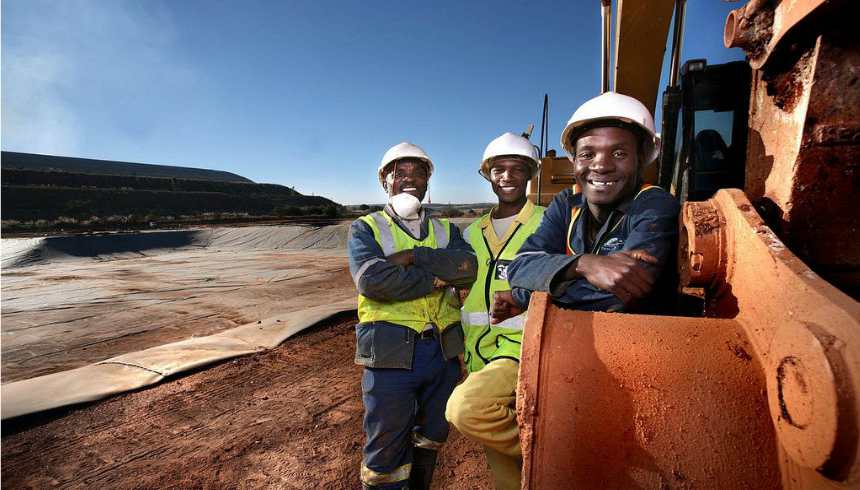
Closed at the end of November in Brazil, COP30 was an opportunity to call on the international community to support the green industrialization of the African continent. On site, several industrialists, including the giant CMOC, are already trying to approach their strategies for exploiting the continent’s resources in a more responsible manner, whose role in favor of the global energy transition is already essential. At the same time, structuring ecological projects are gradually emerging across the continent, giving it an increasingly central place in the green economy.
Africa remains the main victim of climate change
The figures alone summarize the impasse in which the African continent seems to be engaged: responsible for 4% of global greenhouse gas emissions – for 17% of its population – it is the most exposed to climate change. And this, at the human, biodiversity preservation, and socio-economic development levels. “Today, the link between climate and underdevelopment is no longer in doubt. Climate, rural exodus, migration, and instability in all its forms are interrelated,” emphasized Mahamoud Ali Youssouf, President of the African Union Commission (AU), last September.
This analysis is widely supported by global scientific research and, in particular, the World Meteorological Organization (WMO), which deplores, among other things, “extreme floods” and “multi-year droughts.” The WMO also states that “early investments will protect lives and economies.” For example, climate change would cost nearly $13 billion per year to African infrastructure, according to Ramesh Subramianiam, director of the Coalition for Disaster Resilient Infrastructure (CDRI).
In this context, an alarming observation is necessary: international financial commitments are struggling to keep up with the urgency of the situation. Only 2% of international green investments and less than 10% of funding for climate change adaptation are thus directed towards Africa, which faces high interest rates, chronic mismanagement, and overwhelming structural debt.
A context that has led African countries, as part of Africa Day at COP 30, to demand a reform of the “global financial architecture” to facilitate the mobilization of private capital towards the continent. An urgent transformation because the decline in investments towards Africa is worsening with the international decline in development aid mechanisms and the increasing instability of the continent. As a reminder, the COP29 in Baku had, as best as possible, agreed to allocate 300 billion in aid to the African continent. A movement whose realization is hindered by structural obstacles, according to the United Nations Economic Commission for Africa.
Increase in international pressure on African natural resources
And yet, according to many observers, the continent remains an essential player in the international energy transition with 60% of the world’s solar potential, 40% of the global potential in renewable energies, and subsoils richly endowed with essential resources for ecological transition, including cobalt, lithium, and manganese. These are minerals that are the international spearhead of the energy transition, particularly in highly strategic sectors such as electric mobility or renewable energies.
Among them, the DRC, which is at the heart of this transition, gathers 62% of the world’s cobalt reserves and a significant share of coltan or lithium resources, under constant pressure from a growing international demand. The lithium market is boosted by demand for energy storage systems. Global demand for cobalt is expected to increase by 11% in 2025, particularly in Europe (+22%), the United States (+16%), and China (+36%), according to data from the Cobalt Institute. As for copper, demand growth is expected to be 40% by 2040. International pressure on these resources raises serious environmental questions, particularly in the Congo, where extraction conditions intensify concerns in the areas of child labor, pollution, and fair distribution of water resources.
Under pressure from African countries, some industrialists are trying to adopt a more reasonable extraction approach. In the DRC, CMOC, one of the main operators in the country’s cobalt extraction, obtained the Copper Mark in June 2024 – a first for a mining actor on the continent. It is based on 33 criteria, combining governance, social, and environmental aspects, including biodiversity preservation and water or waste management. This dynamic is part of CMOC’s overall sustainability strategy, which, beyond more responsible extraction, invests notably in the Heshima hydroelectric project to provide clean and sustainable energy to its operations and local communities in the DRC. This strategy has allowed the group to maintain an AA rating from MSCI ESG for the third consecutive year.
At the African level, the Fair Cobalt Alliance aims to bring together industrialists, customers of extractive companies, and NGOs in a common approach. The FCA brings together, in addition to CMOC and its main competitor Glencore, giants like Google or Tesla, as well as NGOs such as Save the Children or The Center for Childs Rights and Business. Its objective? To promote fair, more responsible, and environmentally friendly value chains in the African environment.
Good news emerges
In recent years, the continent has also demonstrated its ability to launch major projects without the declining support of international donors. The Grand Ethiopian Renaissance Dam was thus commissioned in 2025 without foreign support. 40 million Africans have been able to access energy through off-grid solar systems in recent years, while Kenya has been able to guarantee two-thirds of its population access to electricity through geothermal energy.
The fight is far from won, and the investment deficit remains a structuring constraint for Africa. But the dual mobilization of governments and some industrialists tends to demonstrate that a path is possible.

