



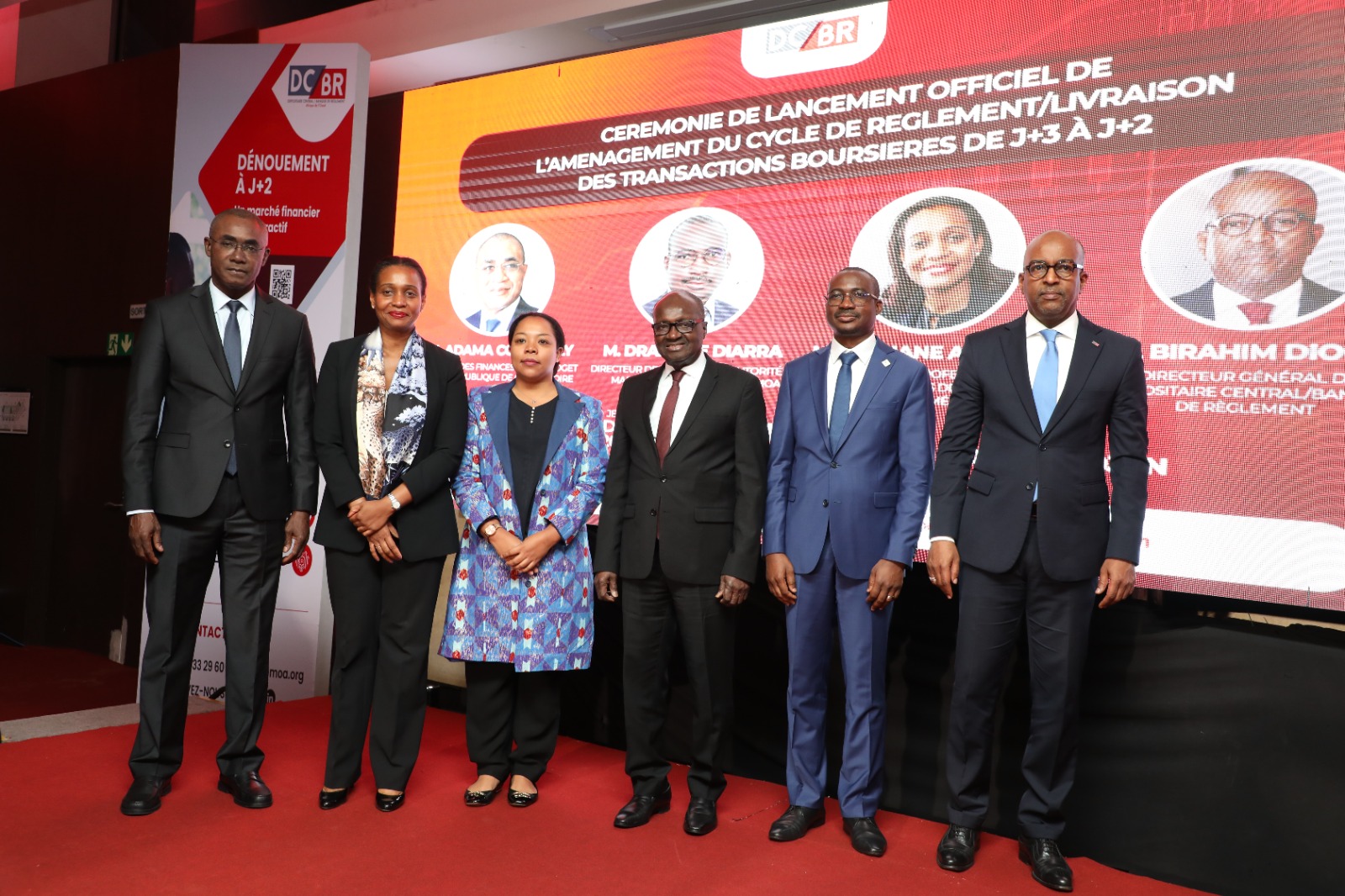
The regional financial market of the West African Economic and Monetary Union (WAEMU) reached a major milestone on Thursday, December 4 with the implementation of a new settlement/delivery cycle moving from T+3 to T+2. The official ceremony, held in Abidjan, brought together key players in the regional financial ecosystem. Led by the Central Securities Depository/Clearing Bank (DC/BR) and approved by the Financial Markets Authority of the WAEMU (AMF-WAEMU), this strategic reform aims to enhance liquidity, strengthen market attractiveness, and align the Union with the standards of major international financial centers.
Previously set at T+3, the regional securities delivery cycle now aligns with the international standard adopted by many financial markets in Europe, Asia, and North America. Nigeria also made the same transition a few days ago on November 28.
The central figure in this reform, Birahim Diouf, CEO of DC/BR, emphasized “a strategic evolution that marks a crucial step in improving services and enhancing our positioning at the continental and international levels.”
Since the establishment of the regional market in 1998, the settlement-delivery cycle has gradually been reduced: initially at T+7, it moved to T+3 in 2007 thanks to the introduction of the Real Time Gross Settlement (RTGS) system by the BCEAO.
Eliane Alangba, the representative of the SGI, speaking at the official launch, praised this progress as a logical continuation of recent structural reforms: “The official transition of the settlement-delivery cycle from T+3 to T+2 is a major step forward for the efficiency of our system.”
She highlighted several important milestones: the transition from fixing to continuous trading in 2013, the creation of new compartments at the BRVM in 2021, significant digital progress with online trading (2018) and Digi-APE developed by DC/BR, and the strengthening of the regulatory framework to increase surveillance and investor protection.
“We are delighted with this progress which brings real added value to our market, promotes better liquidity, and paves the way for increased diversification of the investor base,” she added.
The adoption of T+2 is expected to enhance the attractiveness of the BRVM among institutional investors, especially international ones.
However, it requires faster execution of transaction confirmations and strengthened control of operations by SGIs, banks, and depositories.
The BRVM now positions itself among the most advanced post-market infrastructures on the continent. Nairobi, Cairo, and Johannesburg are also studying or preparing to shorten their settlement cycles.

