



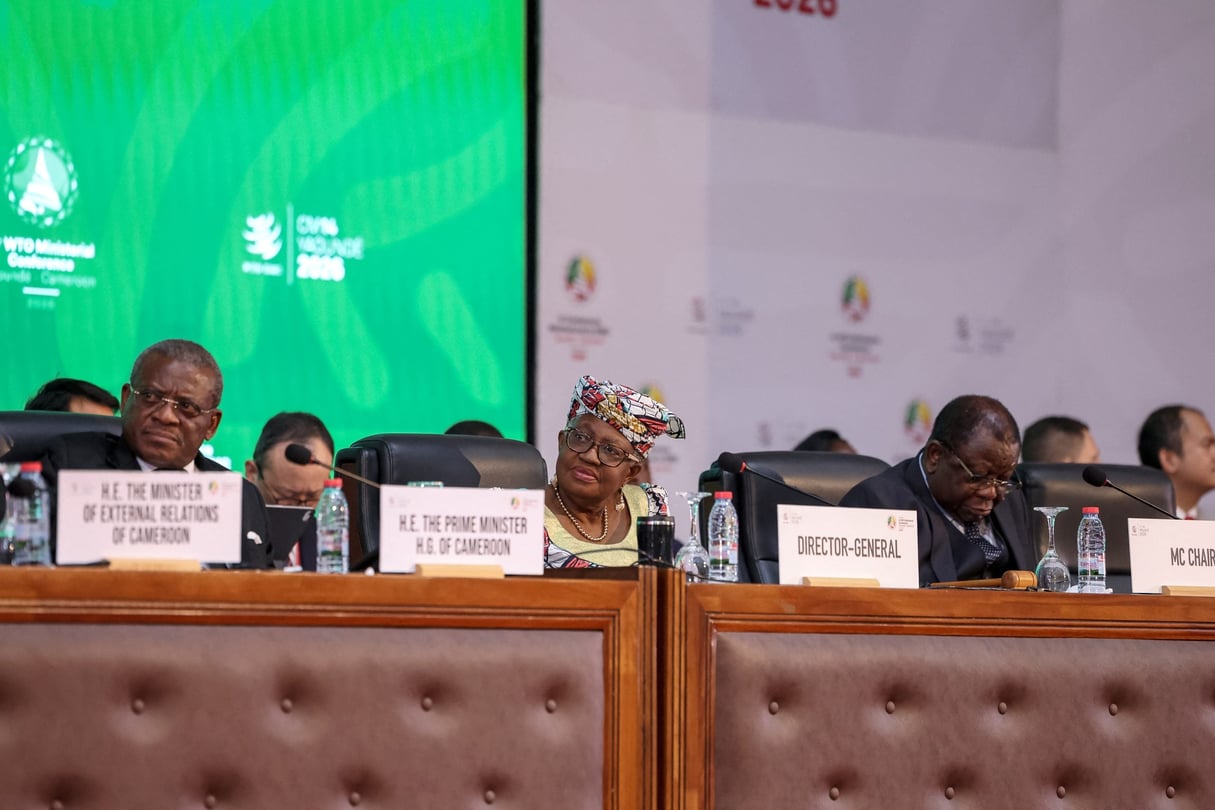
Yaoundé, March 30, 2026 — Gathered for four days in the Cameroonian political capital, the 166 members of the World Trade Organization concluded their 14th Ministerial Conference (MC14) in the night of March 29 to 30 with a minimalist but politically significant compromise. Originally scheduled for midday on March 29, the final agreement was only reached around midnight, after prolonged negotiations and last-minute dealings, illustrating the persistent fault lines within the multilateral trading system. In the absence of a comprehensive agreement, ministers validated several operational decisions and, most importantly, last-minute consolidation of momentum around the Investment Facilitation for Development (IFD) Agreement, now supported by 129 members, representing more than three quarters of the organization.
In a context of trade fragmentation and the rise of unilateral logic, Director-General Ngozi Okonjo-Iweala hailed “a new way of working” within the WTO, marked by more flexibility and a pragmatic approach to negotiations. The conference president, Cameroonian Minister of Trade Luc Magloire Mbarga Atangana, acknowledged that “time was lacking” to conclude several key issues, including e-commerce and the renewal of the moratorium on customs duties applied to electronic transmissions — a crucial mechanism whose imminent expiration poses a direct risk to global digital flows.
The main achievement of MC14 lies in the political consolidation of the IFD Agreement. Out of the 166 WTO members, 165 supported its integration into the organization’s legal framework during a dedicated ministerial session — an unprecedented near-consensus. The lifting of Turkey’s opposition, greeted with a standing ovation, marks a symbolic turning point. However, the lack of formal consensus still prevents its official integration as a plurilateral agreement of the “Annex 4” type.
The IFD agreement now aggregates 129 parties, including 92 developing countries, 32 African countries, and 28 least developed countries. Its economic potential is far from marginal: according to estimates presented in Yaoundé, its implementation could lead to an increase of at least 9.1% in global foreign direct investment (FDI) flows and a gain of nearly 1% of global GDP over a decade. For African economies, where FDI represents a critical lever for structural transformation, the stakes are significant.
Beyond the numbers, the financial architecture accompanying this agreement is taking shape. The European Union, through the European Investment Bank, announced an initial envelope of 300 million euros, with a potential leverage effect close to one billion euros. China added 1.59 million dollars to the International Trade Centre to finance technical assistance, while the UK mobilized 750,000 pounds for the World Bank’s C-JET fund. To date, 27 needs assessments are underway or completed in developing countries, a prerequisite for the operationalization of the agreement.
A real advance, but still insufficient
Despite these advances, MC14 leaves several key issues unresolved. Negotiations on fisheries subsidies — essential to regulate practices contributing to overfishing — are deferred to the next Ministerial Conference (MC15), with the aim of achieving comprehensive disciplines in line with the existing agreement’s Article 8. On e-commerce, divergences persist, especially between advanced economies, in favor of renewing the moratorium, and several Southern countries that see it as a loss of customs revenue estimated at several billion dollars annually.
The same unfinished logic applies to WTO reform. While a draft ministerial declaration on the institution’s modernization has emerged, it remains to be finalized in Geneva, as do the texts related to non-violation complaints under the TRIPS Agreement and the package in favor of least developed countries (LDCs). The Director-General thus refers to an embryonic “Yaoundé package,” the completion of which could be a strategic turning point for an organization weakened since the stagnation of the Doha Round.
In practice, MC14 confirms a profound transformation of commercial multilateralism. In the absence of global consensus, the WTO is moving towards a variable geometry, where plurilateral agreements — like the IFD — become the main drivers of progress. This trajectory is embraced by a majority of members, but raises questions about the system’s coherence and the risk of normative fragmentation.
In closing the proceedings, Ngozi Okonjo-Iweala emphasized the urgency of seizing the opportunity: “We are very close to a significant package of agreements. We must not leave it on the table.” A statement that sums up the real state of commercial multilateralism: a system still alive, but forced to innovate under pressure to avoid obsolescence.

