



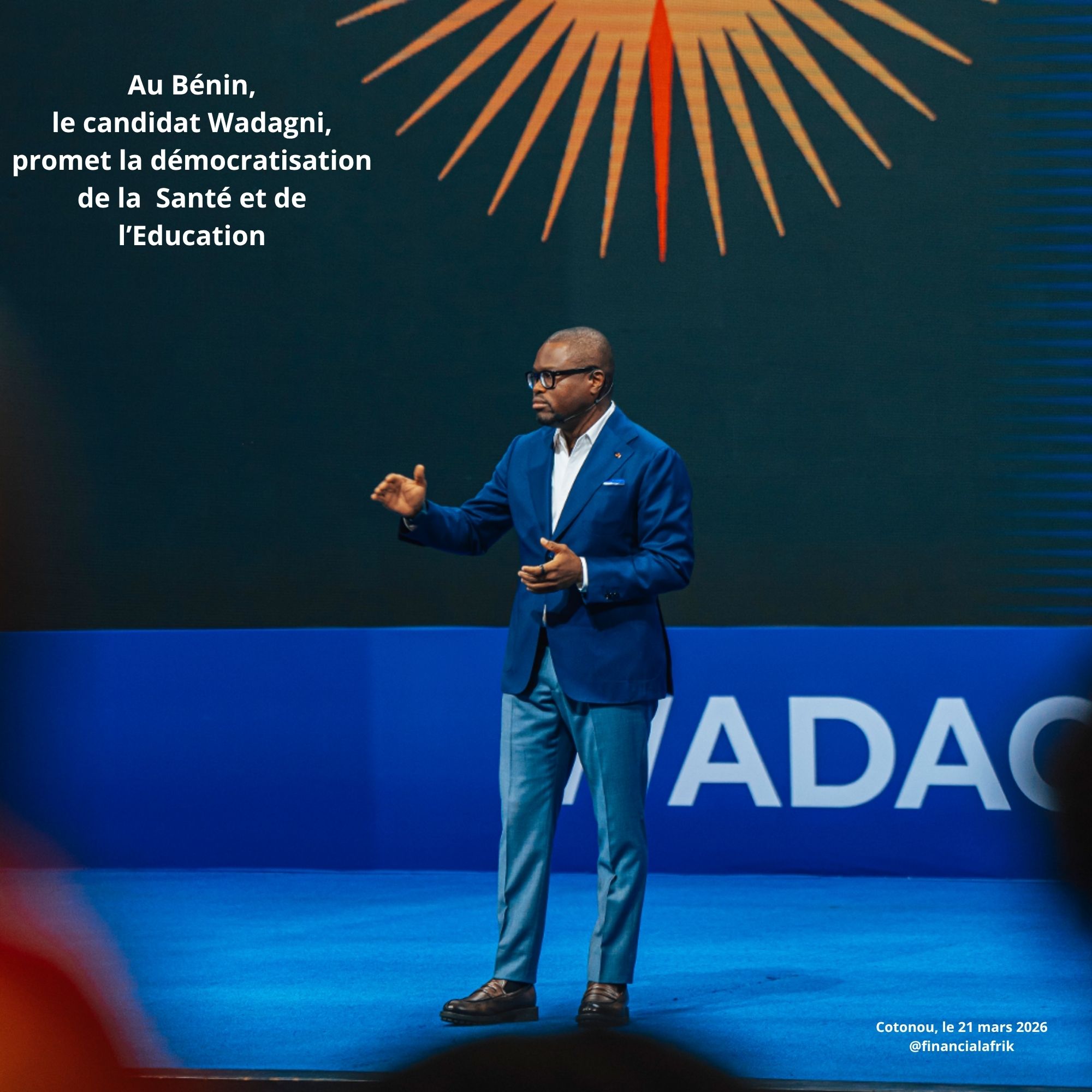
After a decade of reforms focused on macroeconomic consolidation, President Talon’s record now serves as a springboard for a new ambition. At the Palais des Congrès in Cotonou, candidate Wadagni unveiled on Saturday, March 21, during a keynote, a 2026-2033 program where the macroeconomic strength he himself built becomes the engine of an unprecedented social shield. His promise: to use the power of the modern state to develop territories and create opportunities for youth, under the banner “Further Together.”
In the West African political landscape, Benin has distinguished itself over the past decade with budgetary rigor and remarkable investments in infrastructure development and modernization. While these reforms have restored the country’s credibility, they have also sometimes fueled the feeling of “top-down” development, struggling to trickle down to the household level. It is precisely to this latent criticism that Romuald Wadagni’s program responds. As a former Minister of Economy and Finance for a decade, he embodies the proof that economic performance is not an end in itself, but an essential means to finance today’s social audacity.
The first pillar of this social pivot addresses health insecurity, a major concern for the population. After modernizing technical platforms (including CHIC), candidate Wadagni will establish a groundbreaking measure: the systematic coverage of life-threatening emergencies through a deferred payment system. As he stated during the presentation of his project: “Going further together is first and foremost to decree that human dignity is not a luxury, but a right.” The philosophy is clear: “You are treated first.” No life should be extinguished at the doors of a hospital for lack of immediate funds.
To complement this proximity system, the program provides for the deployment of a national social emergency service. Designed to intervene urgently, guide, and support citizens in situations of great precariousness, this service embodies the vision of a state that does not just wait in offices, but goes to meet the most vulnerable.
Aware that the rural world has sometimes felt overlooked by urban modernization, the Wadagni-Talata project proposes a historic agreement with those who feed the nation. For the first time in Benin, an agricultural retirement coupled with a provident fund (crop insurance) will be established. This structural measure aims to secure farmers’ incomes against climatic hazards and ensure that those who have worked the land all their lives never beg in their old age. At the same time, the use of the National Household Registry will provide targeted and precise emergency assistance to eradicate extreme poverty in rural areas.
The social pivot also plays out in schools. To combat school dropout linked to poverty, the candidate pledges to provide 100% of public primary schools across the country with school canteens. A guaranteed hot meal for every child is the assurance of better learning and real relief for families’ budgets.
Finally, to break the cycles of precariousness, free secondary education will be extended to all girls throughout Benin. A massive investment in female human capital, considered the most powerful lever for long-term social transformation.
In conclusion, Romuald Wadagni’s program offers a powerful synthesis. It does not deny the economic performance that has made Benin successful, but humanizes it. By proposing a unique social shield, from deferred payment of emergencies to agricultural retirement, Romuald Wadagni demonstrates that the true strength of a nation is measured by the protection it offers to its most vulnerable citizens.

