



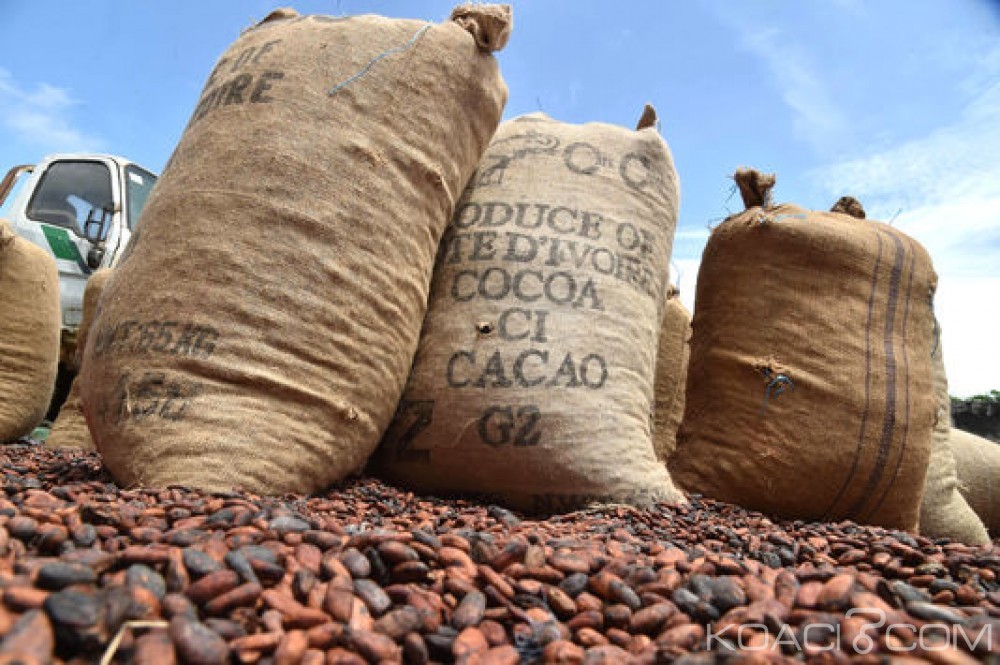
As the world’s leading cocoa producer with nearly 40% of the global supply, Ivory Coast is facing logistical tensions in the flow of its main campaign. Members of the coffee-cocoa agricultural interprofessional organization (OIA), gathered on March 19, 2025 in Abidjan, examined the current situation and challenges related to the evacuation of residual stocks. Out of the 100,000 tons initially inventoried in cooperative warehouses, the assessment remains partial: according to Doua Obedé, 3rd vice-president of the organization, approximately 37,774 tons have been removed to date, in addition to 13,000 tons currently being processed in ports. This assessment leaves a critical volume estimated between 55,000 and 60,000 tons still awaiting removal – a situation that crystallizes the concerns of cooperative presidents, whose storage capacities are reaching their limits.
At the same time, the transition from the main campaign to the intermediate campaign introduces a significant tariff adjustment for producers. The decrease in the purchase price from 2,800 to 1,200 CFA francs represents a notable economic adjustment. While farmers seem willing to accept this new rate for the small campaign, the priority issue remains the full payment of old stocks at the guaranteed price of 2,800 CFA francs. “The price of 1,200 francs is accepted and I believe that producers have already started selling the small campaign. We have no problem with that, but let’s ensure that producers can earn 2,800 francs on the residual stock of 100,000 tons so that the social climate remains peaceful,” said Mr. Doua.
The blockage of the operation seems to stem from a distortion between the forecast inventory and the actual execution of flows. The OIA points out an anomaly in the distribution of volumes: a significant part of the subsidized stock would have been captured by operators not initially listed as beneficiaries. Specific volumes – 15,000 tons directed towards Transcao and 30,000 tons towards an unidentified private operator – would have been diverted from the targeted cooperative channels. This dysfunction calls for an urgent reorientation of flows towards the actors initially identified by the Coffee-Cocoa Council, in order to restore the fairness of the government measure.
Facing this situation, the OIA favors an institutional approach rather than confrontation. The issue is now brought to the highest level of the State, with the involvement of the National Assembly, the Prime Minister’s Office, and the Presidency. The objective of this advocacy approach is to ensure a smooth flow of technical information to the executive, so that the 291 billion CFA francs (approximately 509 million dollars) mobilized by the State effectively reach their recipients. By relying on data from the Directorate of Domestic Marketing, the OIA hopes for a swift resolution that would allow cooperatives to free up their warehouses and improve the cash flow of the entire sector.

