



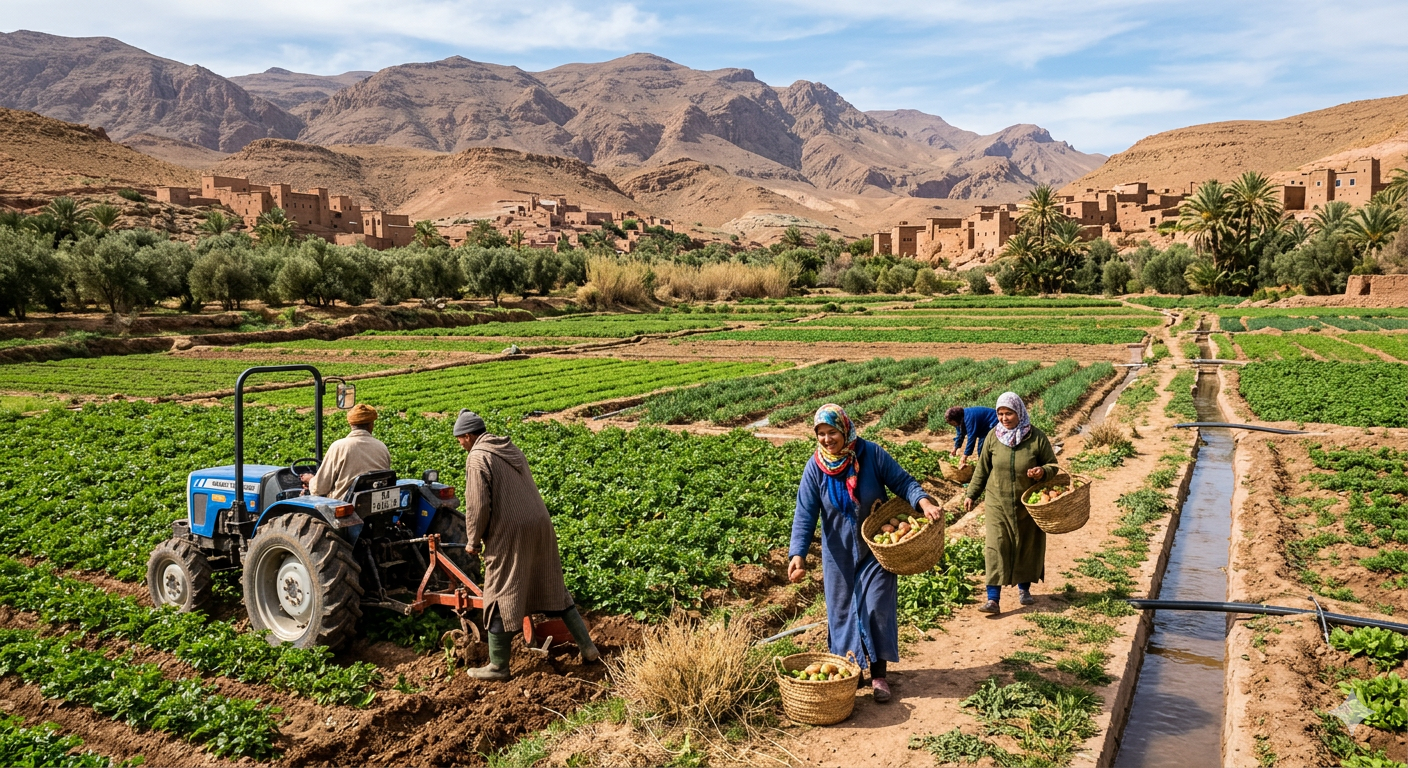
The national economy is set to validate a fifth consecutive year of recovery in 2026, driven by a synergy between the resilience of non-agricultural activities and a major acceleration of the primary sector. During the Government Council of March 12, 2026, the Prime Minister, Aziz Akhannouch, announced exceptional growth prospects for the agricultural sector, with value added expected to jump by 15%. This record performance positions agriculture as the central engine of the economic dynamics of the current year.
The main catalyst for this recovery lies in unprecedented rainfall. Between September 1, 2025, and March 11, 2026, the Kingdom recorded a total of 462 mm of precipitation, representing an increase of 56% compared to the thirty-year average and 134% compared to the previous campaign. Although local floods were reported in the North and West, the abundance of water affected most productive basins, notably the Saïss, Chaouia, and Doukkala, ensuring a strategic filling of reserves.
Technically, this rainfall translates into optimized yields for all sectors. The Minister of Agriculture, Ahmed El Bouari, emphasizes that the productivity of cereals, basic crops, and livestock directly benefit from these favorable conditions. These indicators make it possible to envisage a return of agricultural value added levels to the historical standards observed at the end of the Green Morocco Plan, thus consolidating the country’s food sovereignty in the face of past climatic hazards.
Finally, this dynamic goes beyond simple production to become a lever for macroeconomic stability. Despite localized impacts of weather on specific crops, the overall trend remains “promising”. The performance of the agricultural sector in 2026 is not limited to seasonal success but is part of a strategy to consolidate national growth, proving the resilience of Moroccan production chains in the face of environmental challenges.

