



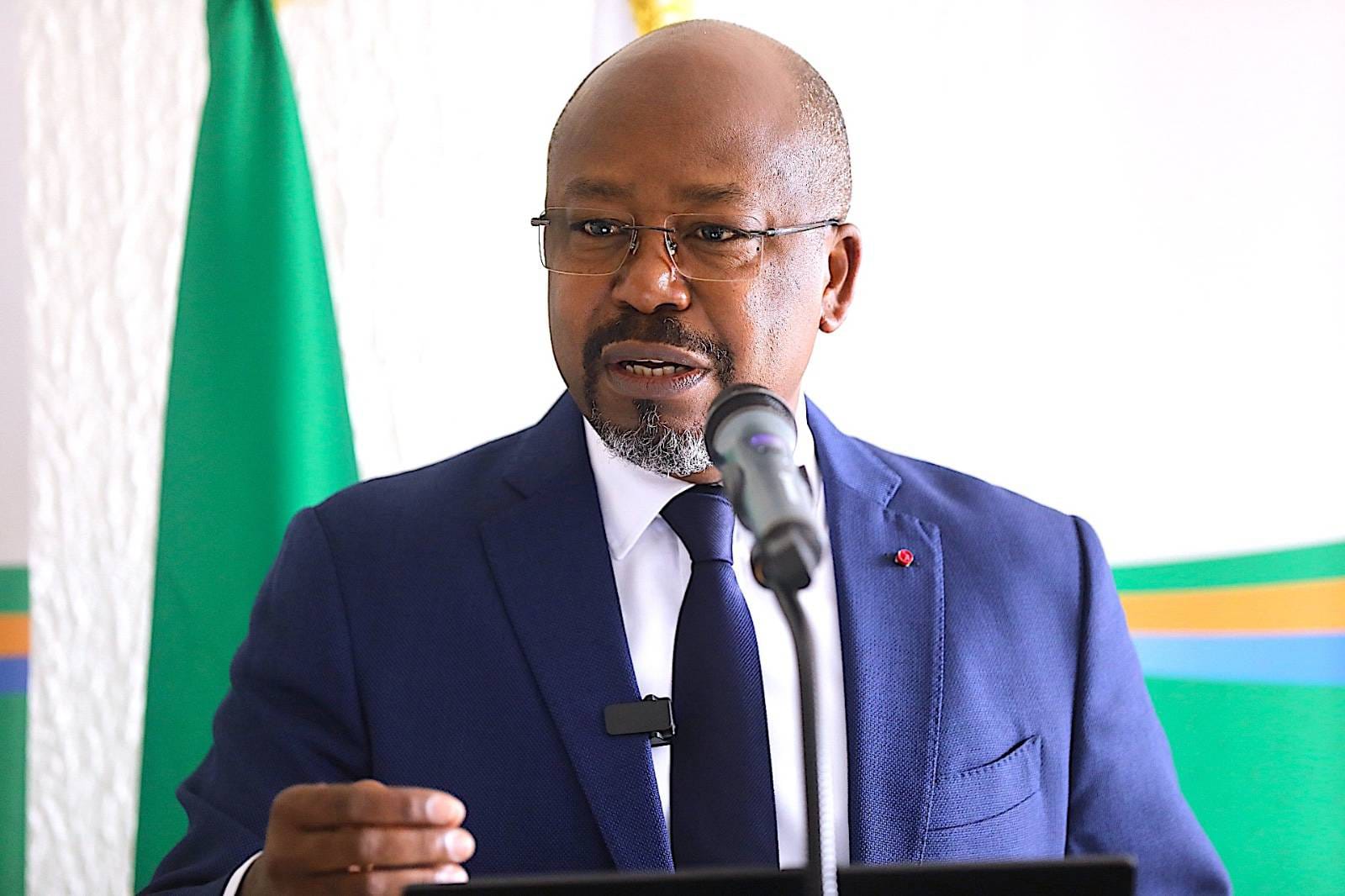
In this exclusive interview granted to Financial Afrik on February 12th, Alain-Claude Bilie-By-Nze, former Prime Minister of Gabon, provides a technical opinion on the trajectory of his country, Gabon, a member country of the Central African Economic and Monetary Community (CEMAC).
Interview by Ismael Sy, Casablanca.
In several of your public statements, you speak of a governance without direction in Gabon. What exactly do you mean by that?
When I speak of a governance without direction in Gabon, I am not making an abstract political judgment. I am describing an operational reality. A direction is not a slogan, nor a circumstantial speech. A direction is a clearly defined economic vision for 10 or 15 years, prioritized objectives, an execution schedule, and specific indicators to evaluate results. However, for too long, public decisions have been made without overall coherence: announced reforms that are then abandoned, frequent changes in direction, short-term decisions taking precedence over strategy. This instability creates uncertainty, and uncertainty is the enemy of investment, budget discipline, and citizen trust. Without a clear direction, the State navigates blindly, and society with it.
What, in your opinion, are the priority institutional reforms needed to truly break with the past?
Breaking with the past does not mean erasing history or denying achievements. It means correcting the structural weaknesses that have weakened the State for decades. True change will not come from a simple change in discourse or a reshuffling of faces, but from the strength of institutions. The priorities are clear. First, there must be a real rebalancing of powers to move away from excessive concentration that weakens the State in the long term. It is also essential to ensure the effective independence of the judiciary, a prerequisite for institutional credibility. The electoral process must be secure from start to finish to restore democratic confidence.
I also believe that budget discipline must be enshrined at the highest normative level, including constitutionally. Finally, clarifying public responsibilities and fighting impunity are essential. A State is not reformed through wishful thinking, but through stable rules applied to all without exception.
You place youth and employment at the heart of your project. What concrete measures do you propose to combat youth unemployment?
Youth is not a campaign theme; it is the core of the social contract. Youth unemployment in Gabon is not temporary, it is structural. Therefore, the responses must be as well. The first response is industrialization. The massive youth unemployment is a symptom of an economy too dependent on rents. As long as we mainly export raw materials, we will create few jobs. We need to transition to a local production and transformation economy.
The second lever is a profound reform of vocational training. There is currently a clear mismatch between the training offered and the needs of the labor market. Every major public or semi-public project must include a mandatory quota of local training and employment to create a direct link between investment and professional integration.
The third axis is massive support for youth entrepreneurship. The goal is to turn young people into value creators, not just seekers of public jobs. This requires access to financing, technical support, and an adapted regulatory environment. Finally, I advocate for a reorientation of public spending towards productive employment, as well as targeted social support for the most vulnerable youth, including a stabilization allowance. This is not about handouts, but about avoiding social marginalization and enabling sustainable integration.
How do you envision the redefinition of Gabon’s international relations, especially with its historical partners?
Sovereignty is not a slogan of rupture; it is a concrete ability to decide freely, negotiate firmly, and diversify intelligently. It is not about breaking with Gabon’s historical partners, especially France, but about moving away from an occasionally unbalanced relationship to one based on acknowledged interests. My vision is based on four pillars: strategic continuity with historical partners, but on an equal basis; acknowledged geopolitical diversification; strengthening African integration; and economic sovereignty based on budget discipline and transparency. The line is clear: neither passive dependence nor ideological rupture. Gabon must practice a diplomacy of interests, pragmatic, aligned with its economic and social priorities.
What strategy does CEMAC need to break free from dependence on raw materials?
Within CEMAC, the challenge is similar to that of Gabon, but on a regional scale. A monetary union without real productive integration is an unfinished construction. The priority must be the construction of regional value chains capable of pooling the comparative advantages of member states. No country can succeed alone. It is also necessary to harmonize industrial policies, facilitate the free movement of goods and people, and invest massively in regional infrastructure. Without this, dependence on raw materials will persist, with the same vulnerabilities.
Regarding Gabon-Morocco cooperation, what priority sectors do you identify to strengthen this partnership (education, energy, finance, infrastructure, etc.) and how does this fit into a pan-African vision of development?
Cooperation with Morocco should be seen as a transformative partnership. Priority sectors are energy, structured finance, transformation industry, digital, and especially education. Morocco has recognized expertise in these areas. Gabon, on its part, must demand skills transfers, co-investments, and local value creation. It is under these conditions that cooperation will be part of a credible pan-African vision.
As an author and opinion leader, what message do you wish to convey through your writings?
My writings are primarily a work of truth and transmission. They aim to lucidly analyze the functioning of our institutions, draw lessons from the past without complacency, and propose concrete paths for the future. It is not a personal exercise, but a contribution to public debate. My ambition is to contribute to the emergence of a more rigorous, demanding political and economic thought in Gabon and Africa, focused on the general interest. Gabon and Central Africa deserve better than constant improvisation. They deserve a structured, credible, and assumed project.
What is your personal ambition today for Gabon and the region?
My ambition is to propose a credible and alternative project. Gabon deserves better than the current makeshift solutions, and our region, rich in potential, deserves a new dynamic, in connection with other states and community institutions.
Biography of Alain-Claude Bilie-By-Nze
Alain-Claude Bilie-By-Nze was born on September 16, 1967 in Makokou. Coming from a large family, he is the son of a postal worker. A graduate of the Police Cadet Secondary School (ESCAP), he eventually chose to pursue studies in literature at Omar-Bongo University, where he wrote a thesis on Sony Labou Tansi. Engaged early on in student activism, he founded the Gabonese Student Union (SEG). Expelled from university in 1994 following student movements, he fully engaged in politics within Paul Mba Abessole’s National Rally of Woodcutters (RNB).
He held several ministerial positions starting in 2006 and was elected as a deputy for Makokou. After his expulsion from RNB in 2010, he joined the presidential majority, became a counselor and spokesperson for Ali Bongo Ondimba, then joined the Gabonese Democratic Party (PDG) in 2013. He successively held portfolios in Communication, Digital Economy, Culture, Sports, Foreign Affairs, and Energy. Appointed as Vice Prime Minister in October 2022, he became Prime Minister on January 9, 2023, before being overthrown during the August 2023 coup in Gabon.
Today, a major figure in the opposition, he founded the platform “Together for Gabon.” He is the author of “And what if we talked about it” (2007) and “Awu mawu, For another Gabon” (2024).

