



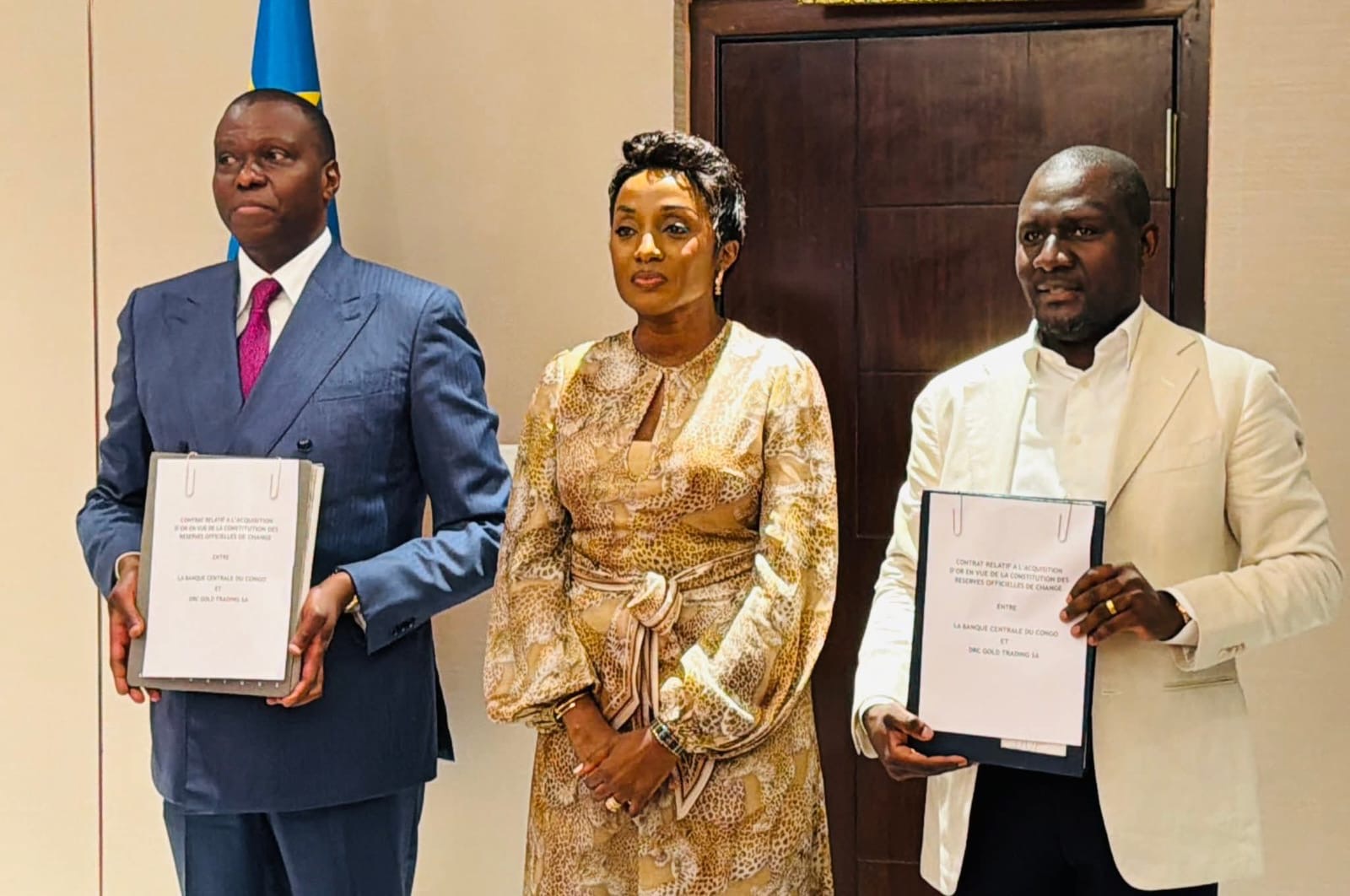
The Central Bank of the DRC and DRC Gold signed a strategic partnership on February 19, 2026 in Kinshasa in the presence of Minister of Portfolio Julie Shiku focused on replenishing the monetary gold reserves of the Democratic Republic of Congo (DRC) in order to strengthen the official reserves of the DRC’s scriptural institution.
By Rodrigue Fénelon Massala
According to the information we have, the agreement will allow the BCC to acquire gold from DRC Gold Trading SA, a company responsible for the collection, certification, and traceability of gold extracted in the territory. This quantity of gold will then be added to the central bank’s official reserves. Up to now, Congo’s reserves were mostly in foreign currencies (dollars, euros).
The incorporation of gold strengthens the solidity of reserves in case of financial or geopolitical crises. Markets and investors see gold as a safe haven, especially in this period where the yellow metal is experiencing a rise in its price in the market and in precious metals exchanges.
This agreement promotes a reduced dependence on foreign currencies: increased diversification of reserves can mitigate the sensitivity of the DRC to extreme fluctuations in the dollar or euro.
Monetary impact on the Congolese franc
This agreement aims, indirectly, to stabilize the Congolese franc (CDF) by strengthening its reserve base and, furthermore, in the background, by improving the expected monetary credibility: central banks with reserves in tangible assets (gold) are often considered more reliable by investors globally.
This approach has a stabilizing impact on the exchange rate: during episodes of economic tensions or possible depreciation of the Congolese Franc, gold can act as a confidence buffer and minimize external shocks. Regarding the potential strengthening of the CDF, stronger reserves can help mitigate inflationary pressure and contribute to improving external stability, although this is also dependent on other broader monetary policies.
As a recent example, prudent monetary policies and better reserve accumulation have contributed to a strong appreciation of the Congolese Franc in African markets even without considering gold, making it one of the continent’s top-performing currencies over a given period.
Broader economic implications
The agreement includes traceability of gold from small-scale mining. As frequently emphasized by Joseph KAZIBAZIBA, CEO of DRC-Gold Trading and a staunch advocate against gold trafficking, this could improve transparency in mining profits and increase state revenues if a larger portion of gold passes through official channels. For him, this fight is crucial to ensure gold traceability and ensure that these resources represent a significant reserve for the state.
By transforming a natural resource directly into a national value reserve, the DRC relies less on international financial markets to ensure its stability or monetary interventions.
This policy aimed at strengthening monetary credibility can reassure foreign investors (FDI), especially in the mining and financial sectors, as it reduces the risk associated with exchange rate volatility.
For the Governor of the Central Bank, André Wamesso, this agreement aims to strengthen the official gold reserves: it is part of a proactive strategy to replenish and diversify the reserves of the BCC, integrating monetary gold alongside conventional reserves in foreign currencies. This is seen as a way to increase the country’s financial sovereignty. Strength of the Congolese franc: gold is perceived as a safe asset, beneficial for defending the Congolese franc against external shocks, inflation, and currency tensions.
By sourcing from DRC Gold Trading SA, a Congolese company under state control, the BCC aims to better integrate artisanal gold into the formal economic circuit and reduce smuggling routes.

