



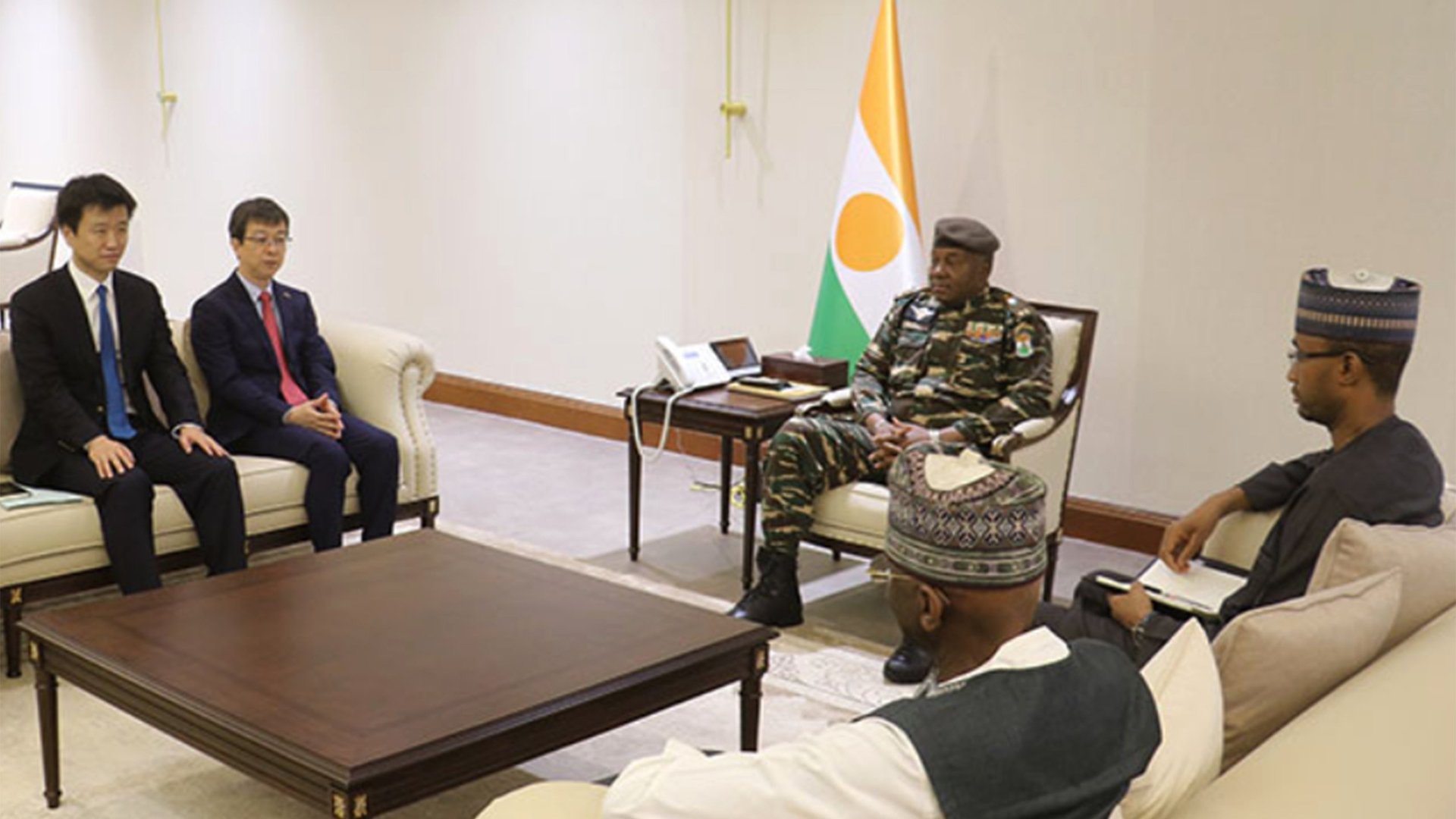
Transfer of permits, “Nigerianization” policy, unilateral decision, unexpected tax adjustments… The coup by General Abdourahamane Tiani in July 2023 marked the beginning of endless hassles for China in Niger. These have still not subsided to this day.
Following in the footsteps of the French company Orano (formerly Areva), expelled from the country before the nationalization of its assets in June 2025, the China National Petroleum Corp. (CNPC) is now bearing the brunt of the junta’s sovereignist policy. Under constant pressure for months, the local subsidiaries of the Chinese giant, including the Zinder Refinery Company (Soraz) which started operations in 2011 (20,000 b/d), serve as a cash cow to replenish funds, and are also the target of the national preference policy in terms of hiring.
In addition to Soraz, in which it holds 60% (40% owned by the Nigerien State), CNPC, the main player in the oil sector in the country since 2003, operates the two major Agadem I and II fields (100,000 b/d).
Points of friction
Among the main points of friction is the government’s demand to increase the proportion of local employees to 80% on CNPC projects, compared to less than 30% currently. In May 2025, the government demanded that CNPC terminate the contracts of expatriate personnel in the country for more than four years and hire local staff with salaries aligned with those of foreign personnel. In total, 127 Chinese executives and employees, including nearly 80 engineers, are affected by this measure. Directives that the Chinese partner did not comply with. Even if they wanted to, they could not due to the insufficient training and qualifications of Nigeriens in this highly specialized sector.
At this stage, the goal of “Nigerianization” is considered unrealistic unless, following the Orano model, Niger simply decides to expel Beijing, nationalize its oil assets, and have them managed by a new partner like Algerian Sonatrach or Russian Lukoil.
However, while the Nigerien government, like the other two countries in the Sahel States Alliance (AES), seeks to strengthen its control over the country’s natural resources, it is not willing to go to extremes, as Soraz represents nearly $2 billion in annual revenue. On the other hand, China clings to its strategy, emphasizing the expertise needed in the sector while seeking to maintain control over the exploitation and export of black gold.
Tax adjustment
However, its monopolistic position is increasingly challenged. The demand for “Nigerianization” comes after a tax adjustment of over $100 million notified to CNPC at the end of 2024 for the 2022 and 2023 fiscal years. A few months earlier, the same major missed out on the allocation of the Bilma block in the Agadez region, despite heavy investments made since 2008. This block, rightfully claimed by Beijing, was awarded to the Nigerien Petroleum Company (Sonidep). This decision angered Beijing and led to Chen Jintao, the head of CNPC Exploration & Development Corp. (CNODC), traveling to Niamey to meet with Prime Minister Ali Lamine Zeine.
Retaliatory measures
Despite being unhappy with the junta’s treatment, the Chinese side avoids confrontation to avoid weakening its position in the country. Time is on its side. However, this does not rule out retaliatory measures such as limiting the production of refined oil by Soraz. The capacity has been reduced from 20,000 b/d to 10,000 b/d. This decrease is attributed to “technical issues” which actually hide a certain annoyance.
New negotiators
On the other hand, Niger has another card to play to try to break this monopoly. It could soon open up the marketing of crude oil to competition. So far, this sale was still the responsibility of the Chinese major due to a $400 million pre-financing disbursed at the end of 2024. But as it repays this debt by mid-2026, Niger could then turn to other traders, thus twisting the arm of a historical partner.

