



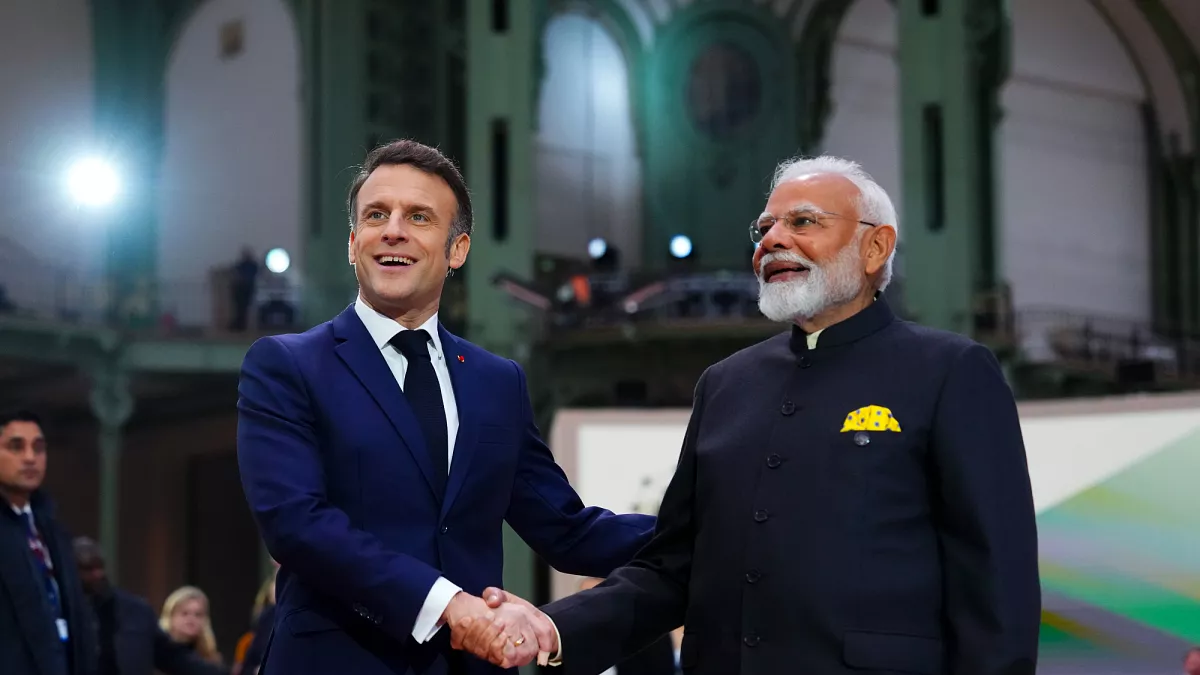
President Emmanuel Macron begins a decisive state visit to India on February 17. Beyond the record sale of Rafale jets by France to New Delhi, the African continent, although not a co-organizer, is primarily concerned. The “India AI Impact” summit on February 19, 2026, materializes the outlines of a tripartite technological partnership in artificial intelligence, of which Africa is the natural beneficiary. Analysis of the stakes of a summit placed under the sign of “impact” and strategic autonomy in the face of China and the United States’ hegemonic ambitions.
By Christine Holzbauer, in Paris
In addition to bilateral contracts, Emmanuel Macron’s fourth trip to India aims to “reach a new milestone” and “synthesize all the cooperation initiatives launched” by France since the AI Action Summit (SAIA) on February 10 and 11, 2025, according to the Elysée. With Paris assuming the presidency of the G7 in January and India assuming that of the BRICS, the goal is to promote a “renewed multilateralism,” with AI as a development lever for the global South. Around twenty heads of state and government (France, Brazil, Netherlands, Spain, United Arab Emirates, etc.) are expected to join Indian Prime Minister Narendra Modi for this fourth global meeting dedicated to artificial intelligence. Before the Paris summit, already co-chaired by France and India, there was the one at Bletchley Park in the UK in November 2023, followed by the “Global Digital Pact” as part of the “Pact for the Future” adopted by the UN summit in New York in September 2024, to improve the planet’s present while preserving the future.
American industry leaders in the sector are also expected in the Indian capital until Friday, from Sam Altman, head of OpenAI, to Google CEO Sundar Pichai, to Jensen Huang, CEO of Nvidia, the American microprocessor giant. Beyond the issue of regulation that has deterred Americans and Britons from joining the Current AI foundation, which brings together 61 states, mostly European, “this summit should enrich global thinking on various aspects of AI such as innovation, collaboration, or responsible use,” said Narendra Modi. It also “proves that our country is rapidly advancing in the field of science and technology” and “confirms the capabilities of the youth of our country,” he added.
Indian mantra, French expertise
The New Delhi summit revolves around a clear mantra: “impact” with three “sutras” – People, Planet, and Progress – and seven “chakras” (working groups), according to Elysée sources. For Africa, work on sustainable AI (co-chaired by France) and the democratization of resources are essential. The goal is to transform AI into a “global common good,” away from technological monopolies. “The Indian summit is very much in line with French priorities: AI rooted in scientific research and in favor of the general interest,” according to the Elysée’s global affairs advisor.
Paris aims to provide “concrete answers” to a number of vital sectors, particularly health and agriculture, for which AI represents a real advancement. The French President will inaugurate the Franco-Indian AI Center in Health at AIIMS in New Delhi, the most prestigious Indian hospital. This center will serve as a laboratory for decentralized diagnostic solutions, directly applicable to African medical deserts. Discussions will also focus on the use of satellite data (New Space) for precision agriculture. An AI-based Earth observation solution will be officially signed, offering new tools for food security.
The presence of a delegation of cutting-edge startups alongside Emmanuel Macron (including AI champions like Mistral AI, Owkin, or Pigment, as well as space gems like Aldoria) aims to reassure about the willingness to “diversify partnerships.” France positions itself as the partner capable of mobilizing European investments, starting with the 2.6 billion euros raised by French AI startups in 2025. “The vitality of our ecosystem must now irrigate our strategic partnerships. My ambition in New Delhi is for these flows not to stop at our borders, but to turn towards Franco-African joint ventures to build AI for the general interest,” said the French President to digital ecosystem actors on February 10. For African startups, it is the hope of accessing “Compute”: France and India intend to facilitate access to computing resources to avoid dependence on American or Chinese infrastructure. Like startup H, which will announce partnerships in hospital AI, the summit aims to promote tripartite alliances where French technology and Indian engineering adapt to African markets.
Strategic autonomy
For several months, France and India have multiplied signals in favor of a “triangular” partnership. The French Development Agency organized a pre-summit at the end of January 2026 to lay the groundwork for an India-Africa-France dialogue. The goal is clear: to prevent the African continent from being merely a consumer of solutions designed in Silicon Valley or Beijing. One of the main hopes for Africa lies in the transfer of Indian expertise in frugal AI (or digital Jugaad). Unlike resource-intensive American models, India has developed efficient tools capable of operating on lighter infrastructures: predictive algorithms to optimize harvests despite climate change, the model of “Digital Public Infrastructure,” which has enabled banking services for hundreds of millions of people, and the deployment of “low-cost” diagnostic solutions on smartphones to detect diabetic retinopathy or screen for tuberculosis, these tools represent a real advancement for the continent.
The cultural aspect is also crucial, as the New Delhi summit emphasizes the development of multilingual foundation models. While current AI is dominated by English, the Indian initiative to create models supporting 22 official languages resonates directly in Africa. The continent expects partnerships to train AIs in African languages, ensuring that future tools respect local specificities. “This summit is the first organized by the global South for the global South. We no longer want theoretical principles, but demonstrable impact on our economies,” confides an African Union expert. The joint announcements at the end of the summit on February 20 could include the creation of a fund to support African startups specializing in responsible AI, according to Elysée sources.
Towards the “Africa Forward” summit in May 2026
Beyond technology, this rapprochement is based on a “common understanding of the importance of strategic autonomy.” The Franco-Indian pillar is at the heart of France’s Indo-Pacific strategy, emphasizes the Elysée’s Asia-Oceania Americas advisor. In the defense field, the inauguration of an Airbus helicopter assembly line in Bangalore and discussions on the historic 114 Rafale contract (with a strong Made in India component) show Africa the way to a partnership that accepts technology transfer and local production. “New Delhi knows our very firm position on Russia… but we agree on the importance of upholding international law for a just and lasting peace,” said this source, recalling that India, like many African countries, pursues an independent foreign policy.
In response to a question from Financial Afrik about the repercussions for Africa and the announcements to expect at the “Africa Forward” summit on May 11 and 12, which will bring together Emmanuel Macron and many African heads of state and government in Nairobi, including the Indian Prime Minister and the German President, the Elysée made no secret that the French President’s state visit to India serves as a “launching pad” for the Africa-France summit in Kenya. However, significant challenges remain. The digital divide remains deep: for AI to truly benefit Lagos, Nairobi, or Dakar, the New Delhi summit must lead to concrete commitments regarding access to computing capacities and connectivity.
For most observers, African leaders present in New Delhi will see this step as a test: if the technological transfer promises of February materialize, the Nairobi summit in May could mark the birth of a true North-South digital bloc. President Macron and Prime Minister Modi have managed to create a “brand”: one of technology that respects national independence. For Africa, this is an invitation to no longer choose between American efficiency and Chinese infrastructure but to build its own path. While waiting for the third path of industrial autonomy that requires huge investments in R&D.

