



by Lamine Bal, special envoy.
At a time when global competition for critical minerals is reshaping geo-economic balances, the question is no longer just about the volumes extracted, but about the ability of territories to structure complete industrial ecosystems. The Democratic Republic of the Congo represents approximately 70% of global cobalt production and is among the leading global producers of copper, two essential minerals for global energy transition.
According to several international projections, global demand for copper could significantly increase in the coming decades, driven by the electrification of transportation, renewable energies, and digital infrastructure. In this context, Lualaba — a key province in the Congolese Copperbelt — concentrates a significant portion of this strategic production.
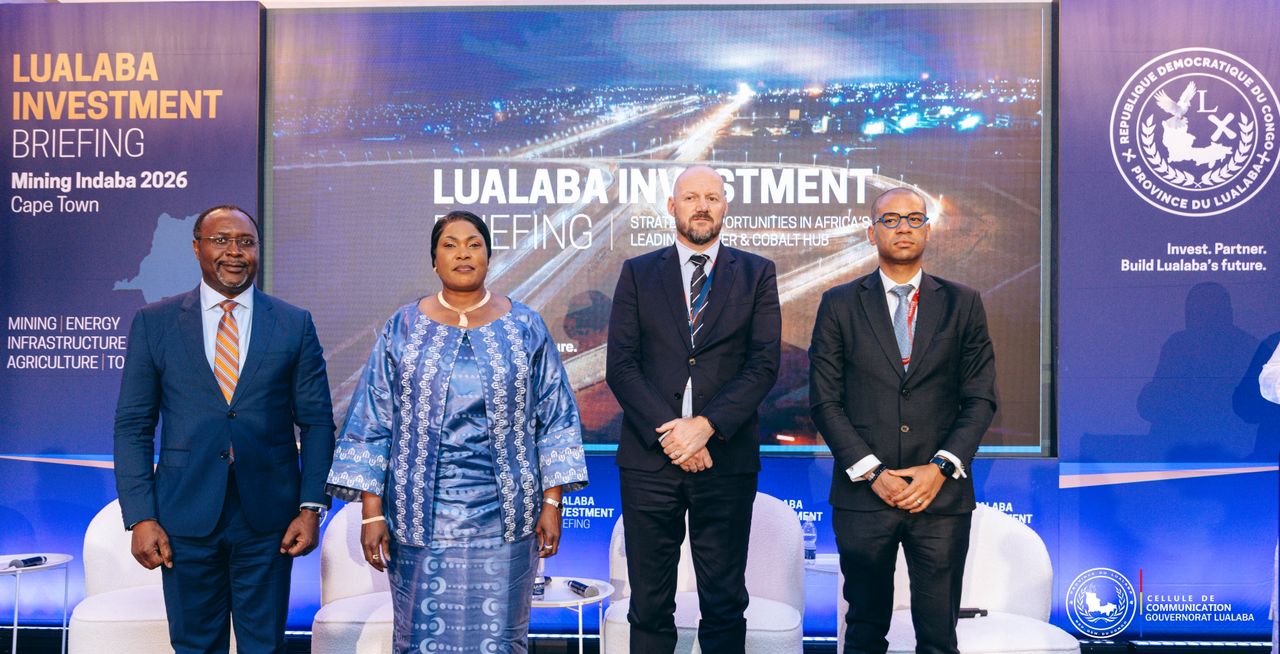
During the Mining Indaba 2026 held in Cape Town from February 9 to 12, the Province of Lualaba (Democratic Republic of the Congo) organized a Mining Investment Briefing to present a clearly stated ambition: to become a structuring hub for the next African mining and industrial cycle. With its major deposits of copper and cobalt, Lualaba is one of the nerve centers of Congolese production. The mining sector remains the country’s main source of foreign exchange and attracts several billion dollars in foreign direct investment each year, mostly focused on strategic minerals. Mining activity is seen as the foundation of an integrated strategy that combines institutional stability, energy, logistics, and social inclusion.
Stability and attractiveness
This vision was championed by Fifi Masuka Saini, Governor of the Province of Lualaba. “Our first guarantee for investors is peace and institutional stability. No company would invest billions of dollars without solid guarantees. If large mining groups have been operating in Lualaba for years, sometimes decades, it is because the environment is predictable and secure,” declared the Governor.
Beyond the institutional framework, provincial authorities emphasize ongoing dialogue with economic operators. “When there are difficulties, we talk. When there are none, we also talk, in order to improve what can be improved,” explained H.E. Madame Fifi Masuka Saini.
A private sector attentive to infrastructure
Representatives of the private sector present at the Mining Investment Briefing panel confirmed the structural attractiveness of the territory. “From a capital allocation perspective, developing additional copper production capacity in the DRC is more attractive than in other jurisdictions, in terms of dollars invested per installed tonne,” stated Mark Davis, CEO of Glencore Copper Africa. “Infrastructure, especially logistics, is crucial for our long-term competitiveness. Projects like the Lobito corridor can fundamentally transform our cost structure.” For his part, Mr. Olivier Binyingo, Chairman of the Board of Kamoa Copper, believed that “institutional stability and regulatory visibility are essential elements for industrial investment decisions. Mining projects create value when they integrate into the local economy.”
Diversifying for sustainability
While copper and cobalt remain central, the province emphasizes sectoral diversification. According to available estimates, less than a quarter of the provincial territory has undergone in-depth geological exploration, hinting at significant future development potential. Mining exports account for the vast majority of national export revenues, reinforcing the strategic importance of securing logistics and gradually upgrading them. “We cannot talk about industrialization without energy. Industry depends on it, but so do households, schools, and hospitals,” reminded the Governor. The provincial strategy is based on five priority sectors: mining, energy, agriculture, tourism, and health.
An open approach to international partners
In a context of increased competition for strategic minerals and a reconfiguration of geo-economic balances, the issue of international partnerships has emerged as a central axis of exchanges. The Governor of Lualaba advocated a clear line: openness, diversification, and regulatory sovereignty. “The DRC is not a country that works with a single partner. Europeans are present, as are Asians, and African investors too. What matters is respect for our laws and contribution to local development,” affirmed H.E. Madame Fifi Masuka Saini. She continued, “Lualaba is open for business. Investors are already present, and we will continue to engage with those who wish to commit to a long-term vision.”
According to her, this approach is part of a logic of securing and diversifying investment flows, at a time when critical minerals are becoming global strategic assets. Also present at the panel, Mr. Albert G. Zeufack, Division Director at the World Bank, broadened the perspective, emphasizing that the valorization of resources cannot be limited to extraction and that the challenge goes beyond the provincial framework alone. “Mineral wealth represents a major opportunity for the DRC, but its transformation into sustainable growth will depend on investments in infrastructure, human capital, and governance,” highlighted Albert G. Zeufack.
The Lobito corridor: a strategic convergence
The geographical position of Lualaba is a structuring lever. The Lobito corridor, a railway infrastructure connecting the Congolese and Zambian Copperbelt to the Angolan port of Lobito on the Atlantic, aims to significantly reduce export times and costs to international markets. For private operators, these infrastructures represent a major competitive advantage. Internationally, several resource-rich countries have embarked on similar trajectories. Zambia seeks to strengthen its production capacities and stabilize its regulatory environment; Chile is heavily investing in adding value and innovation around copper; Indonesia, on the other hand, has strategically chosen to mandate local transformation of nickel before export to capture more value domestically.
In this evolving landscape, Lualaba is attempting to articulate a progressive approach: consolidating extractive attractiveness while preparing the conditions for increased industrialization, conditioned by energy, infrastructure, and social stability.
Towards an African strategic hub
With a population estimated at over 3 million inhabitants and a pivotal position between several regional economic spaces (SADC, COMESA, EAC), Lualaba has the potential to become a regional platform in the heart of the African continent. By 2030, the province aims to surpass its status as an extractive territory and establish itself as an African strategic hub at the intersection of mining, energy, and logistics corridors. “Our priorities are sequenced over time. In the short term, energy and infrastructure are urgent. In the medium term, improving social conditions is essential…,” concluded the Governor.
The challenge for Lualaba is not only to capture the mining rent of the current cycle but to transform this dynamic into a structural lever for territorial development, in a global context marked by supply chain security and industrial relocation.

