



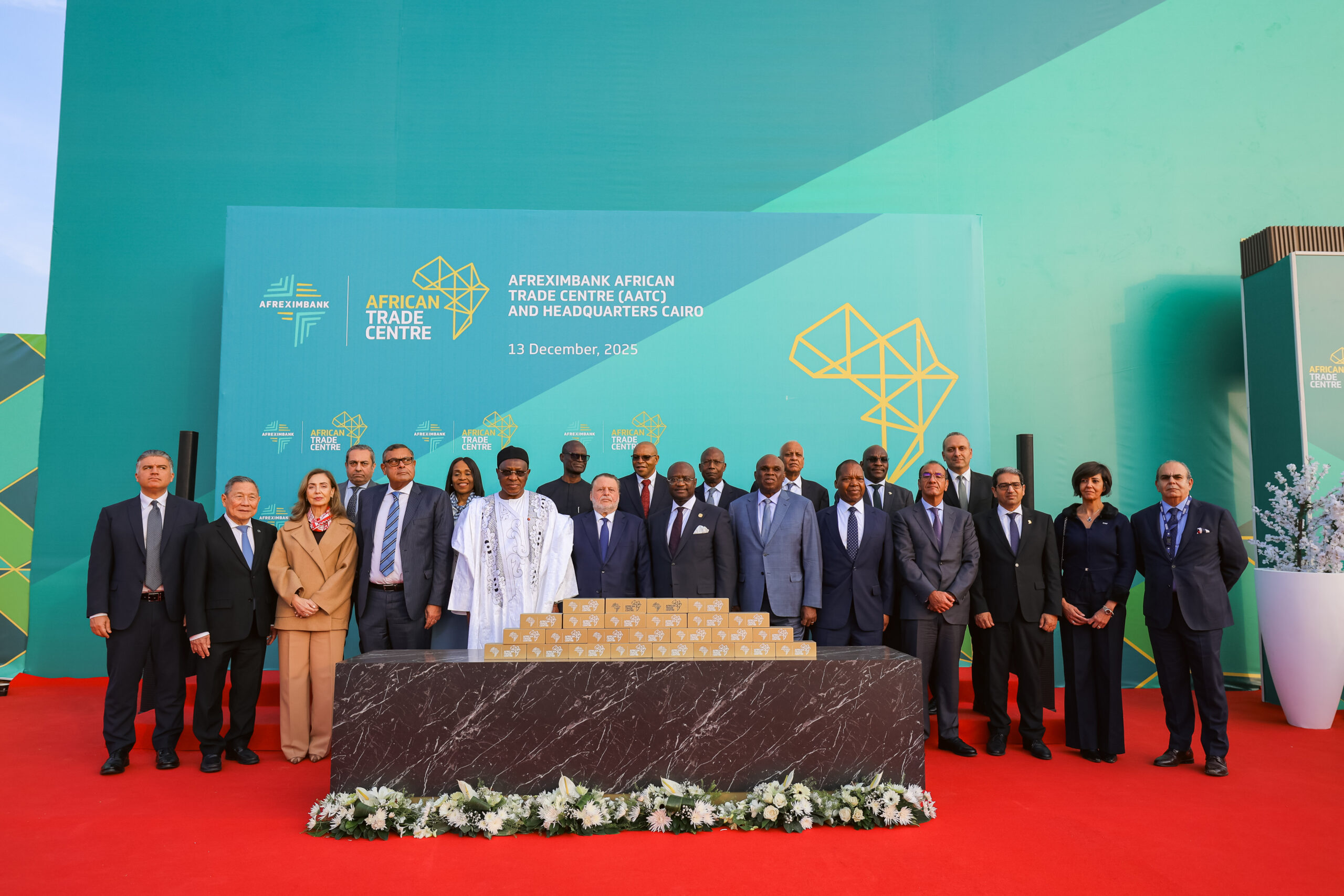
Cairo, Egypt, December 13, 2025 – The African Export-Import Bank (Afreximbank), Africa’s premier multilateral financial institution, reached a historic milestone today with the groundbreaking ceremony for the African Trade Center of Afreximbank (AATC) in the new Egyptian capital, which will also house the Bank’s new global headquarters.
Located in the diplomatic district of the new capital, approximately 45 kilometers east of Cairo, the African Trade Center of Afreximbank will be situated in a modern and strategically planned environment bringing together ministries, foreign embassies, and international organizations. It will be the first facility of its kind in the North African region.
During the ceremony, the Egyptian Prime Minister, Dr. Mostafa Madbouly, stated: “The establishment of the African Trade Center of Afreximbank (AATC) in the new Egyptian capital reflects the significant role played by Egypt in continental economic integration and trade facilitation. As the host country of Afreximbank’s global headquarters, Egypt is proud to deepen this collaboration through a unique infrastructure that will serve as a hub for business intelligence, capacity building, innovation, and continental connectivity.”
The President of Afreximbank and the Bank’s Board of Directors, Dr. George Elombi, expressed gratitude to the Egyptian government for its longstanding support since the establishment of Afreximbank in 1993. He emphasized that Egypt has been hosting the Bank’s global headquarters for over three decades, significantly contributing to Afreximbank’s strong growth. He added that Egypt, represented by its central bank, is also the largest sovereign shareholder of Afreximbank.
Dr. Elombi stated: “The African Trade Center of Afreximbank aims not only to accommodate the Bank’s expansion but also to address the lack of trade and investment information among African businesses; a challenge that has hindered intra-African trade and investment growth for nearly seven decades.”
Describing the relationship between Afreximbank and the Egyptian government as “truly symbiotic,” Dr. Elombi highlighted that Afreximbank has injected USD 41 billion into the Egyptian economy, significantly increasing investments in strategic sectors such as energy, telecommunications, construction, and manufacturing, while enhancing trade and investment exchanges between Egypt and Africa.
“We have helped Egyptian entities leverage increasing investment opportunities across Africa, assisting them in securing and executing projects in multiple countries,” continued the President of Afreximbank.
The African Trade Center of Afreximbank in the new capital (Cairo) will position Egypt as a major commercial hub, housing technology centers for housing and SME incubation, as well as a digital gateway for African trade offering business information, customer due diligence, payments, and other digital services.
The AATC in Cairo is part of Afreximbank’s overall vision to develop a network of African trade centers in strategic commercial hubs in Africa and the Caribbean. These centers will provide business information, market intelligence, financing, networking and collaboration opportunities, as well as essential support infrastructure to accelerate trade, enhance economic cooperation, and stimulate intra-African growth.
Occupying a site of 48,888 square meters, Afreximbank’s ultramodern complex will include two underground levels and six floors, with a total built-up area of 156,147 square meters.
Once completed, the AATC in Cairo will offer 57,298 square meters of office space to accommodate Afreximbank’s expanding staff. Additional office spaces will be made available to African and international agencies active in trade, finance, and investment, as well as some African diplomatic missions abroad.
The complex will house a full range of modern facilities to support trade, including a trade information center, a library and world-class knowledge center, an innovation and SME incubation center to support entrepreneurship, a business center, a 110-room aparthotel, a modern 750-seat conference center, an exhibition center, shops and restaurants, boutiques, extensive technical and support facilities, and a 1,200-space parking lot.
The architectural design integrates three interconnected blocks, arranged around a landscaped interior street, creating the social and spatial heart of the complex. Green inner courtyards, shaded walkways, and collaborative spaces will foster seamless interaction between work, training, and leisure, reflecting Afreximbank’s commitment to innovation, sustainability, and the well-being of its employees.
Designed to achieve LEED Gold certification or higher, the complex will incorporate high-efficiency intelligent systems, solar energy, water-saving technologies, and bioclimatic design with shaded and comfortable outdoor spaces.
Afreximbank’s new headquarters stands out as one of Africa’s most modern and environmentally friendly institutional projects.
Afreximbank has appointed Hassan Allam Construction, one of Egypt’s leading engineering and construction companies, as the main contractor under a $249.5 million contract. The architectural design and project supervision are provided by the renowned engineering firm EHAF Consulting Engineers.
This project will generate numerous jobs during the construction phase and in ongoing operations. It will stimulate opportunities for local entrepreneurs, suppliers, SMEs, and a wide range of service providers.
The groundbreaking for the AATC in Cairo, expected to be completed in early 2009, follows the AATC in Barbados in March 2025 and the official opening of the AATC in Abuja in April 2025. Similar projects are underway in Harare and Kampala.
Afreximbank’s network of African trade centers will include hubs in Abuja (Nigeria), Harare (Zimbabwe), Kampala (Uganda), Cairo (Egypt), Abidjan (Ivory Coast), Yaoundé (Cameroon), Bridgetown (Barbados), Kigali (Rwanda), and Tunis (Tunisia).
Together, these centers will connect buyers, sellers, suppliers, service providers, businesses, governments, chambers of commerce, financial institutions, development organizations, and the African and global trade and investment community at large.

