



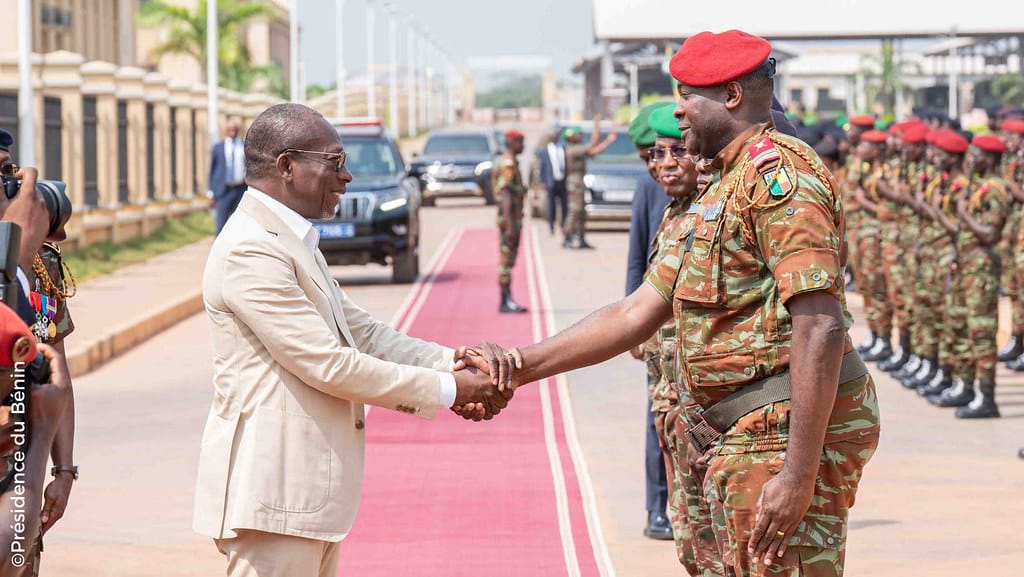
The failed coup attempt on December 7 provided a window into the resilience of the Beninese state apparatus. Far from revealing institutional fragility, the episode highlighted a country rooted in strong republican traditions, but also the result of a modernization effort initiated since 2016, with increased budgetary resources, recruitment, and capacity renewal to address new threats.
Benin’s stability is often recognized, but this test confirmed its deep foundations. What emerged was not uncertainty or institutional drift, but a coordinated response, where civilian authorities, senior military leadership, and operational units acted as one to defend the Republic. This cohesion was not limited to official statements. It was reflected in decision-making, operational readiness, and a clear message: constitutional authority was neither contested nor negotiable. The institutions functioned, as did the armed forces. The crisis was quickly contained because the state’s foundations held firm.
A republican army at the heart of the response
One of the most striking lessons of this episode is the posture adopted by the Beninese Armed Forces. The mutineers acted in the hope that hesitation or fragmentation within the military institution would provide them with a political maneuvering space. They encountered the exact opposite: an institution that did not waver, fracture, or deviate from its mandate.
From the outset, the chain of command remained intact. Units remained aligned with their hierarchy, and no credible segment of the various forces expressed sympathy for the attempted coup. On the contrary, they quickly acted, sometimes spontaneously, to support the institutions.
This reflects a deeply ingrained ethos. For decades, the army has internalized a republican identity in which political ambitions are excluded from its scope, and where constitutional order is considered the non-negotiable foundation of national stability.
An illustrative structural example of this choice lies in Benin’s decision to have a republican guard rather than a presidential guard. The distinction is not merely semantic: it signals that the armed forces are organized around the defense of the Republic’s institutions, not the protection of an individual. This choice has shaped the command culture, reinforced neutrality, and reduced the risk of personalized power dynamics within the military apparatus.
This culture, consolidated by defense reforms initiated since 2016, whether in combating corruption, depoliticization, or increased professionalization of cadres, set the tone for crisis management. By refusing to consider any form of political intervention, the armed forces deprived the mutineers of their only plausible leverage and prevented the situation from escalating or becoming ambiguous.
Operational mastery that remained entirely national
Beyond institutional loyalty, the armed forces demonstrated a decisive level of operational coherence. Once alerted, the loyal units secured strategic points, regained control of public broadcasting, and neutralized the group behind the attempted destabilization of the state. All of this was carried out through national command structures, with orders transmitted and executed in a disciplined and coordinated manner.
This reactivity is part of a modernization effort that began several years ago, with an equipment plan that significantly increased the rate of realization of automotive materials, acquisitions of tactical vehicles, armored vehicles, surveillance means, aerial vectors, floating devices, as well as strengthening territorial coverage and creating intervention units dedicated to counterterrorism in the north.
Foreign partners provided support on the margins, whether in surveillance, observation, or logistics, but only after the decisive phase of the crisis was already behind the country. While the Beninese army could have crushed the mutineers by mid-afternoon, it was decided, in consultation with these partners, to intervene later in the day to minimize collateral damage, ultimately amounting to zero.
This choice reflects a genuine commitment ethic: the army did not opt for bombing the fugitives, adhering to international law and the principle of not shooting at fleeing and unarmed individuals.
The role of partners did not overshadow the central fact: the heart of the response was Beninese, designed and implemented by national forces who retained control of each critical decision. Crisis situations often reveal where authority truly lies. In this case, it resided in Beninese institutions, which did not relinquish operational initiative or depend on external actors to stabilize the situation.
The human dimension: soldiers serving constitutional duty
Institutions function through women and men, and the aborted coup served as a reminder of this with uncommon clarity. Several officers are now better known to the public, such as Colonel Dieudonné Simon of the Republican Guard, but it is all soldiers who deserve recognition for their commitment to defending Beninese democracy.
Officers and soldiers exposed themselves to protect infrastructure, secure colleagues taken by the mutineers, and prevent an escalation of violence. Their actions were guided by a shared sense of duty rather than factional allegiances.
This type of conduct is often overlooked in political system analysis, yet it precisely gives concrete expression to constitutional frameworks. In this case, decisions made on the ground were based on capacities patiently strengthened for nearly a decade and directly contributed to the rapid restoration of order and protection of democracy.

