



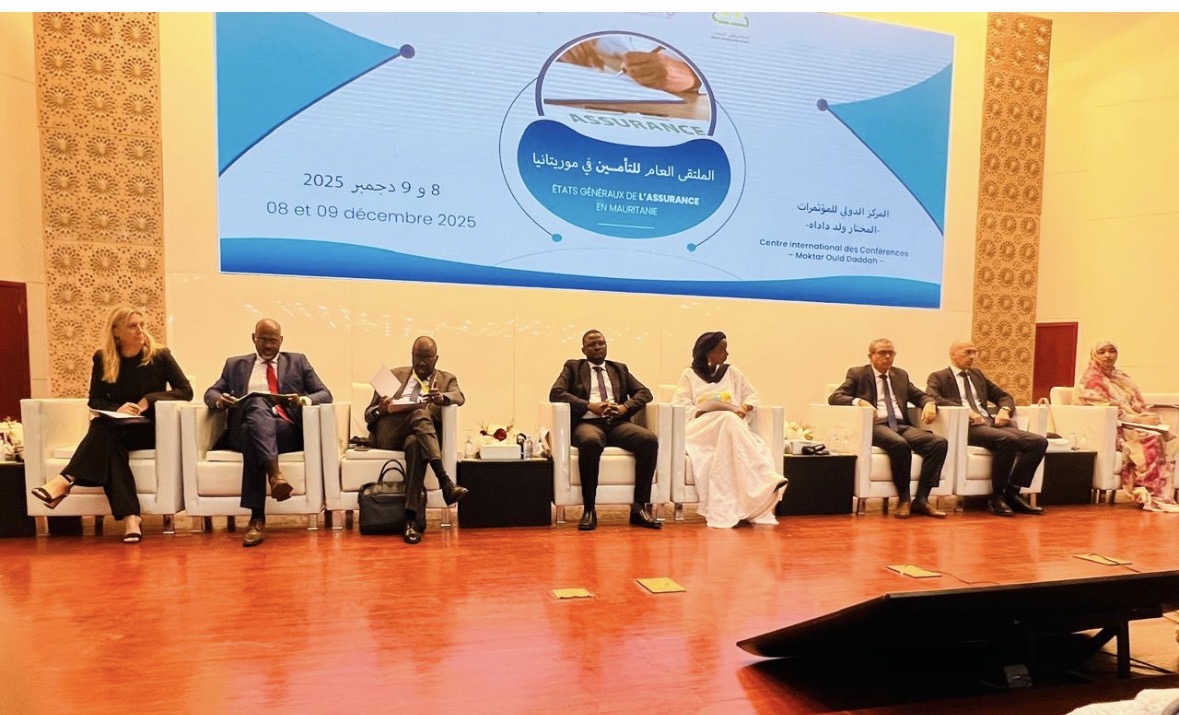
Mauritania held its Insurance General Assembly on December 8 and 9, 2025, a strategic event organized in partnership with FINACTU and under the supervision of the Central Bank of Mauritania (BCM), which has been regulating the sector since September 2025. This transfer of supervision, coupled with a strong desire to reform the market, marks the beginning of a vast transformation aimed at restoring insurance to its rightful place in the national financial system.
For two days, insurance companies, intermediaries, legal professionals, security forces, financial institutions, technical partners, and ecosystem actors gathered for workshops, panels of international experts, and consultation sessions. These discussions provided a clear diagnosis of a sector that is still underdeveloped despite a positive momentum initiated since 2020, mainly driven by the Non-Life branch.
The discussions highlighted several structural issues limiting market development: significant undercapitalization, linked to a minimum capital of 30 million MRU (approximately $750,000 USD), well below regional standards; excessive fragmentation of the sector, with 17 companies for less than 5 million inhabitants, 10 of which focus on Automobile insurance; and an overall lack of technical skills and insurance culture.
Despite these weaknesses, the discussions confirmed a considerable growth potential: the market could triple in the short term and even increase ninefold with ambitious and coherent reforms.
The General Assembly also made progress on three key pillars of the ongoing reform: co-constructing a program contract between the BCM and insurance companies, participatory development of a new Insurance Code, and modernizing the control and supervision system. The six workshops on the second day consolidated a consensus around an ambitious national strategy for cleaning up and developing the sector, structured into three axes and eight objectives.
The first axis aims to establish a cleaned and credible sector by strengthening supervision capacities, restoring company solvency, and regulating distribution. The second axis focuses on establishing a sustainable “zero tolerance” discipline, particularly through strict application of prudential rules, enhancing claims reporting and compensation, and ensuring the effectiveness of mandatory insurance. The third axis focuses on modernizing and developing the market through promoting new products such as agricultural insurance, microinsurance, or Takaful, and sustainably enhancing technical skills of the actors.
At the end of the discussions, a program contract was officially signed between the Central Bank of Mauritania and the Professional Association of Insurers of Mauritania (APAM), under the presidency of Her Excellency Madame Aminata Kané, Vice-Governor of the BCM. Both institutions committed to implementing the recommendations and fully assuming their responsibility in executing the reforms. “These consultation days were an important step in diagnosing the reality of the insurance sector and defining the contours of a comprehensive reform to meet the existing challenges and opportunities,” stated Aminata Kane.
The Vice-Governor of the BCM believes that the roadmap will accelerate modernization, improve governance, strengthen trust, and enhance service quality.
This optimism is shared by the President of the Professional Association of Mauritanian Insurers, Ezza mint Memma, who sees these consultation days as establishing a common and objective vision of the reality of the insurance sector in Mauritania.
Finactu, a leading technical partner
The partnership with FINACTU is a key support in structuring these General Assemblies. In her speech, Madame Géraldine Mermoux, Associate Managing Director of FINACTU, praised the initiative and highlighted the firm’s experience in supporting countries like Morocco or Tunisia in their insurance reforms. She emphasized that the success of such transformations relies on three strong convictions: the importance of cleaning up to restore confidence, the need for solutions tailored to national realities – particularly in agricultural insurance, microinsurance, Takaful, and digitalization – and the requirement for collective mobilization of all public and private actors.
These General Assemblies mark a decisive turning point for the Mauritanian insurance sector, embarking on a path of professionalization, modernization, and credibility. The announced reforms aim to structure a more disciplined, transparent market focused on the needs of citizens and businesses, contributing sustainably to the country’s financial stability and economic development.

