



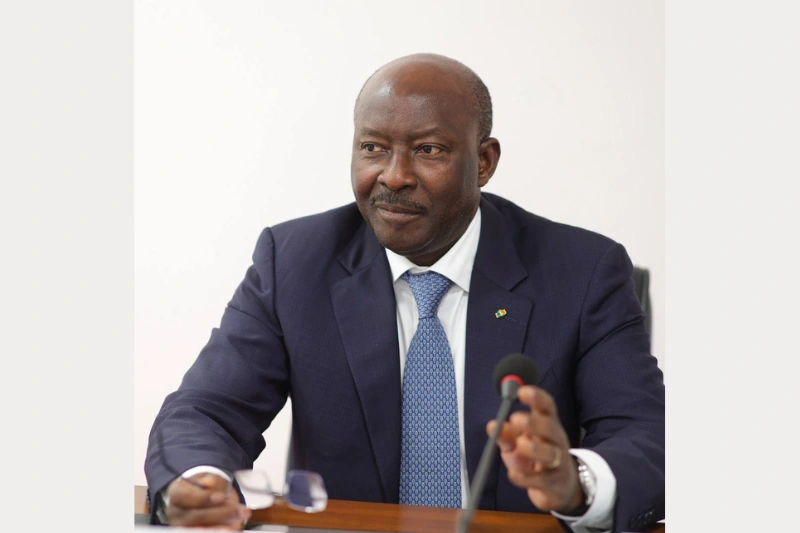
The Minister of State, Minister of Economy, Finance, Debt and Participation, in charge of fighting against the high cost of living, Henri-Claude Oyima, also Vice-President of the Government ad interim, presented the structuring orientations of the 2026 budget as well as the strict rules that will now frame public management. In front of Government members, administrative officials, and public partners, he recalled that the directives of the President of the Republic, General Brice Clotaire Oligui Nguema, impose on the executive a profound transformation based on discipline, performance, and the restoration of economic sovereignty.
Adopted unanimously by the National Assembly and then voted on by the Senate, the 2026 budget, amounting to 6,358.2 billion CFA francs, reflects a resolutely proactive project. It is based on 4,154 billion in revenues, including 1,544.2 billion in domestic tax revenues, 1,525 billion in oil revenues, 707.3 billion in customs revenues, 133.7 billion from participations, and 243.7 billion from other non-tax revenues. Operating expenses amount to 3,638.2 billion CFA francs, while investment reaches a historic level of 2,119.2 billion CFA francs, focused on energy, water, infrastructure, agriculture, health, education, digital technology, and industrialization. For Henri-Claude Oyima, “this budget is not just an accounting exercise: it is the engine of our sovereignty and the foundation of our transformation.”
But for this budget to produce the expected results, “it must be executed rigorously,” insists the Minister of State, who calls for a clear break with past practices: delays, off-budget commitments, expenses without impact, tax leaks, public procurement drifts, payment delays, opaque management, and governance failures in public institutions. “This era must come to an end. 2026 will be the year of restoration: sovereignty, credibility, discipline.”
Each administration is now assigned specific responsibilities. The General Directorate of Taxes must mobilize the expected 1,544 billion by putting an end to under-declarations and abandoned collections. Customs must secure the planned 707 billion by eliminating undervalued values, abusive exemptions, and parallel circuits. The General Directorate of the Budget must restore budgetary sincerity and ban off-budget commitments. Public Procurement must ensure transparency, competition, and an end to overpricing. The Treasury must protect the State’s Single Account, pay on time, and put an end to parallel accounts. Sectoral administrations must present technically sound, monitored, and properly documented projects. As for agencies, EPICs, and APUs, they must prove their usefulness, produce their accounts, and respect the law, otherwise their subsidies will be cut: “Public money is not intended to finance inefficiency,” warns Oyima.
The Minister of State has also set new calendar requirements, now non-negotiable: stop Treasury visas by December 31, close the complementary period by January 31, produce the State’s accounts by March 30, and mandatory submission of the Settlement Law by June 30. “These deadlines are markers of discipline and financial credibility,” he reminds.
Henri-Claude Oyima also emphasizes the total accountability of the financial chain: Central Directors of Financial Affairs, whom he urges to become “rigorous, uncompromising, and exemplary,” and project coordinators, whose mastery of schedules and determined follow-up will condition the performance of public investment. “A poorly coordinated project becomes a stalled construction site, an unnecessary extra cost, and a loss for the Nation,” he points out.
In conclusion, the Minister of State calls on the administration to change its culture and embody the spirit of the Fifth Republic: discipline, responsiveness, adaptability, and results. Quoting Darwin, he summarizes the new requirement: “Those who survive are not the strongest, but those who know how to adapt.”
“Gabon does not expect speeches, it expects results. We no longer have the right to make mistakes. 2026 will be the year of seriousness.”

