



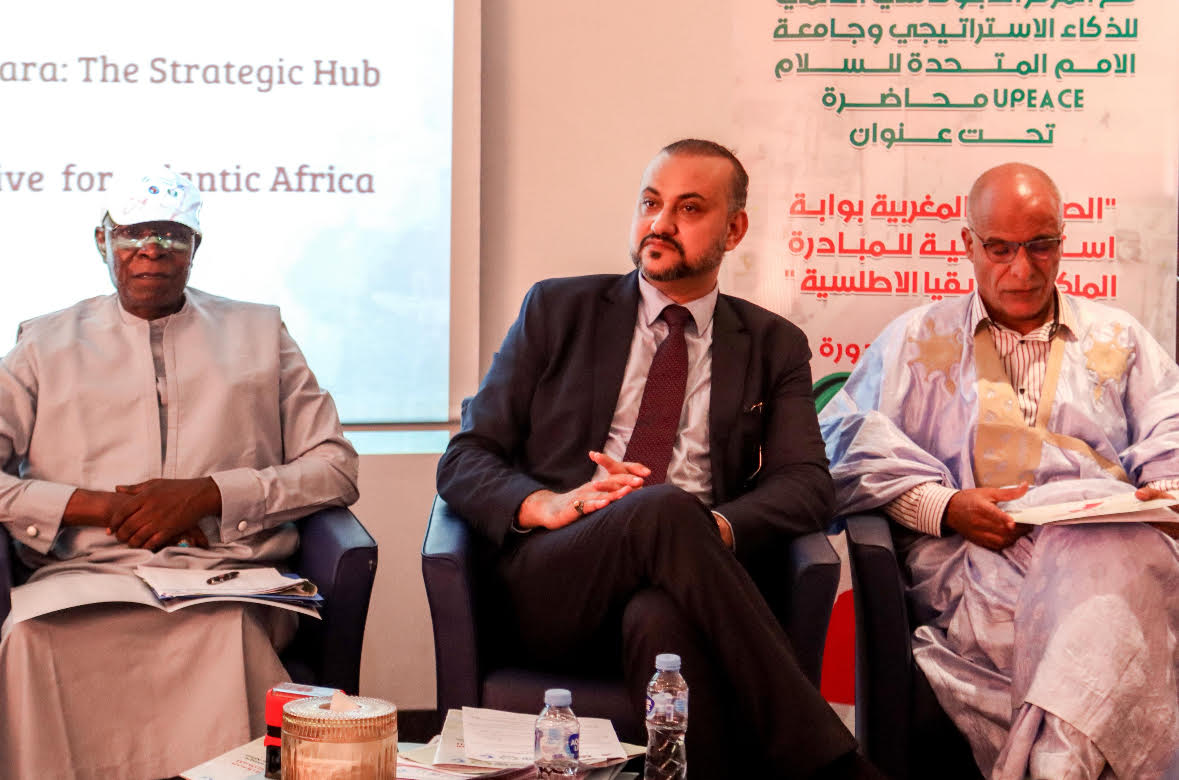
The Atlantic city of Dakhla, located 1695 km from Rabat, hosted an international conference on November 6, 2025, dedicated to the theme “The Moroccan Sahara: a strategic gateway of the Royal Initiative for the Atlantic Africa”, organized by the Council of the Commune of Dakhla, the International Diplomatic Center, the African Center for Strategic Intelligence, and the United Nations University for Peace in Dakar. The event, held in the context of the 50th anniversary of the Green March, concluded with an “Africa-Atlantic Declaration” that synthesizes the current state of the Sahara issue, international positions, and ongoing transformations in the Southern regions.
The Declaration acknowledges the diplomatic evolution of the past five years, marked by the American recognition in 2020, French positions in 2023-2024, and the opening of over twenty African consulates in Laâyoune and Dakhla. It also notes the adoption, on October 31, 2025, of UN Security Council resolution 2797, confirming the pre-eminence of the Moroccan autonomy plan as a serious and realistic basis for settlement. On the humanitarian front, it recalls the need for a census of the populations in the Tindouf camps, requested by the United Nations since 1977, and calls for respect for the 1991 ceasefire.
Participants examined the progress of the development model of the Southern provinces launched in 2015, with planned investments exceeding 77 billion dirhams. Ongoing projects include the Dakhla Atlantic port – 12.6 billion DH, scheduled to start operations in 2028 – a desalination plant of 275,000 m³/day, an energy park of 900 MW, as well as the modernization of road and airport infrastructure. These facilities are part of a broader set linked to regional initiatives in energy, transport, and connectivity.
The conference also addressed continental projects, including the Nigeria-Morocco gas pipeline (5,600 km, involving 13 countries, estimated cost of 25 billion dollars for an annual capacity of 30 billion m³) and the Africa-Atlantic Initiative launched in 2023, aiming to structure a cooperation space encompassing 23 coastal countries. The initiative to provide access for Sahel countries – Mali, Niger, Burkina Faso, Chad – to the Atlantic Ocean was discussed as a axis for economic and logistical rebalancing.
Discussions also focused on Moroccan institutional mechanisms: the role of the National Human Rights Council and its regional branches, the action of the armed forces in peace operations, migration monitoring mechanisms, security cooperation, and territorial partnerships. The Council of the Commune of Dakhla was mentioned for its cooperation agreements with African, European, and American communities.
Finally, the Declaration highlights the growing role of the Southern regions in Morocco’s economic projection towards West Africa. Dakhla is identified as an entry point and a developing platform, in a context where energy, port, and road corridors play a crucial role in African discussions on sovereignty, integration, and regional value chains. The entire text reflects, without emphasis, a willingness to formalize current diplomatic convergences and to set operational priorities around the African Atlantic space.

