



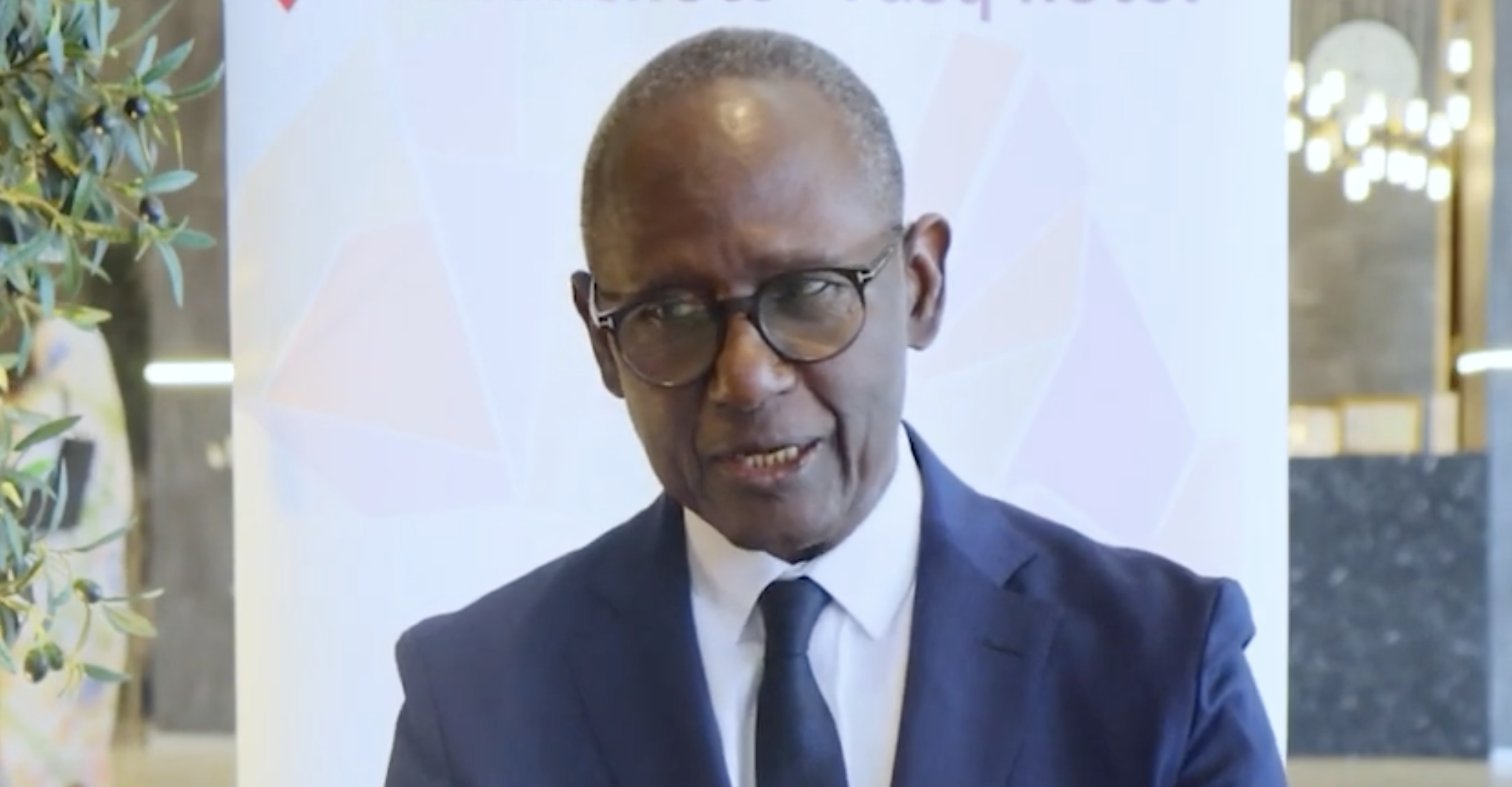
Interview with Abou Bacry Ly, President of GDM-AGRICONCEPT and member of the High Council of Investment
Interview by Mayo Sow, Nouakchott.
“I have decided to return to Mauritania and invest with my own funds.” With this confident statement, Abou Bacry Ly, President of GDM-AGRICONCEPT and member of the High Council of Investment, summarizes a strategic and personal choice: to transform Mauritanian agriculture through innovation, agro-ecology, and local private investment. On the sidelines of Les Rencontres Africa, an event organized in Nouakchott in partnership with Financial Afrik, he, who has worked throughout his career between Africa and Europe, serving major modernization projects in the agriculture, industry, public finance, banking, media, and higher education sectors, advises young entrepreneurs not to fall into the trap of wanting to do everything alone. “We must learn to undertake together.”
The entrepreneur and digital expert has chosen to return to his country to contribute concretely to national food sovereignty. His bet is based on a large-scale project of 21 million euros, launched in the Senegal River valley, aiming to demonstrate that modern, sustainable, and competitive agriculture is possible in Mauritania. In Rosso, 200 km south of the capital, Nouakchott, on a pilot site of 155 hectares located 30 kilometers from the city, GDM-AGRICONCEPT has installed state-of-the-art infrastructure, including an irrigation pivot of nearly 500 meters covering 57 hectares, mobilizing intelligent water management technologies, adapted crop rotation, and soil restoration without chemical inputs. This first hub serves as a matrix for an ambitious scaling up, with a second phase planned in Keur-Macène: four pivots initially, then twenty-four, with a targeted pace of ten to twelve pivots per year. The goal is clear: to build a high-performing agricultural sector adapted to the Sahel, capable of locally producing vegetables, forage, and cereals, as well as animal feed currently imported in large quantities while Mauritania has nearly 30 million head of livestock.
For Abou Bacry Ly, agriculture can no longer be thought of solely as production; it must become an integrated industry where technology, training, research, processing, and logistics converge. The project includes storage platforms, refrigeration, packaging, training programs for technicians and engineers, as well as a close partnership with research institutions to develop a true knowledge-based agriculture. Beyond material investment, it is about building an economy of skills and valuing young talents. “We must demonstrate that Mauritania can produce, process, and export its expertise,” he insists, convinced that human capital is the country’s primary agricultural resource. The project aims to create a thousand direct and indirect jobs in the coming years, while serving as a replicable model for young agripreneurs and local SMEs.
This return to the country, financed with own funds, is also a message: local productive investment can precede foreign investment. In a world marked by rising agricultural prices, supply tensions, and climate risks, food sovereignty becomes strategic. Mauritania, like its Sahelian neighbors, seeks to secure its production chains and reduce its dependence.
By contributing to structuring a modern and resilient agro-industrial sector, GDM-AGRICONCEPT fully aligns with this national dynamic. Determined, Abou Bacry Ly embraces a demanding path: test, produce, prove, train, then amplify. His ambition exceeds his company: it is part of a vision of productive rebirth driven by the return of diaspora skills and a new generation of leaders who choose to invest first in themselves and in their country. In the river valley, a model is taking shape: that of an African agriculture that combines technological innovation, agro-ecology, food sovereignty, and local value creation. A model that reminds us that the continent’s transformation will begin with courageous individual decisions—like returning, investing, and building.

